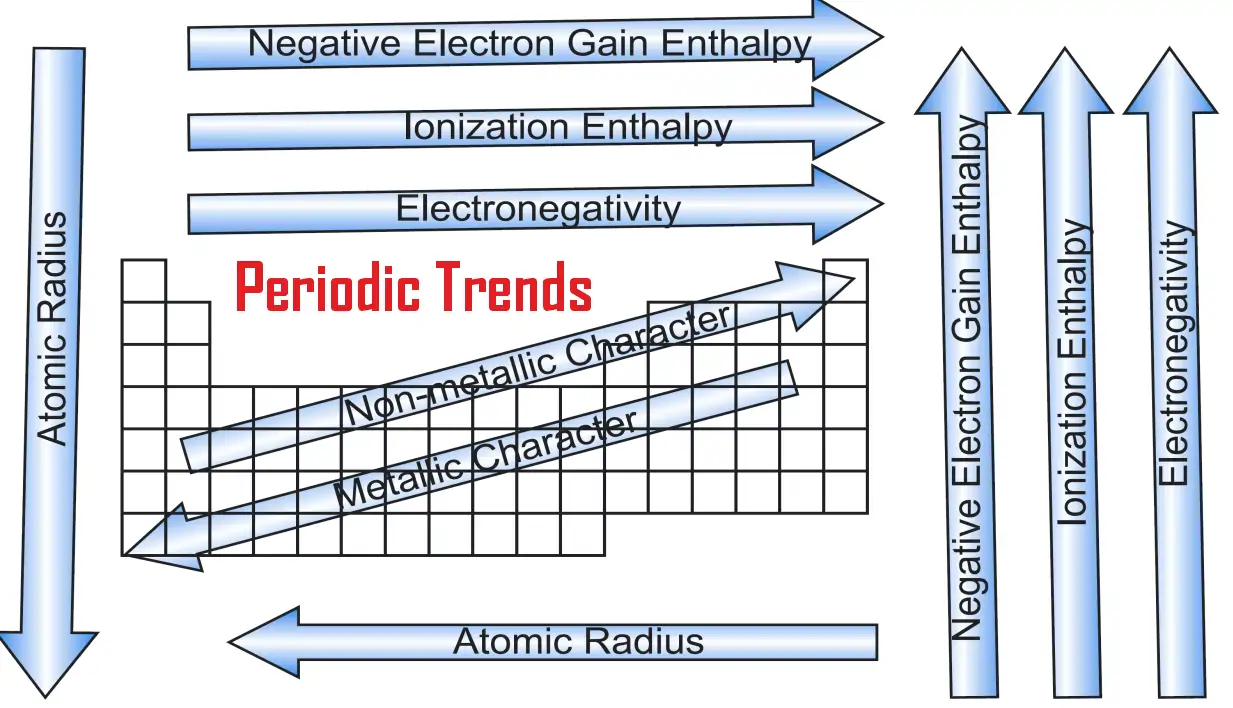
Periodic trends and chemical reactivity are important concepts in chemistry that explain how the physical and chemical properties of elements change across periods and down groups in the periodic table. These trends are mainly based on variations in atomic size, ionization enthalpy, electron gain enthalpy, electronegativity, metallic character, and non-metallic character. Understanding these periodic properties helps in predicting the behavior, reactivity, oxidising nature, reducing nature, and compound formation of different elements. The study of periodic trends also explains why metals and non-metals show different chemical properties and how the nature of oxides and hydroxides changes across the periodic table.
For complete preparation, also study NCERT Solutions: Classification of Elements and Periodicity in Properties Class 11 Chemistry
Periodic Trends and Chemical Reactivity
We have learnt the periodic trends in some fundamental properties such as atomic and ionic radii, ionization enthalpy, electron gain enthalpy and, electronegativity and valence. The periodicity in these properties are related to electronic configurations.
“Build strong concepts by studying Causes of Periodicity : Why Do Elements Show Periodicity? “
Since the chemical and physical properties of the elements and compounds are a manifestation of the electronic configuration of elements, therefore, the chemical reactivity of the elements are also governed by these fundamental properties.
“To understand this topic better, learn about Division of Periodic Table into s,p,d,f blocks : Prediction of Period, Group and Block of Elements“
The atomic and ionic radii generally decrease in a period from left to right. As a result, the ionization enthalpies in general increase (with some exceptions) and electron gain enthalpies become more negative across a period. In other words, the ionization enthalpy of the extreme left element in a period is the least and therefore, it will have highest tendency to lose electron and this tendency decreases as we move in the period from left to right.
“Explore more concepts related to Ionization Enthalpy Trends Along a Period and Down a Group“
“Important related topics are Electron Gain Enthalpy : Definition, Units, Factors, Trends“
Similarly, with the exception of noble gases the electron gain enthalpy of the element on the extreme right is the highest negative showing that it has strongest tendency to gain electron and form negative ion. Noble gas element is an exception because it has filled shells and have rather positive electron gain enthalpy values. Therefore, these are least reactive.
Thus, we see that there is high chemical reactivity at two extreme ends and the lowest in the centre. Thus, the maximum chemical reactivity at the extreme left (among alkali metals) is exhibited by the easy loss of electrons forming a cation and at the extreme right (among halogens) shown by gain of electrons forming an anion.
This property of losing or gaining electrons can be related with oxidising and reducing behaviour of the elements. The elements which readily lose electrons act as strong reducing agents while those which readily accept electrons act as strong oxidising agents.
“Read more about Valence or Oxidation States, Variation of Valency Along a Period and Down the Group“
Metallic and Non-Metallic Character Across a Period
However, this tendency of an element to lose or gain electrons is also related to metallic or non-metallic character. The metals have strong tendency to lose electrons. Thus, the metallic character of an element is highest at the extreme left and decreases from left to right.
On the other hand, the non-metallic character is highest at the extreme right. In other words, the metallic character decreases and non-metallic character increases from left to right across the period. For example, Lithium (Li) is strongest metal while Fluorine (F) is strongest non-metal. The chemical reactivity of an element can best be shown by its reactions with oxygen and halogen.
“Important JEE exam-related topics include JEE Main PYQs Previous Year Questions MCQs : Classification of Elements and Periodicity in Properties“
Acidic, Basic and Amphoteric Character of Oxides
Elements on the two extremes of a period readily combine with oxygen to form oxides. The normal oxide formed by the element on the extreme left (most metallic) is most basic (e.g. sodium oxide Na2O) wheras, the oxide formed by the element on the extreme right (most non–metallic) is most acidic (e.g. Dichlorine heptoxide or perchloric anhydride Cl2O7).
$$4\text{Na} + \text{O}_2 \rightarrow 2\text{Na}_2\text{O}$$
$$2\text{Cl}_2 + 7\text{O}_2 \rightarrow 2\text{Cl}_2\text{O}_7$$
Since sodium oxide Na2O reacts with water to give strong base sodium hydroxide, it is a basic oxide. Conversely perchloric anhydride (Cl2O7) gives strong acid called perchloric acid upon reaction with water, so it is an acidic oxide.
$${\text{Na}}_2{\text{O}} + {\text{H}}_2{\text{O}} \rightarrow 2{\text{NaOH}}$$
$${\text{Cl}}_2{\text{O}}_7 + {\text{H}}_2{\text{O}} \rightarrow 2{\text{HClO}}_4$$
Thus, the elements from the two extreme ends of the periodic table behave differently as expected.
Oxides of the elements in the centre are amphoteric (e.g., Al2O3) or neutral (e.g., CO, NO, N2O, etc.). The amphoteric oxides show the acidic and basic character. They behave as acidic with bases and basic with acids. On the other hand, the neutral oxides have no acidic or basic properties.
In general, on moving across a period from left to right, the basic character of the oxides decreases while acidic character increases. For example, on moving across the third period, it is observed that Na2O is strongly basic, MgO is less basic, Al2O3 is amphoteric, SiO2 is weakly acidic, P2O5 is acidic, SO3 is strongly acidic and Cl2O7 is very strongly acidic. As we go down the group, the basic character of the oxides increases or acidic character decreases.
For example, in group 13, B2O3 is acidic, Al2O3 and Ga2O3 are amphoteric while In2O3 is basic. It may be noted that among transition elements (3d series), the change in atomic radii is much smaller as compared to those of representative (s and p–block) elements across the period. This changes in atomic radii is still smaller among inner transition metals (4f–series).
The important acidic, basic and amphoteric character of oxides are as follows :
| Element | Na | Mg | Al | Si | P | S | Cl |
|---|---|---|---|---|---|---|---|
| Oxide | Na₂O | MgO | Al₂O₃ | SiO₂ | P₂O₅ | SO₃ | Cl₂O₇ |
| Nature | Strongly Basic | Basic | Amphoteric | Weakly Acidic | Acidic | Strongly Acidic | Very Strongly Acidic |
“Important JEE exam-related topics include IMU CET Merchant Navy Sponsorship Exam MCQs (PYQs) on Periodic Table and Periodicity“
Basic Character Down The Group
As we move down the group, the ionisation energy decreases and the electropositive character of elements increases. Hence, the hydroxides of these elements become more basic. For example, let us consider the nature of the second group hydroxides : Be(OH)2 amphoteric; Mg(OH)2 weakly basic; Ba(OH)2 strongly basic. Beryllium hydroxide reacts with both acid and base as it is amphoteric in nature.
$${\text{Be(OH)}}_2 + 2{\text{HCl}} \rightarrow {\text{BeCl}}_2 + 2{\text{H}}_2{\text{O}}$$
$${\text{Be(OH)}}_2 + 2{\text{NaOH}} \rightarrow {\text{Na}}_2{\text{BeO}}_2 + 2{\text{H}}_2{\text{O}}$$
The ionization enthalpies of d– and f– block elements are intermediate between those of s– and p–blocks. As a result, d-and f-block elements are less electropositive than group 1 and group 2 metals.
“Important NEET exam-related topics include NEET PYQs Previous Year Questions MCQs Classification of Elements and Periodicity in Properties“
In a group, the increase in atomic and ionic radii with increase in atomic number generally results in a gradual decrease in ionization enthalpies and a regular decrease (with some exceptions) in electron gain enthalpies in case of main group elements. Thus, the metallic character increases down the group and non-metallic character decreases. For example, in 4th group, Carbon (C) is typical metal, Silicon (Si) and Germanium (Ge) are non-metals while Tin (Sn) and Lead (Pb) are typical metals. This bond can also be related with their reducing and oxidising properties which you will learn later. However, in case of transition elements, a reverse trend is observed which can be explained in terms of atomic size and ionization enthalpy.
“Understand related topics like Atomic Radius Trends : Variation of Atomic Radius in a Period and Down The Group“
Periodic Trends and Chemical Reactivity – Questions and Answers
What are the periodic trends in atomic and ionic radii, ionization enthalpy, electron gain enthalpy, electronegativity, and valence?
Atomic and ionic radii generally decrease across a period from left to right due to increasing nuclear charge. Ionization enthalpy and electronegativity usually increase across the period. Electron gain enthalpy becomes more negative because atoms gain electrons more easily. Valence changes periodically according to the electronic configuration of the elements.
How are periodic properties related to electronic configuration?
Periodic properties depend upon the arrangement of electrons in the shells and subshells of atoms. Elements having similar electronic configurations show similar chemical properties. The repetition of valence shell configuration after regular intervals causes periodicity. Thus, electronic configuration is the basis of all periodic trends.
Why are the chemical and physical properties of elements governed by electronic configuration?
The chemical and physical properties of elements depend mainly on the behavior of electrons present in atoms. Electrons take part in bond formation and chemical reactions. The arrangement of electrons determines atomic size, ionization energy, and reactivity. Therefore, electronic configuration controls the overall properties of elements.
Why does chemical reactivity depend on periodic properties?
Because periodic properties such as atomic radius, ionization enthalpy, electron gain enthalpy, and electronegativity are determined by electronic configuration. Since reactivity is the manifestation of electron loss or gain, it directly depends on these properties.
How does atomic radius change across a period from left to right?
Atomic radius generally decreases across a period from left to right. This happens because the nuclear charge increases while electrons are added to the same shell. The increased attraction between nucleus and electrons pulls the electrons closer. As a result, the atomic size becomes smaller.
How does ionic radius vary across a period?
Ionic radius generally decreases across a period due to increasing effective nuclear charge. The greater nuclear attraction pulls the electrons closer to the nucleus. Cations are usually smaller than their parent atoms, while anions are larger. Overall, ionic size decreases from left to right in a period.
How does ionization enthalpy generally change across a period?
Ionization enthalpy generally increases across a period from left to right. The atomic size decreases and nuclear attraction for electrons increases. Therefore, more energy is required to remove an electron. However, some exceptions are observed due to stable electronic configurations.
Why does electron gain enthalpy become more negative across a period?
Electron gain enthalpy becomes more negative because atoms have greater tendency to accept electrons. The effective nuclear charge increases across a period. As a result, the incoming electron is more strongly attracted by the nucleus. Hence, more energy is released when an electron is added.
Which element in a period has the lowest ionization enthalpy?
The element present on the extreme left side of a period has the lowest ionization enthalpy. Alkali metals generally possess this property. They can lose electrons very easily because of their large atomic size and low nuclear attraction. Therefore, they are highly reactive metals.
Why do elements on the extreme left of a period have the highest tendency to lose electrons?
Elements on the extreme left have very low ionization enthalpy values. Their valence electrons are loosely held by the nucleus. Hence, these electrons can be removed easily. This gives them a strong tendency to form positive ions.
How does the tendency to lose electrons change across a period?
The tendency to lose electrons decreases from left to right across a period. This happens because ionization enthalpy increases gradually. Atoms hold their valence electrons more strongly due to increasing nuclear charge. Therefore, electron removal becomes difficult across the period.
Which elements have the highest tendency to gain electrons in a period?
Elements on the extreme right side of a period, especially halogens, have the highest tendency to gain electrons. Their electron gain enthalpy values are highly negative. They require only one electron to complete their octet. Hence, they readily form negative ions.
Why are noble gases least reactive?
Noble gases have completely filled valence shells which make them highly stable. They neither gain nor lose electrons easily. Their ionization enthalpy is very high and electron gain enthalpy is positive. Therefore, noble gases show very low chemical reactivity.
Why do noble gases have positive electron gain enthalpy values?
Noble gases possess completely filled electronic configurations which are highly stable in nature. Adding an extra electron disturbs this stable arrangement. Therefore, energy has to be supplied to force an electron into the atom. As a result, noble gases have positive electron gain enthalpy values.
Why is chemical reactivity high at the two extreme ends of a period?
Elements on the extreme left lose electrons very easily, while elements on the extreme right gain electrons very easily. Both these processes make the elements highly reactive. Alkali metals are strongly electropositive and halogens are strongly electronegative. Therefore, chemical reactivity is maximum at the two ends of a period.
Why is chemical reactivity lowest in the centre of a period?
Elements present in the centre of a period neither lose electrons easily nor gain electrons easily. Their ionization enthalpy and electron gain enthalpy are moderate in value. Therefore, they are comparatively less reactive than elements at the ends. Hence, the chemical reactivity becomes minimum in the middle of a period.
How do alkali metals exhibit maximum chemical reactivity?
Alkali metals have only one electron in their outermost shell. They can lose this electron very easily because of low ionization enthalpy. After losing one electron, they attain stable noble gas configuration. Therefore, alkali metals are highly reactive and form positive ions easily.
How do halogens exhibit maximum chemical reactivity?
Halogens require only one electron to complete their octet. They possess highly negative electron gain enthalpy values. Due to strong attraction for electrons, they readily gain electrons from other atoms. Hence, halogens are highly reactive non-metals.
How is the tendency to lose or gain electrons related to oxidising and reducing behaviour?
Elements that lose electrons easily donate electrons to other substances and act as reducing agents. Elements that gain electrons easily accept electrons and act as oxidising agents. Thus, reducing behavior is related to electron loss while oxidising behavior is related to electron gain. Therefore, metallic and non-metallic properties are connected with redox behavior.
Which elements act as strong reducing agents?
Elements that readily lose electrons act as strong reducing agents. Alkali metals are good examples because they have low ionization enthalpy. These elements donate electrons easily during chemical reactions. Therefore, they reduce other substances while themselves getting oxidized.
Which elements act as strong oxidising agents?
Elements that readily gain electrons act as strong oxidising agents. Halogens are strong oxidising agents because they possess highly negative electron gain enthalpy values. They accept electrons from other substances very easily. Hence, they oxidize other elements during reactions.
How is metallic character related to the tendency to lose electrons?
Metallic character depends upon the ease with which an atom loses electrons. Elements that lose electrons easily are called metals. Such elements form positive ions readily in chemical reactions. Therefore, greater tendency to lose electrons means greater metallic character.
How does metallic character vary across a period?
Metallic character decreases from left to right across a period. This is because atomic size decreases and ionization enthalpy increases. As a result, atoms cannot lose electrons easily. Therefore, elements gradually change from metals to non-metals across a period.
How does non-metallic character vary across a period?
Non-metallic character increases from left to right across a period. Elements on the right side have greater tendency to gain electrons. Their electron gain enthalpy becomes more negative and electronegativity increases. Hence, non-metallic nature becomes stronger across the period.
Why is lithium considered the strongest metal in a period?
Lithium is placed on the extreme left side of the second period. It loses its valence electron easily due to low ionization enthalpy. Thus, it shows maximum metallic character in its period. Therefore, lithium is considered the strongest metal in that period.
Why is fluorine considered the strongest non-metal?
Fluorine has very high electronegativity and strong tendency to gain electrons. It requires only one electron to complete its octet. Due to its small atomic size, it attracts electrons very strongly. Therefore, fluorine is regarded as the strongest non-metal.
How can the chemical reactivity of an element be shown?
The chemical reactivity of an element can be understood from its reactions with oxygen and halogens. Highly reactive metals form oxides and halides easily. Similarly, reactive non-metals also combine readily with other elements. Thus, chemical reactions help in determining reactivity.
Why do elements at the extreme ends of a period readily combine with oxygen?
Elements at the left end lose electrons easily, while elements at the right end gain electrons easily. Oxygen readily reacts with such elements to form stable oxides. Metallic elements form basic oxides whereas non-metallic elements form acidic oxides. Hence, elements at both ends combine readily with oxygen.
Which oxide is formed by the most metallic element in a period?
The most metallic element in a period forms a strongly basic oxide. Metals lose electrons easily and produce ionic oxides in reactions with oxygen. These oxides react with water to form bases. For example, sodium forms sodium oxide which is strongly basic in nature.
Why is sodium oxide considered a basic oxide?
Sodium oxide reacts with water to form sodium hydroxide, which is a strong base. It shows basic properties during chemical reactions. Sodium is a highly electropositive metal and forms ionic compounds easily. Therefore, sodium oxide is classified as a basic oxide.
Which oxide is formed by the most non-metallic element in a period?
The most non-metallic element in a period forms a strongly acidic oxide. Such oxides react with water to produce acids. These oxides are generally covalent in nature. For example, chlorine forms dichlorine heptoxide which is strongly acidic.
Why is dichlorine heptoxide considered an acidic oxide?
Dichlorine heptoxide reacts with water to form perchloric acid. Since it produces an acid upon reaction with water, it behaves as an acidic oxide. Chlorine is highly non-metallic and forms covalent oxides. Therefore, dichlorine heptoxide is considered strongly acidic.
What happens when sodium oxide reacts with water?
Sodium oxide reacts vigorously with water to form sodium hydroxide. Sodium hydroxide is a strong alkali and shows basic character. The reaction releases heat because it is exothermic in nature. Hence, sodium oxide behaves as a strongly basic oxide.
What happens when perchloric anhydride reacts with water?
Perchloric anhydride reacts with water to form perchloric acid. Perchloric acid is a very strong acid. This reaction shows the acidic nature of dichlorine heptoxide. Therefore, perchloric anhydride is classified as an acidic oxide.
Why do elements at the two extreme ends of the periodic table behave differently?
Elements at the left side are highly metallic and lose electrons easily. Elements at the right side are highly non-metallic and gain electrons easily. Their electronic configurations and chemical behavior are completely different. Hence, they show opposite chemical properties.
What are amphoteric oxides?
Amphoteric oxides are oxides that show both acidic and basic behavior. They react with acids as bases and react with bases as acids. Such oxides possess intermediate properties between metals and non-metals. Aluminium oxide is a common example of an amphoteric oxide.
What are neutral oxides?
Neutral oxides are oxides that neither show acidic nor basic behavior. They do not react with acids or bases under normal conditions. These oxides are generally covalent compounds. Examples include carbon monoxide, nitric oxide, and nitrous oxide.
How do amphoteric oxides behave with acids and bases?
Amphoteric oxides react with acids to form salts and water. They also react with bases to form complex salts and water. Thus, they exhibit both acidic and basic character. This dual behavior makes them amphoteric in nature.
Why do neutral oxides show neither acidic nor basic properties?
Neutral oxides do not ionize to produce hydrogen or hydroxide ions in water. Therefore, they neither behave as acids nor as bases. Their chemical reactions are limited compared to acidic and basic oxides. Hence, they are called neutral oxides.
How does the basic character of oxides change across a period?
The basic character of oxides decreases from left to right across a period. Metallic character decreases while non-metallic character increases across the period. Therefore, oxides gradually change from basic to acidic nature. Strongly basic oxides are formed on the left side of the period.
How does the acidic character of oxides change across a period?
The acidic character of oxides increases from left to right across a period. This happens because non-metallic character increases across the period. Non-metals generally form acidic oxides with oxygen. Hence, oxides become more acidic toward the right side of a period.
Why is Na₂O strongly basic?
Na₂O is formed by sodium which is a highly electropositive metal. It reacts with water to form sodium hydroxide, a strong base. The oxide contains ionic bonds and releases hydroxide ions in solution. Therefore, Na₂O is strongly basic in nature.
Why is MgO less basic than Na₂O?
Magnesium is less electropositive than sodium. Therefore, magnesium oxide is less ionic and less basic compared to sodium oxide. It reacts less vigorously with water than Na₂O. Hence, MgO is considered less basic.
Why is Al₂O₃ amphoteric in nature?
Aluminium oxide reacts with both acids and bases. It behaves as a base in the presence of acids and as an acid in the presence of bases. This is due to the intermediate metallic character of aluminium. Therefore, Al₂O₃ is amphoteric in nature.
Why is SiO₂ weakly acidic?
Silicon dioxide is formed by silicon which shows non-metallic character. It reacts with strong bases to form silicates. However, its acidic behavior is weaker compared to oxides of sulfur and chlorine. Therefore, SiO₂ is considered weakly acidic.
Why is SO₃ strongly acidic?
Sulfur trioxide is a non-metallic oxide formed by sulfur. It reacts readily with water to form sulfuric acid, which is a strong acid. The oxide shows strong covalent character and acidic nature. Therefore, SO₃ is considered a strongly acidic oxide.
Why is Cl₂O₇ very strongly acidic?
Cl₂O₇ is formed by chlorine in its highest oxidation state. It reacts with water to produce perchloric acid, which is one of the strongest acids. Chlorine shows very high non-metallic character in this compound. Hence, Cl₂O₇ is a very strongly acidic oxide.
How does the basic character of oxides change down a group?
The basic character of oxides generally increases down a group. Metallic character and electropositive nature increase as atomic size increases. Therefore, elements lose electrons more easily and form more basic oxides. Hence, oxides become increasingly basic down the group.
How does the acidic character of oxides change down a group?
The acidic character of oxides generally decreases down a group. This happens because metallic character increases while non-metallic character decreases. As a result, the oxides become less acidic in nature. Therefore, acidity decreases on moving down the group.
Why is B₂O₃ acidic?
Boron is a non-metallic element and forms covalent oxides. Boron oxide reacts with bases to form borates. It does not show basic behavior with acids. Therefore, B₂O₃ is considered an acidic oxide.
Why are Al₂O₃ and Ga₂O₃ amphoteric?
Aluminium and gallium show intermediate properties between metals and non-metals. Their oxides react with both acids and bases. Thus, they possess both acidic and basic behavior. Hence, Al₂O₃ and Ga₂O₃ are amphoteric oxides.
Why is In₂O₃ basic?
Indium shows greater metallic character compared to boron, aluminium, and gallium. Metallic oxides generally behave as basic oxides. Indium oxide reacts with acids to form salts. Therefore, In₂O₃ is basic in nature.
Why is the change in atomic radii smaller among transition elements?
In transition elements, electrons are added to the inner d-subshell instead of the outermost shell. These d-electrons partially shield the nuclear charge. As a result, the decrease in atomic size across the series is very small. Therefore, atomic radii change only slightly among transition elements.
Why is the change in atomic radii still smaller among inner transition elements?
In inner transition elements, electrons are added to the f-subshell. The f-electrons have very poor shielding effect. Consequently, the effective nuclear charge increases gradually without much change in atomic size. Hence, variation in atomic radii is very small among inner transition elements.
How does ionization energy change down a group?
Ionization energy generally decreases down a group. Atomic size increases due to addition of new electron shells. The outermost electrons remain farther from the nucleus and are less strongly attracted. Therefore, less energy is required to remove an electron.
Why does electropositive character increase down a group?
Electropositive character increases because atoms lose electrons more easily down the group. The atomic size increases and ionization enthalpy decreases. As a result, valence electrons are less tightly held by the nucleus. Hence, elements become more electropositive.
Why do hydroxides become more basic down a group?
Hydroxides become more basic because metallic and electropositive character increase down the group. Larger atoms lose electrons more easily and form stronger ionic hydroxides. These hydroxides release hydroxide ions readily in water. Therefore, basic strength increases down the group.
Why is Be(OH)₂ amphoteric?
Beryllium hydroxide reacts with both acids and bases. It forms salts with acids and beryllates with bases. This dual behavior shows both acidic and basic properties. Therefore, Be(OH)₂ is amphoteric in nature.
Why is Mg(OH)₂ weakly basic?
Magnesium hydroxide is ionic in nature but less soluble in water. Therefore, it releases hydroxide ions only to a small extent. Magnesium is less electropositive compared to heavier alkaline earth metals. Hence, Mg(OH)₂ is weakly basic.
Why is Ba(OH)₂ strongly basic?
Barium is highly electropositive and forms strongly ionic hydroxides. Barium hydroxide dissociates almost completely in water to release hydroxide ions. This gives it strong basic character. Therefore, Ba(OH)₂ is strongly basic.
How does beryllium hydroxide react with acids?
Beryllium hydroxide reacts with acids to form salts and water. For example, it reacts with hydrochloric acid to form beryllium chloride. In this reaction, Be(OH)₂ behaves as a base. Thus, it shows basic character toward acids.
How does beryllium hydroxide react with bases?
Beryllium hydroxide reacts with strong bases such as sodium hydroxide to form sodium beryllate and water. In this reaction, it behaves as an acid. This reaction demonstrates its amphoteric nature. Therefore, Be(OH)₂ can react with both acids and bases.
Why are d-block and f-block elements less electropositive than group 1 and group 2 metals?
The ionization enthalpies of d-block and f-block elements are higher than those of alkali and alkaline earth metals. Therefore, they do not lose electrons as easily as group 1 and group 2 elements. Their electrons are held more strongly due to greater nuclear attraction. Hence, d-block and f-block elements are less electropositive.
How do atomic and ionic radii change down a group?
Atomic and ionic radii generally increase down a group. This happens because new electron shells are added as atomic number increases. The distance between the nucleus and outermost electrons becomes larger. Therefore, the size of atoms and ions increases down the group.
How does ionization enthalpy vary down a group?
Ionization enthalpy decreases down a group due to increase in atomic size. The valence electrons remain farther away from the nucleus and experience less attraction. As a result, less energy is required to remove an electron. Hence, ionization enthalpy decreases down the group.
How does electron gain enthalpy vary down a group?
Electron gain enthalpy generally becomes less negative down a group. The atomic size increases and the added electron enters a shell farther from the nucleus. Therefore, the attraction between nucleus and incoming electron decreases. As a result, less energy is released during electron gain.
How does metallic character change down a group?
Metallic character increases down a group because atoms lose electrons more easily. The atomic size increases and ionization enthalpy decreases. Therefore, elements readily form positive ions. Hence, metallic nature becomes stronger down the group.
How does non-metallic character change down a group?
Non-metallic character decreases down a group because the tendency to gain electrons decreases. Larger atomic size reduces the attraction for incoming electrons. Electron gain enthalpy also becomes less negative. Therefore, non-metallic properties decrease down the group.
Why is carbon considered a typical non-metal?
Carbon shows strong non-metallic properties such as covalent bond formation and electron sharing. It does not lose electrons easily to form positive ions. Carbon also forms acidic oxides like carbon dioxide. Therefore, carbon is considered a typical non-metal.
Why are silicon and germanium considered metalloids?
Silicon and germanium show properties of both metals and non-metals. They possess moderate electrical conductivity and form covalent compounds. Their chemical behavior is intermediate between metals and non-metals. Hence, they are classified as metalloids.
Why are tin and lead considered typical metals?
Tin and lead show metallic properties such as good conductivity and electropositive behavior. They can lose electrons to form positive ions. Their oxides are mainly basic in nature. Therefore, tin and lead are regarded as typical metals.
How are metallic and non-metallic characters related to oxidising and reducing properties?
Metals generally lose electrons and act as reducing agents. Non-metals usually gain electrons and act as oxidising agents. Thus, reducing behavior is associated with metallic character while oxidising behavior is associated with non-metallic character. Therefore, these properties are closely related.
Why do transition elements show a reverse trend in some properties down the group?
Transition elements show irregular trends because of the involvement of d-electrons. Variations in atomic size and ionization enthalpy influence their behavior differently. The shielding effect of d-electrons is also not very effective. Therefore, some properties of transition elements show reverse or irregular trends.