
The radius of a cation is always smaller than its parent atom, while the radius of an anion is larger due to changes in electron number and effective nuclear charge. When an atom loses electrons to form a cation, reduced electron-electron repulsion and increased nuclear attraction pull the remaining electrons closer, decreasing size. In contrast, when an atom gains electrons to form an anion, increased repulsion between electrons causes expansion of the electron cloud. In an isoelectronic series, where species have the same number of electrons, size variation depends on nuclear charge—the greater the nuclear charge, the smaller the radius.
Why is the radius of a cation smaller than that of its parent atom?
A cation forms when a neutral gaseous atom losses one or more electrons :
$$\text{Atom} \longrightarrow \; \text{Cation} + e^- \;$$
When this happens :
- The number of protons (nuclear charge) remains the same.
- The number of electrons decreases.
This process usually involves the complete removal of the outermost shell of electrons, resulting in a significant reduction in the overall size of the particle.
Thus the radius of a cation is always smaller than that of the corresponding neutral atom.
Loss of Outer Shell during cation formation :
When the outermost electrons are removed, the corresponding electron shell disappears completely.
Example – Sodium (Na) :
Sodium atom has only one electron in its outermost 3s subshell : $$\text{Na} : 1s^2\, 2s^2\, 2p^6\, 3s^1$$ During cation formation: $$\text{Na} \; \longrightarrow \; \text{Na}^+ + e^-$$ The 3s subshell disappears entirely, leaving the configuration: $$\text{Na}^+ : 1s^2\, 2s^2\, 2p^6$$ This disappearance of the outer shell causes a sharp decrease in radius.
Size comparison:
Na atom : 186 pm
Na+ ion : 95 pm
Multiple Electron Loss during cation formation :
When more than one electron is removed, an even greater reduction in size occurs because more electron shells may be affected.
Example – Magnesium (Mg) : $$\text{Mg}: 1s^2\, 2s^2\, 2p^6\, 3s^2$$ In cation formation: $$\text{Mg} \; \longrightarrow \; \text{Mg}^{2+} + 2e^-$$ Resulting configuration: $$\text{Mg}^{2+} : 1s^2\, 2s^2\, 2p^6$$
This disappearance of the outer shell causes a sharp decrease in radius.
Size comparison :
Mg atom: 160 pm
Mg2+ ion: 72 pm
Role of Effective Nuclear Charge
When electrons are removed :
- The nuclear charge (number of protons) remains unchanged.
- The number of electrons decreases.
This means that the same positive charge now acts on fewer electrons.
Example : Sodium Ion Formation (Reason for Size Reduction) :
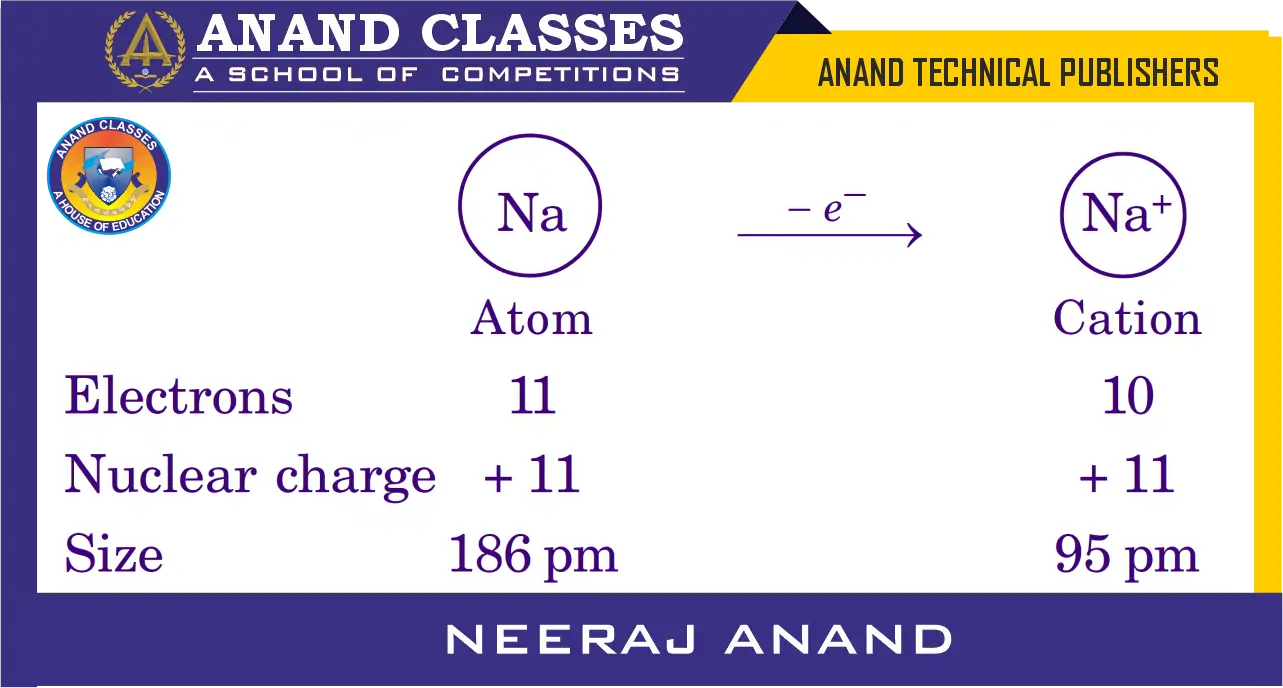
Sodium atom has nuclear charge +11 and 11 electrons; Na+ has the same nuclear charge (+11) but only 10 electrons. The same positive charge (+11) now attracts fewer electrons (10), increasing the effective nuclear charge per electron. The same positive charge now attracts fewer electrons, increasing the effective nuclear charge per electron. This stronger attraction pulls electrons closer to the nucleus, causing a decrease in atomic size.
As a result :
- Effective nuclear charge per electron increases.
- The electrons are pulled closer to the nucleus.
- The electron cloud shrinks, leading to a smaller ionic radius.
Comparative Sizes of Atoms and Their Cations
Table illustrates the comparative size of certain atoms and the positive ions formed from them.
| Species | Li | Na | K | Be | Mg | Ca | Al |
|---|---|---|---|---|---|---|---|
| Atomic Radius (pm) | 152 | 186 | 231 | 111 | 160 | 197 | 143 |
| Cation (Ion) | Li⁺ | Na⁺ | K⁺ | Be²⁺ | Mg²⁺ | Ca²⁺ | Al³⁺ |
| Cationic Radius (pm) | 60 | 95 | 133 | 39 | 72 | 100 | 50 |
Observation : Cationic radii are much smaller than atomic radii due to loss of electrons, increased effective nuclear charge, and reduced electron-electron repulsion.
Why is the radius of a anion larger than that of its parent atom?
A negative ion (anion) is always larger than the neutral atom from which it is formed. This difference in size arises from the fundamental balance between nuclear attraction and electron–electron repulsion inside the atom.
Step-1 : Formation of an Anion
An anion forms when a neutral atom gains one or more electrons : $$\text{Atom} + e^- \; \longrightarrow \; \text{Anion}$$
When this happens :
- The number of protons (nuclear charge) remains the same.
- The number of electrons increases.
This creates a situation where the same positive charge is now responsible for holding more negatively charged electrons.
Step-2. Changes in Forces Inside the Atom
(a) Decrease in Effective Nuclear Charge (Zeff)
The effective nuclear charge per electron is the net positive pull each electron feels from the nucleus after accounting for repulsion from other electrons.
- In a neutral atom, each electron experiences a certain Zeff.
- When electrons are added (forming an anion), the same nuclear charge is distributed over more electrons, so Zeff per electron decreases.
- This weaker pull means electrons are held less tightly, allowing the electron cloud to expand.
(b) Increase in Electron–Electron Repulsion
Electrons are negatively charged and naturally repel each other.
- Adding extra electrons increases repulsion within the electron cloud.
- This repulsion pushes electrons farther apart, further increasing the radius of the ion.
Example – Chlorine to Chloride Ion (Cl → Cl–)
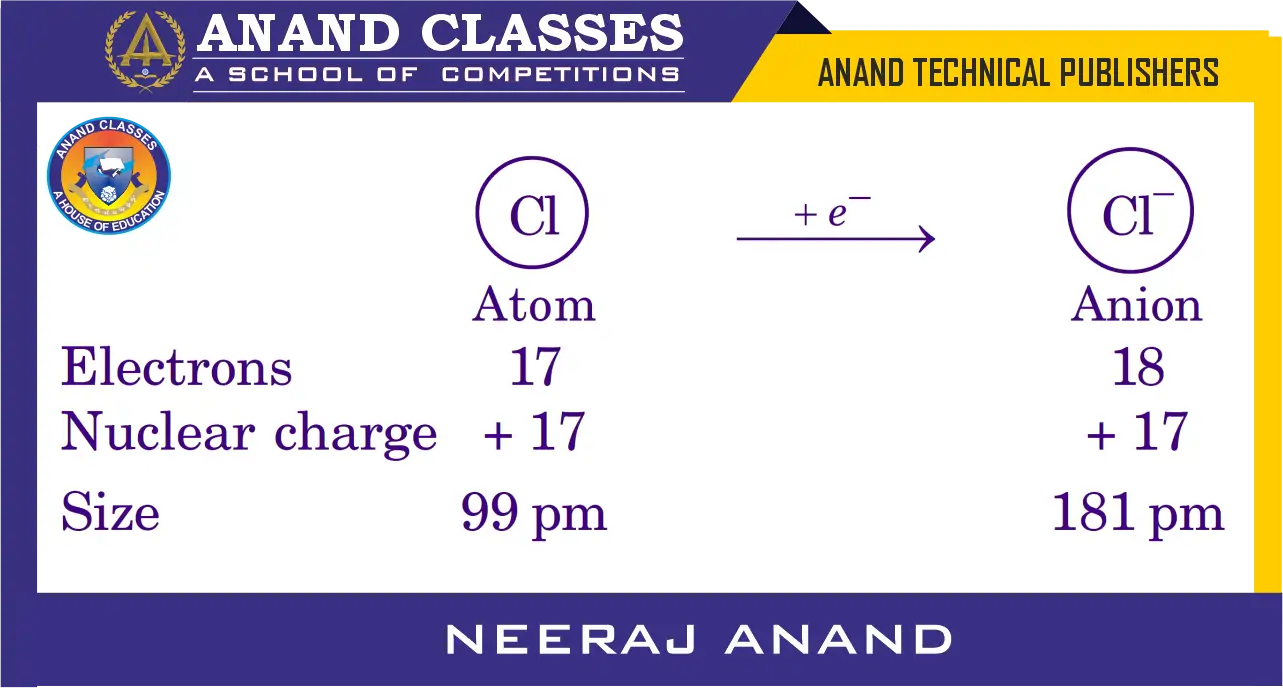
When a chlorine atom gains one electron: $$\text{Cl} \; (17e^-, +17p) \; + \; e^- \; \longrightarrow \; \text{Cl}^- \; (18e^-, +17p)$$
| Property | Cl (Atom) | Cl– (Anion) |
|---|---|---|
| Electrons | 17 | 18 |
| Nuclear Charge | +17 | +17 |
| Size (pm) | 99 | 181 |
In the formation of Cl– ion from Cl atom, the number of electrons increases from 17 to 18 while the nuclear charge remains same (+17). As a result, the same nuclear change acts on larger number of electrons than were present in the neutral atom. In other words, effective nuclear charge per electron is reduced and the electron cloud is held less tightly by the nucleus. This causes increase in the size of the ion.
Observation:
- Nuclear charge : unchanged at +17
- Electron count : increases from 17 to 18
- Size : increases from 99 pm to 181 pm
The result : The same nuclear charge acts on a larger number of electrons, reducing the nucleus’ grip and increasing ionic radius.
Covalent and Ionic Radii of Some Atoms and Anions
Thus, as shown in Table, the anions are larger in size than the corresponding atoms.
| Element | Covalent Radius (pm) | Anion | Ionic Radius (pm) |
|---|---|---|---|
| Cl | 99 | Cl⁻ | 181 |
| Br | 114 | Br⁻ | 196 |
| I | 133 | I⁻ | 220 |
| O | 74 | O²⁻ | 142 |
| N | 75 | N³⁻ | 171 |
Conclusion :
Anions always have a larger radius than their parent atoms because :
- Effective nuclear charge per electron decreases
- Electron–electron repulsion increases
- Electron cloud expands
Variation of Ionic Radii in a Group
The ionic radii in a particular group increase in moving from top to bottom. The reason for the increase is the increase in the principal quantum level though the number of electrons in the valence shell remains the same (similar to those discussed in case of atomic radii).
For example, the ionic radii of alkali metal ions increase from Li+ to Cs+ in the following table.
| Ion | Ionic radius (pm) |
| $Li^+$ | 60 |
| $Na^+$ | 95 |
| $K^+$ | 133 |
| $Rb^+$ | 149 |
| $Cs^+$ | 170 |
Variation of Size in an Isoelectronic Series — Detailed Explanation
Isoelectronic ions are ions of different elements which have same number of electrons but differ from one another in magnitude of the nuclear charge. A set of species having the same number of electrons is known as isoelectronic series.
In the given example, all the ions have 10 electrons, but their nuclear charges (number of protons) are different:
| Ion | Nuclear Charge (+) | Radius (pm) |
|---|---|---|
| N³⁻ | +7 | 171 |
| O²⁻ | +8 | 140 |
| F⁻ | +9 | 136 |
| Na⁺ | +11 | 95 |
| Mg²⁺ | +12 | 72 |
| Al³⁺ | +13 | 50 |
As we move from one ion to the next in this series, the number of protons in the nucleus increases. This increase in nuclear charge results in a stronger force of attraction between the nucleus and the electrons.
Since the number of electrons is the same for all species, the electron–electron repulsion is similar, but the stronger nuclear attraction in ions with more protons pulls the entire electron cloud closer to the nucleus.
Consequently, the electrons are held more tightly, and the ionic radius decreases progressively with increasing nuclear charge.
This explains why Al³⁺, having the highest nuclear charge (+13), is the smallest in size, and N³⁻, having the lowest nuclear charge (+7), is the largest.
Therefore, the order of decreasing radius in this isoelectronic series is :
Al³⁺ < Mg²⁺ < Na⁺ < F⁻ < O²⁻ < N³⁻
Reason for the Size Variation in Isoelectronic Series
- Same Number of Electrons
- All ions in this series have 10 electrons, so the extent of electron–electron repulsion is nearly the same for all.
- Different Nuclear Charges
- As we move from N³⁻ to Al³⁺, the number of protons increases from 7 to 13.
- This means the positive charge in the nucleus increases.
- Effect of Increased Nuclear Charge
- A stronger nuclear charge pulls the same number of electrons more tightly toward the nucleus.
- This reduces the size of the electron cloud.
- Trend in Ionic Radii
- Since the pulling force is strongest in Al³⁺, it has the smallest size.
- The weakest pull is in N³⁻ (lowest nuclear charge), so it has the largest size.
- Order of Decreasing Radius
- From largest to smallest:
N³⁻ > O²⁻ > F⁻ > Na⁺ > Mg²⁺ > Al³⁺ - Or in increasing nuclear charge order:
Al³⁺ < Mg²⁺ < Na⁺ < F⁻ < O²⁻ < N³⁻
- From largest to smallest:
FAQs – Frequently Asked Very Short Questions and Answers
Why is the radius of a cation smaller than its parent atom?
A cation is formed by the loss of one or more electrons, often from the outermost shell. This removal reduces the electron cloud size, and the same nuclear charge now attracts fewer electrons more strongly, pulling them closer to the nucleus and decreasing the radius.
Does the nuclear charge change when a cation is formed?
No. The number of protons (nuclear charge) remains the same, but the number of electrons decreases. This increases the effective nuclear charge per electron, leading to a smaller radius.
Why is Na+ much smaller than Na?
Sodium (Na) has an outermost 3s electron, which is completely lost during cation formation, removing an entire electron shell. Na has a radius of 186 pm, while Na⁺ has only 95 pm.
Why are Mg2+ ions even smaller than Mg atoms?
In magnesium, two outermost 3s electrons are removed to form Mg2+, eliminating the 3rd shell entirely. The radius decreases from 160 pm in Mg to 72 pm in Mg2+.
Is the size reduction the same for all cations?
No. The size decrease depends on the number of electrons removed, the charge on the ion, and the original atomic size. Higher positive charge results in a greater decrease in ionic radius.
Which has a smaller radius — Li+ or Na+?
Li+ has a smaller radius (60 pm) compared to Na⁺ (95 pm) because lithium has fewer electron shells, making the ion more compact.
Why is a negative ion (anion) larger than its corresponding neutral atom?
When an atom gains one or more electrons to form an anion, the number of protons (positive charges) in the nucleus stays the same, but the number of electrons increases. The nucleus now has to attract more electrons without any increase in its pulling power (nuclear charge).
Moreover, the newly added electron(s) increase electron-electron repulsion inside the atom. This repulsion forces electrons to spread out more, causing the electron cloud to expand. As a result, the radius of the anion is larger than that of its parent atom.
Does nuclear charge change when an atom becomes an anion?
No. The nuclear charge is determined by the number of protons in the nucleus, and this does not change during the formation of an anion. For example, in chlorine (Cl) and chloride ion (Cl⁻), both have 17 protons, so the nuclear charge is +17 in both cases.
What changes is the effective nuclear charge per electron — because there are more electrons sharing the same nuclear attraction, each electron experiences a weaker pull, allowing the electron cloud to expand.
What role does effective nuclear charge play in the size of an anion?
The effective nuclear charge (Zeff) is the net positive charge experienced by an electron after accounting for shielding effects caused by other electrons.
In a neutral atom, Zeff is relatively higher because there are fewer electrons to shield each other.
In an anion, the number of electrons increases while the nuclear charge remains constant.
This extra shielding reduces Zeff per electron, which means the nucleus cannot pull the electron cloud as tightly, resulting in a bigger ionic radius.
Can you give an example of size increase from atom to anion?
Yes. Consider chlorine (Cl) :
Cl atom: 17 electrons, 17 protons, radius ≈ 99 pm.
Cl⁻ ion: 18 electrons, 17 protons, radius ≈ 181 pm.
This increase of nearly 82 pm happens because the added electron increases repulsion and reduces the effective pull from the nucleus. Similar trends are observed in bromine (Br → Br⁻), iodine (I → I⁻), and oxygen (O → O²⁻).
Is this trend of anions being larger than their parent atoms true for all elements?
Yes, this is a general rule in chemistry. Whenever an atom gains electrons — whether it is a halogen, chalcogen (oxygen family), or nitrogen family element — the resulting anion is larger than the neutral atom. The only variation is how much the radius increases, which depends on the number of electrons gained and the original size of the atom.
Why do anions have greater electron repulsion than neutral atoms?
Electrons are negatively charged and repel each other due to Coulomb’s law. When an extra electron is added to a neutral atom, the number of electron–electron interactions increases significantly. This repulsion pushes the electrons further apart from each other, increasing the overall size of the electron cloud. The nucleus cannot counter this expansion effectively because its positive pull is now spread over more electrons.
How does the number of added electrons affect anion size?
The more electrons an atom gains, the larger the increase in its size. For example:
Oxygen atom (O): radius ≈ 74 pm.
O²⁻ ion: radius ≈ 142 pm — nearly double!
This is because adding two electrons increases repulsion more than adding just one. Similarly, nitrogen atom (N) → nitride ion (N³⁻) shows an even greater jump in size because three extra electrons cause extreme electron–electron repulsion and strong shielding.
What does “isoelectronic” mean?
“Isoelectronic” literally means “same electrons.” In chemistry, it refers to atoms or ions that contain exactly the same total number of electrons. For example, F⁻, Ne, and Na⁺ each have 10 electrons.
Even though they have the same number of electrons, their nuclear charges (number of protons in the nucleus) are different, because they are different elements.
This difference in nuclear charge is the reason why their sizes are not the same, even though their electron count is identical.
Why do ions in an isoelectronic series have different sizes?
In an isoelectronic series, the electron–electron repulsion inside the atoms or ions is nearly the same, because they have the same number of electrons.
However, the positive pull from the nucleus is different for each species, because they have different numbers of protons.
If an ion has more protons, the positive charge pulls the electrons closer, shrinking the size.
If an ion has fewer protons, the pull is weaker, so the electron cloud spreads out, increasing the size.
Therefore, nuclear charge is the main controlling factor for size differences in an isoelectronic series.
Why is Al³⁺ the smallest ion in the given series?
In the given series (all with 10 electrons), Al³⁺ has 13 protons.
This is the highest nuclear charge among all the ions listed.
Because the positive pull is so strong, the electron cloud contracts significantly, making the ion extremely small — just 50 pm in radius.
Also, Al³⁺ has lost 3 electrons compared to neutral Al, which means there is less repulsion between remaining electrons, allowing the nucleus to pull them even closer.
Why is N³⁻ the largest ion in the series?
N³⁻ has only 7 protons in its nucleus, which is the lowest nuclear charge in the series.
This weak pull is not enough to hold the 10 electrons very tightly.
In fact, nitrogen in N³⁻ has gained 3 extra electrons compared to neutral N, increasing electron–electron repulsion.
This extra repulsion pushes the electron cloud outward, giving N³⁻ the largest radius of the series — 171 pm.
Does electron–electron repulsion affect the trend?
Yes, but only to a smaller extent than nuclear charge.
Since all species have the same number of electrons, the total electron–electron repulsion is similar in all of them.
However, when an atom gains electrons (becoming an anion), the repulsion increases slightly because there are more electrons per proton.
When an atom loses electrons (becoming a cation), the repulsion decreases, allowing the nucleus to pull the remaining electrons even closer.
In the given series, this effect is secondary to the main cause — the difference in nuclear charge.
Can neutral atoms be part of an isoelectronic series?
Yes, as long as they have the same number of electrons as the other members.
For example :
F⁻ → 9 protons, 10 electrons
Ne → 10 protons, 10 electrons
Na⁺ → 11 protons, 10 electrons
All of these are isoelectronic because they each have 10 electrons, even though one is an anion, one is neutral, and one is a cation.
What is the general size trend in an isoelectronic series?
In an isoelectronic series:
Higher nuclear charge (more protons) → smaller radius because the electron cloud is pulled in more tightly.
Lower nuclear charge (fewer protons) → larger radius because the pull is weaker and the electron cloud expands.
So the order is: smallest size = highest nuclear charge, largest size = lowest nuclear charge.
In the given example:
Al³⁺ (Z=13) < Mg²⁺ (Z=12) < Na⁺ (Z=11) < F⁻ (Z=9) < O²⁻ (Z=8) < N³⁻ (Z=7).
Important Chapter Interlinks
This section provides a complete and interconnected study of Classification of Elements and Periodicity in Properties, starting with detailed theory and notes for Class 11 Chemistry to build a strong conceptual foundation. You can explore atomic radius and its types including covalent, van der Waals, metallic, and ionic radii to understand periodic trends in atomic size. It also includes Screening Effect (Shielding Effect) : Calculation of Effective or Reduced Nuclear Charge (Slater’s Rules), which explains how inner electrons reduce the nuclear attraction on outer electrons and influence periodic trends. In addition, topics like Radius of Cation is Less and Anion is More Than Its Parent Atom, Size Variation in Isoelectronic Series help explain how ionic size changes due to gain or loss of electrons and how nuclear charge affects size in species with the same number of electrons. The causes of periodicity explain why elements show repeating properties based on electronic configuration, which is further supported by the modern periodic law and structure of the modern periodic table including groups, periods, and blocks for elements even beyond atomic number 100. The historical development is covered through Mendeleev’s periodic law and table, leading to the modern classification of elements into s, p, d, and f blocks with prediction of period, group, and block. To strengthen exam preparation, you can practice JEE Main PYQs, IMU CET PYQs and Merchant Navy sponsorship exam MCQs, and other previous year questions with solutions, along with solved examples, conceptual questions, and practice problems on the modern periodic table. Additionally, complete study material, mock tests, and guidance are provided under Anand Classes Chemistry notes, along with expert support from Er Neeraj Anand, making this section a comprehensive resource for competitive exam preparation.