
Chemical bonding is one of the most important topics in Class 11 Chemistry for CBSE Board, JEE Main, JEE Advanced, and NEET examinations. Among the various concepts used to study chemical bonds, dipole moment is a valuable tool for understanding the polarity, nature, and geometry of molecules. It helps distinguish between polar and non-polar molecules, determines the degree of polarity, calculates the percentage ionic character of a bond, predicts molecular shapes, and differentiates between cis-trans as well as ortho-, meta-, and para-isomers. A thorough understanding of the applications of dipole moment strengthens the fundamentals of chemical bonding and is essential for scoring well in both board and competitive examinations.
How does dipole moment help distinguish between polar and non-polar molecules? Why H2 is non polar and HCl is polar ?
The measurement of dipole moment helps distinguish between polar and non-polar molecules. Non-polar molecules have zero dipole moment (μ = 0) because the bond dipoles cancel each other completely. Polar molecules have a non-zero dipole moment (μ ≠ 0) due to unequal distribution of charge.
For example, H₂ has zero dipole moment and is a non-polar molecule, whereas HCl has a dipole moment of 1.07 D and is a polar molecule. Some other examples are given below :
| Non-polar molecules (Dipole moment = 0) | Polar molecules (Dipole moment ≠ 0) |
|---|---|
| H₂ | H₂O — 1.85 D |
| O₂ | HF — 1.78 D |
| Cl₂ | HCl — 1.07 D |
| N₂ | H₂S — 0.95 D |
| CO₂ | |
| BeF₂ | |
| BF₃ | |
| CH₄ |
Practice more questions from Why Exact Atomic Radius is Difficult to Determine ?
How does dipole moment indicate the degree of polarity in a molecule? Why HF is more polar than HCl ?
Dipole moment measurement also gives an idea about the degree of polarity especially in a diatomic molecule. The greater the dipole moment, the greater is the polarity in such a molecule. For example, HF has a dipole moment of 1.78 D, whereas HCl has a dipole moment of 1.07 D. Therefore, HF is more polar than HCl.
Explore detailed notes on Why Van der Waals Radius is Needed ?
How is dipole moment used to determine the shape of molecules ? Why carbon dioxide (CO₂) is linear and water (H₂O) is bent or angular (V) shape ?
In molecules containing more than two atoms, the dipole moment depends not only on the polarity of individual bonds but also on their arrangement in space. Hence, dipole moment helps determine the molecular shape.
For example, carbon dioxide (CO₂) has a dipole moment of zero, showing that it is a linear molecule in which the dipole moments of the two C=O bonds cancel each other.
On the other hand, water (H₂O) has a dipole moment of 1.85 D, indicating that it is bent (angular) rather than linear. In water, the bond dipoles do not cancel completely, resulting in a net dipole moment.
Continue learning with Pauling’s method of determining ionic radius
How is dipole moment used to calculate the percentage ionic character of a molecule ? How to calculate %ge ionic character of HCl molecule ?
Dipole moment helps determine the percentage ionic character of a chemical bond. A larger difference in electronegativity between two bonded atoms results in greater ionic character.
As an extreme case, when the electron is completely transferred from one atom to another, an ionic bond is formed. Therefore, the ionic bond is regarded as an extreme case of covalent bond. The greater the difference in electronegativities of the bonded atoms, the higher is the ionic character. It has been observed that when the electronegativity difference between two atoms is 1.7, then the bond is 50% ionic and 50% covalent.
If the electronegativity difference is more than 1.7, then the chemical bond formed is predominantly ionic (more than 50% ionic character) and if the difference is less than 1.7, the bond formed is mainly covalent. Larger the electronegativity difference, larger will be the ionic character.
For example, bond between Cs (0.7) and F (4.0) is more ionic than bond between Li (1.0) and F (4.0). On the other hand, the bond between C (2.5) and H (2.1) or Cl (3.0) is almost covalent because the electronegativity difference between bonding atoms is small.
The percentage of ionic character can be calculated from the ratio of the observed dipole moment to the theoretical dipole moment for the complete electron transfer (100% ionic character).
For example, in HCl molecule, the observed dipole moment is 1.07 D and its bond length is 1.275 Å. Assuming 100% ionic character, the charge developed on H and Cl atoms would be 4.8 × 10⁻¹⁰ esu.
Therefore, dipole moment for 100% ionic character will be :
μmax (ionic)= q × d = 4.8 × 10–10 esu × 1.275 × 10–8 cm
μmax = 6.12 × 10⁻¹⁸ esu cm = 6.12 D
Calculate Percent Ionic Character
Using the observed (experimental) dipole moment, which is 1.07 D :
Thus, HCl has about 17.48% ionic character, showing that it is predominantly covalent.
Important related topics are Why are ionic compounds generally non-flammable?
How does dipole moment help distinguish between cis- and trans-isomers? Why trans 1,2-dichloroethene (C₂H₂Cl₂) has zero dipole moment and cis 1,2-dichloroethene (C₂H₂Cl₂) has non zero dipole moment ?
Dipole moment measurements help to distinguish between cis- and trans-isomers because cis- isomer has usually higher dipole moment than trans isomer.
In cis-isomers, similar atoms or groups are on the same side of the double bond. The bond dipoles point in roughly the same direction, so they add together.
In trans-isomers, similar atoms or groups are on opposite sides of the double bond. Their bond dipoles point in opposite directions and cancel each other.
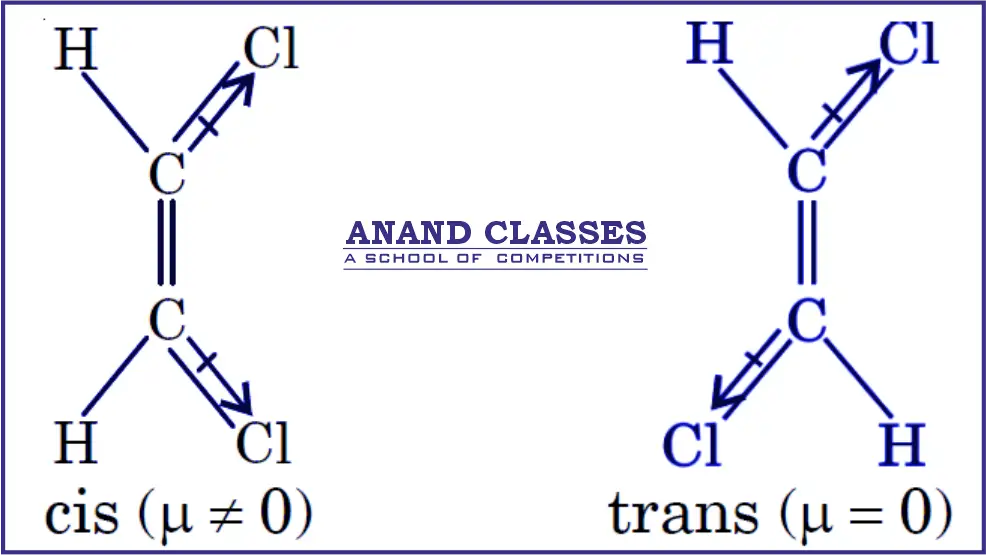
For example, in trans-isomer of 1,2-dichloroethene (C₂H₂Cl₂), the dipole moment is less because the bond moments of C—Cl bonds cancel each other.
In cis-isomer of 1,2-dichloroethene (C₂H₂Cl₂) both C–Cl bond dipoles point toward the chlorine atoms. Since both Cl atoms are on the same side, the dipoles add up. Dipole moment is high.
In trans-isomer of 1,2-dichloroethene (C₂H₂Cl₂) the two C–Cl bond dipoles point in opposite directions. They cancel each other because of the symmetrical arrangement. Dipole moment is nearly zero.
You may also like to study What is an Ionic Bond or Electrovalent Bond?
How does dipole moment help distinguish between ortho-, meta-, and para-isomers? Why ortho dichlorobenzene has highest dipole moment and trans dichlorobenzene has zero dipole moment
Dipole moment measurements help distinguish between ortho (o-), meta (m-), and para (p-) isomers because the position of the substituent groups affects the overall polarity of the molecule. The individual bond dipoles combine differently depending on the arrangement of the substituents, resulting in different net dipole moments.
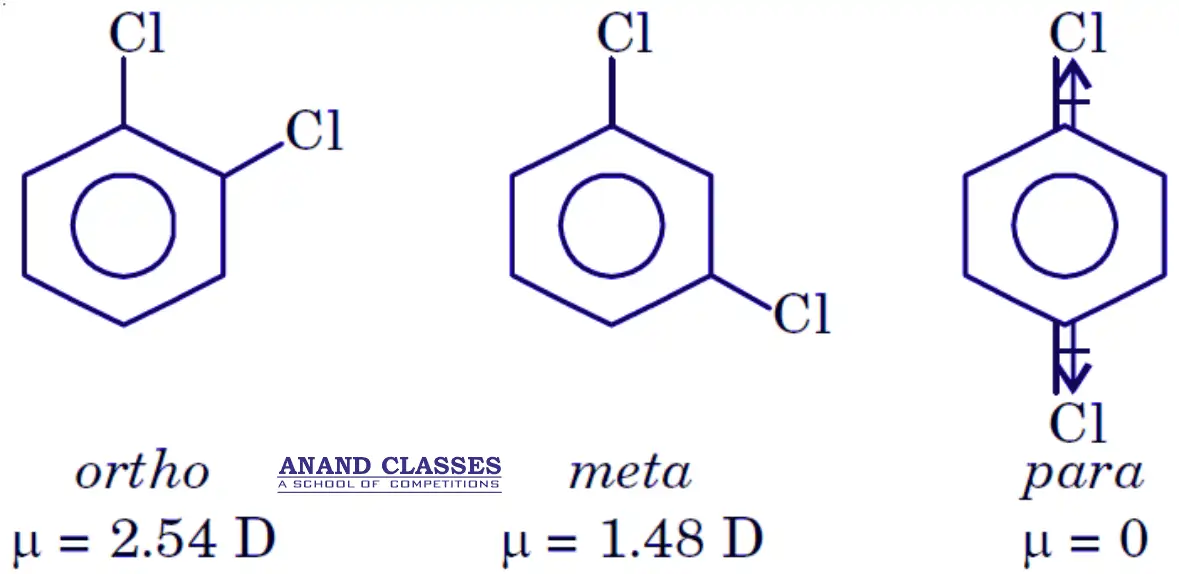
For example, in dichlorobenzene, the ortho (1,2-) isomer has the highest dipole moment. Since the two chlorine atoms are attached to adjacent carbon atoms, the dipole moments of the two C–Cl bonds act in similar directions and reinforce each other. As a result, the molecule has a large net dipole moment.
In the meta (1,3-) dichlorobenzene isomer, the chlorine atoms are separated by one carbon atom. The bond dipoles partially cancel each other because of their arrangement. Therefore, the net dipole moment is lower than that of the ortho isomer but greater than that of the para isomer.
In the para (1,4-) dichlorobenzene isomer, the chlorine atoms are located opposite each other on the benzene ring. The molecule is symmetrical, and the dipole moments of the two C–Cl bonds are equal in magnitude but opposite in direction. They completely cancel each other, making the dipole moment zero.
Thus, the order of dipole moments for the isomers of dichlorobenzene is:
Ortho (o-) > Meta (m-) > Para (p-) = 0
Hence, dipole moment measurements are useful in distinguishing between o-, m-, and p-isomers, as the para isomer has zero dipole moment, the meta isomer has an intermediate dipole moment, and the ortho isomer has the highest dipole moment.
To strengthen your concepts, learn about How does electron gain enthalpy affect ionic bond formation?