An Ionic or Electrovalent Bond is a type of chemical bond formed by the complete transfer of one or more electrons from one atom to another, resulting in the formation of positively charged cations and negatively charged anions. The electrostatic force of attraction between these oppositely charged ions holds them together to form ionic compounds. Understanding the formation of ionic bonds, their characteristics, examples, and the factors affecting their formation is essential for explaining the properties of many chemical substances. This topic is an important part of Class 11 Chemistry and is frequently asked in CBSE, JEE Main, JEE Advanced, NEET, IMUCET, and other competitive examinations.
Ionic or Electrovalent Bond for Class 11 Chapter 4 Chemical Bonding and Molecular Structure
Master Ionic or Electrovalent Bond concepts with well-structured notes, solved examples, practice questions, and exam-focused explanations. This study material is designed to help Class 11 students strengthen their fundamentals and prepare effectively for CBSE board exams, JEE Main, JEE Advanced, NEET, IMUCET, and other competitive examinations.
How can students make Chemistry easier to learn and revise?
Students can make Chemistry easier by understanding concepts thoroughly, revising regularly, practicing questions consistently, and focusing on the logical connections between topics.
Important exam-related topics include Lattice Enthalpy of Ionic Crystals, Properties of Ionic Compounds
Why is concept-based learning important for competitive examinations?
Concept-based learning helps students solve unfamiliar questions, improves analytical thinking, and builds confidence for tackling higher-level problems in entrance examinations.
What is an Ionic Bond or Electrovalent Bond?
Electrovalent bond or Ionic bond. is formed by the transference of one or more valence electrons of one atom to the other atom so as to complete their outermost octets or duplets and acquire stable nearest noble gas configurations, the bond formed is called electrovalent bond or ionic bond. In this type of bonding, one atom completes its octet and acquires noble gas configuration by losing the electrons and the other by gaining the electrons.
The atom which loses the electrons acquires a positive charge, and the other which gains the electrons acquires a negative charge. These two oppositely charged ions, thus formed, come closer due to electrostatic forces of attraction and form an ionic bond.
Thus, the electrostatic force of attraction which holds the oppositely charged ions together is known as ionic bond or electrovalent bond. The compounds containing ionic or electrovalent bonds are called ionic or electrovalent compounds.
Ionic bonds are usually found in compounds that contain metals combined with non-metals. When this type of bond is formed, electrons are transferred from the metal atoms to the non-metal atoms during the chemical reaction. In doing this, the atoms become more stable due to their full outer shells. For example, consider what happens when sodium and chlorine react together and combine to make sodium chloride
sodium + chlorine → sodium chloride
Sodium has just one electron in its outer shell (11Na 2,8,1). Chlorine has seven electrons in its outer shell (17Cl 2,8,7). When these two elements react, the outer electron of each sodium atom is transferred to the outer shell of a chlorine atom. In this way both the atoms obtain full outer shells and become ‘like’ the noble gas nearest to them in the Periodic Table.
Learn more about Screening Effect (Shielding Effect) : Calculation of Effective or Reduced Nuclear Charge (Slater’s Rules)
Formation of Sodium Chloride (NaCl) – An Ionic Compound
Let us illustrate the formation of ionic bond by considering the example of formation of sodium chloride by reaction of sodium and chlorine.
Sodium atom (1s² 2s² 2p⁶ 3s¹) has only one electron in the valence shell, and by losing this electron, it can acquire the stable electronic configuration of neon (1s² 2s² 2p⁶).
Chlorine atom (1s² 2s² 2p⁶ 3s² 3p⁵) has seven electrons in its valence shell and needs only one electron to complete its octet. Thus, both atoms can complete their octets if a sodium atom gives one electron to a chlorine atom. This tendency is responsible for bonding between sodium and chlorine atoms.
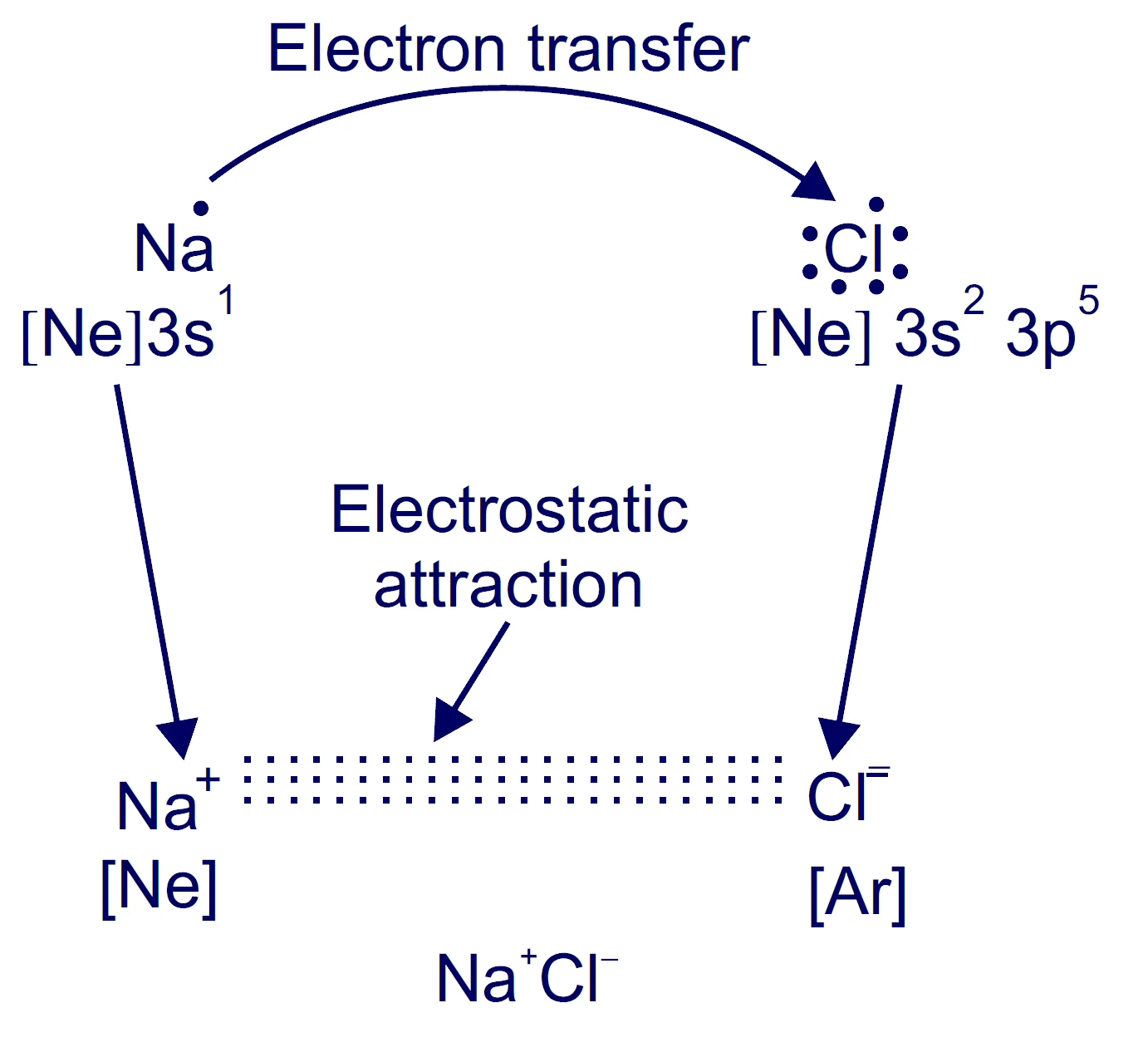
Therefore, sodium gives one electron and becomes a positively charged Na⁺ ion, while chlorine takes up the electron and becomes a negatively charged Cl⁻ ion. These two ions are then held together by strong electrostatic forces of attraction, which constitute the ionic bond.
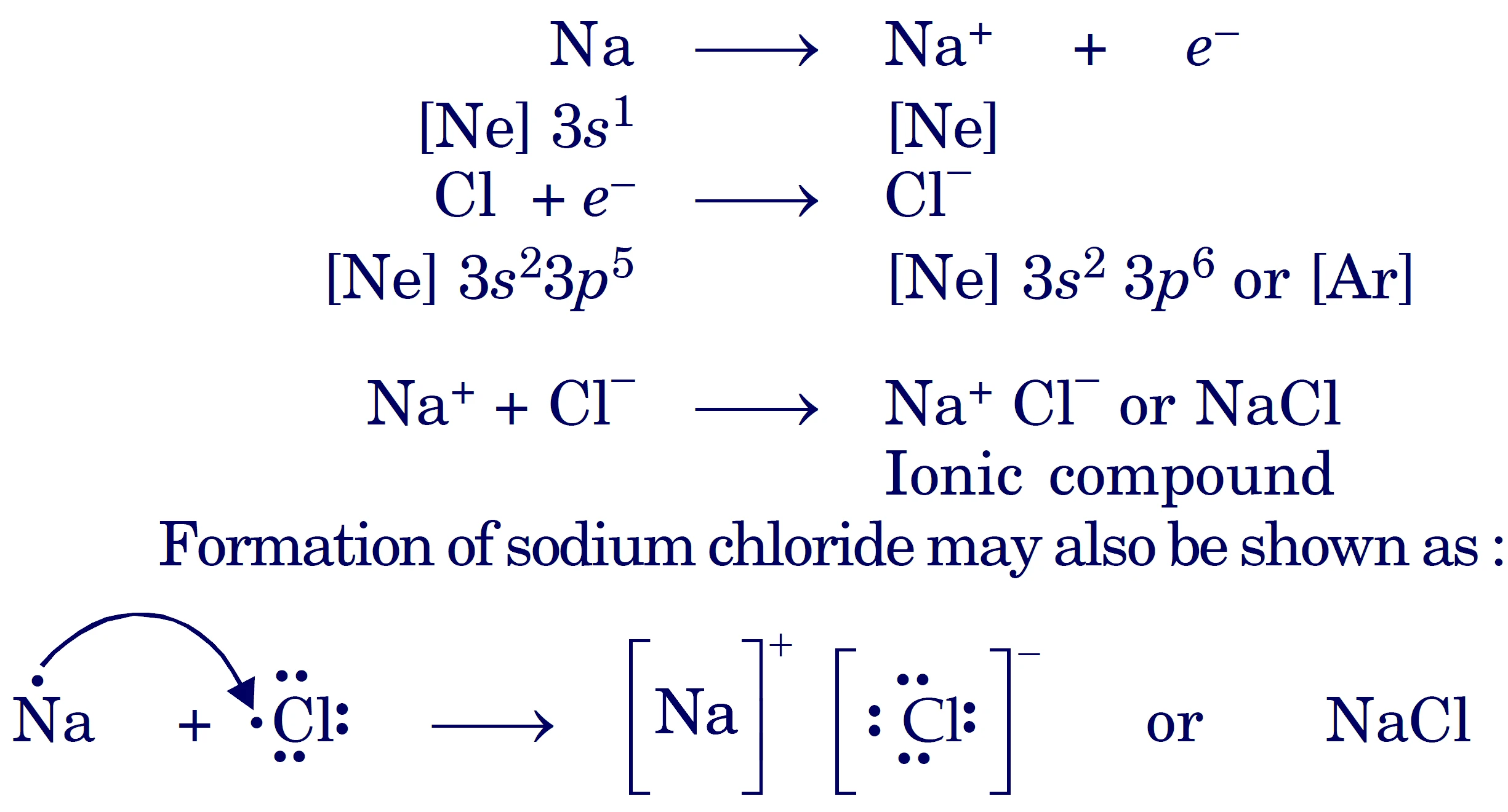
The charges on the sodium and chloride ions are equal but opposite. They balance each other and the resulting formula for sodium chloride is NaCl. Only the outer electrons are important in bonding, so we can simplify the diagrams by missing out the inner shells.
| Noteworthy Point |
|---|
| The properties of salt are very different from those of the sodium and chlorine it was made from. To get salt into your diet you would not eat sodium or inhale chlorine ! |
Learn more about Why Exact Atomic Radius is Difficult to Determine ?
Formation of Calcium Fluoride (CaF2) – An Ionic Compound
The electronic configurations of calcium and fluorine atoms are :
Ca (Z = 20): [Ar] 4s²
F (Z = 9): [He] 2s² 2p⁵
When calcium and fluorine react and form calcium fluoride, calcium loses its two valence electrons to two fluorine atoms. Each fluorine atom requires one electron to complete its octet. As a result, calcium forms a Ca²⁺ ion, while each fluorine atom forms an F⁻ ion.
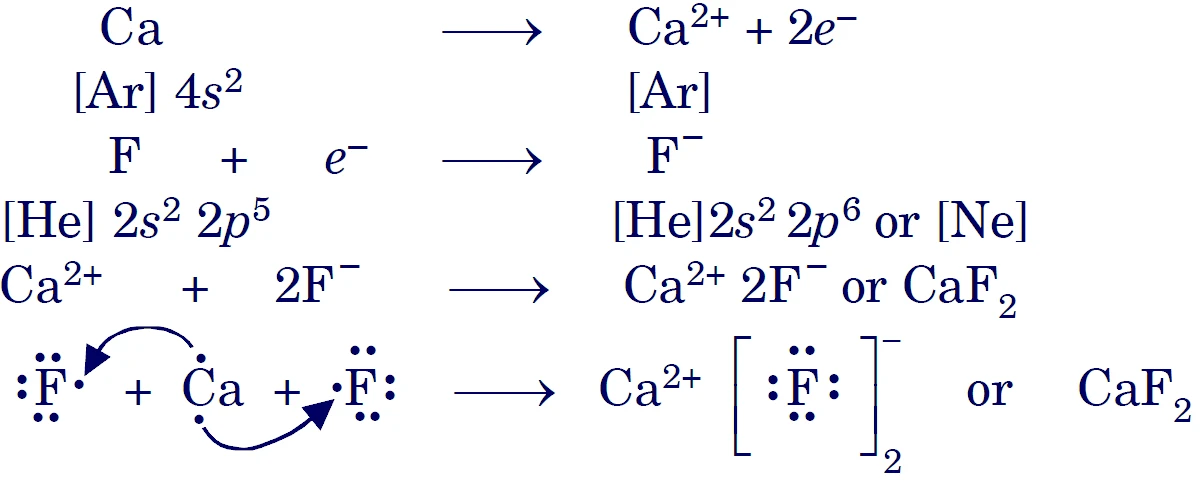
Thus, one Ca²⁺ ion and two F⁻ ions are produced. All these ions attain stable noble gas electronic configurations. The electrostatic force of attraction between the positively charged Ca²⁺ ion and the negatively charged F⁻ ions leads to the formation of ionic bonds, resulting in the compound calcium fluoride (CaF₂).
Similarly When calcium and chlorine react, the calcium atom gives each of the two chlorine atoms one electron. In this case, a compound is formed containing two chloride ions (Cl−) for each calcium ion (Ca2+). The chemical formula is CaCl2.
Formation of Magnesium Oxide (MgO) and Other Examples of Ionic Compounds
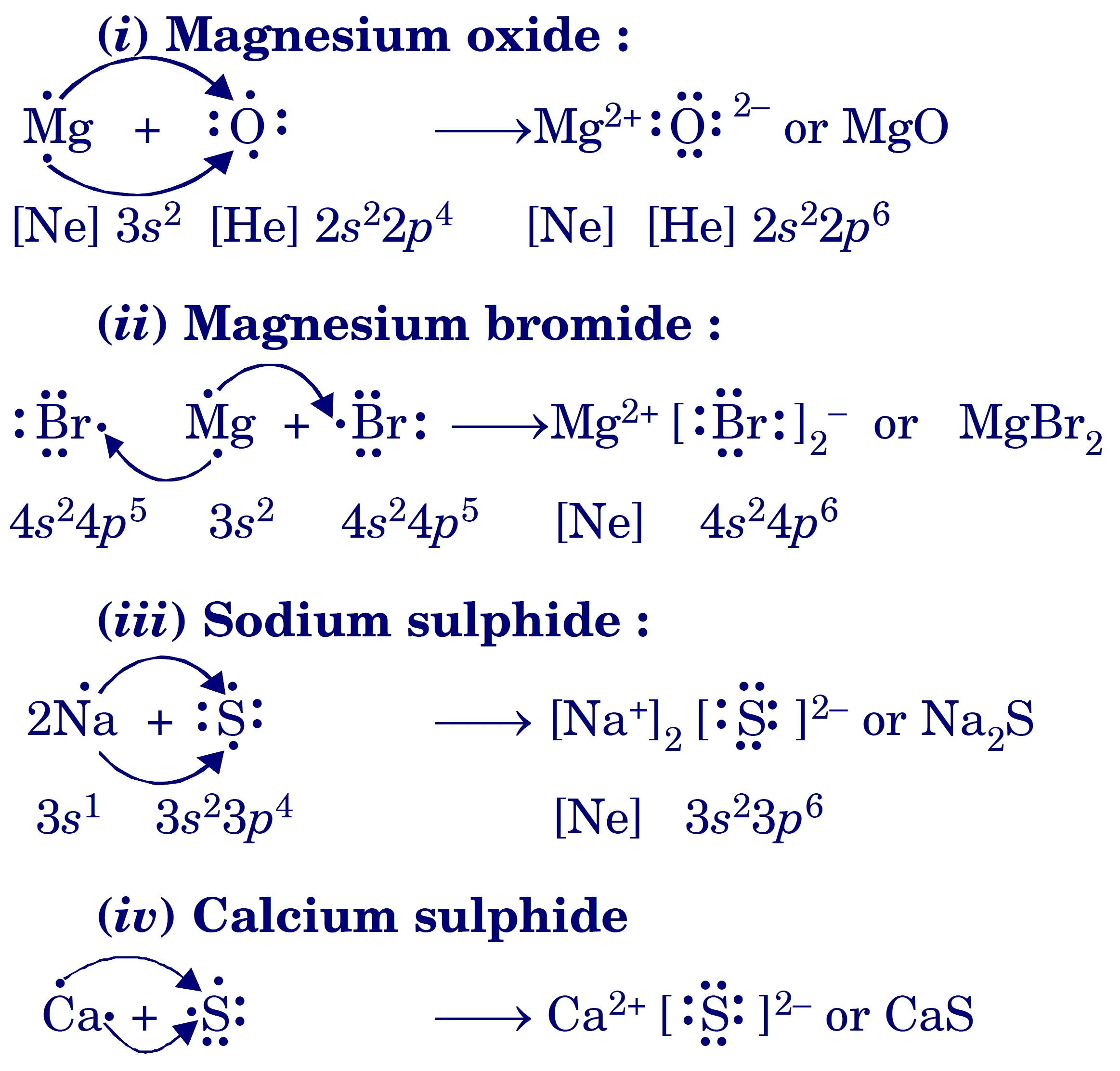
Figure (i) below shows the electron transfers that take place between a magnesium atom and an oxygen atom during the formation of magnesium oxide. Magnesium obtains a full outer shell by losing two electrons. These are transferred to the oxygen atom. In magnesium oxide, the Mg2+ and O2− are oppositely charged and are attracted to one another. The formula for magnesium oxide is MgO.
The other examples of Ionic Compounds (ii) Magnesium Bromide: (iii) Sodium Sulphide: (iv) Calcium Sulphide are shown as below.
What is Electrovalence or Electrovalency ?
In the formation of electrovalent bond, the number of electrons lost or gained by an atom is called its electrovalence or electrovalency. It is also equal to the number of unit charges on the ion.
For example :
- Sodium is assigned a positive electrovalence of one
- Calcium is assigned a positive electrovalence of two
- Chlorine and fluorine both are assigned a negative electrovalence of one
Atoms that readily lose electrons are called electropositive, while those which readily gain electrons are called electronegative.
Similar concepts include What is Lewis Structure Theory ?
What are the factors affecting the formation of Ionic Bonds ?
The tendency of atoms to form ionic bonds between them depends upon the following factors :
1. Cation has low Ionization Enthalpy
The ease with which an atom can lose electrons depends upon its ionization enthalpy. The ionization enthalpy is the amount of energy required to remove the most loosely bound electron from an isolated gaseous atom to form a positive ion.
$ \mathrm{M(g) \text{+ Ionization enthalpy} \rightarrow M^{+}(g) + e^-} $
Lesser the ionization enthalpy of an atom, the greater is the ease of losing the valence electron. Therefore, in general, metals which have low ionization enthalpy values, have greater tendency to form ionic bonds. For example, alkali and alkaline earth metals which have relatively low ionization enthalpies, generally form ionic compounds.
To understand this topic better, learn about Ionization Enthalpy Trends Along a Period and Down a Group
2. Anion has high Electron Gain Enthalpy
The tendency of an atom to gain electrons depends upon its electron gain enthalpy. Electron gain enthalpy is the energy released when an electron is added to an isolated gaseous atom to form a negative ion.
$ \mathrm{X(g) + e^- \rightarrow X^{-}(g)} \text{+Electron gain enthalpy} $
Higher the value of negative electron gain enthalpy, greater will be the ease of formation of anion. Therefore, in general, the elements which have high gain enthalpy values form ionic compounds. For example, halogen and oxygen group elements mostly form ionic compounds.
To understand this topic better, learn about What are the factors on which Electron Gain Enthalpy Depends ?
3. High Lattice Enthalpy of Solid
The formation and strength of an ionic bond also depend upon the electrostatic force of attraction between oppositely charged ions. Due to the strong electrostatic attraction between the ions, formation of the crystal results in release of energy. The amount of energy released when free ions combine together to form one mole of a crystal is called lattice enthalpy (U).
$ \mathrm{M^{+}(g) + X^{-}(g) \rightarrow MX(s)} \:+\: \text{Lattice enthalpy (U)} $
Higher the value of lattice enthalpy, greater will be the ease of formation of the ionic compound. The ionization process is always endothermic (absorbs energy) while electron gain enthalpy process may be exothermic (releases energy) or endothermic (absorbs energy). Lattice enthalpy is exothermic (releases energy).
Now, if the net effect of the above three factors is the release of energy, then ionic bond will be formed. This is in accordance with the general observation that only those processes occur in which there is decrease of energy.
Consider the formation of NaCl :
Ionization of sodium (step-1)
$\mathrm{Na(g) \rightarrow Na^{+}(g) + e^-} \quad \Delta i H = 495.8\ \mathrm{kJ\,mol^{-1}}$
Electron gain by chlorine (step-2)
$\mathrm{Cl(g) + e^- \rightarrow Cl^{-}(g)} \quad \Delta eg H = -348.7\ \mathrm{kJ\,mol^{-1}}$
Lattice formation (step-3)
$\mathrm{Na^{+}(g) + Cl^{-}(g) \rightarrow Na^{+}Cl^{-}(s)} \quad U = -788\ \mathrm{kJ\,mol^{-1}}$
The ionic bond is formed because the energy released in step (2) and (3) is more than the energy required in step (1).
$ \Delta H = -348.7 + (-788) + 495.8 = -640.9\ \mathrm{kJ\,mol^{-1}} $
As may be calculated from the above steps, 640.9 kJ/mol of energy is released and therefore, NaCl is formed.
Thus, a quantitative measure of the stability of an ionic compound is provided by its lattice enthalpy and not simply by achieving octet of electrons around the ionic species in the gaseous state.
What is the condition for formation of ionic compounds using energy considerations ?
The formation of ionic compounds depends upon the total energy changes (Ionization enthalpy + Electron gain enthalpy + Lattice enthalpy) in the formation of ionic bonds.
- The Ionization process is endothermic (absorbs energy).
- Electron gain enthalpy may be exothermic (releases energy) or endothermic.
- Lattice enthalpy is always exothermic (releases energy).
If the net effect of these three processes results in overall energy release, an ionic bond will form. This follows the principle that processes accompanied by a decrease in energy are spontaneous.
Thus, to sum up, the conditions for stable ionic bonding are :
(i) The ionisation enthalpy of atom forming the cation should be low.
(ii) The electron gain enthalpy of atom forming the anion should be highly negative.
(iii) Lattice enthalpy should be high.
Formation of Ionic Bonds
The ease of formation of ionic compounds primarily depends upon :
- The arrangement of positive and negative ions in the solid (called the lattice of the crystalline compound). This is also called the lattice of the crystalline compound.
- The ease of formation of positive and negative ions from the respective neutral atoms.
Solved Examples Based on Lewis Structure of Ionic/Electrovalent Bond
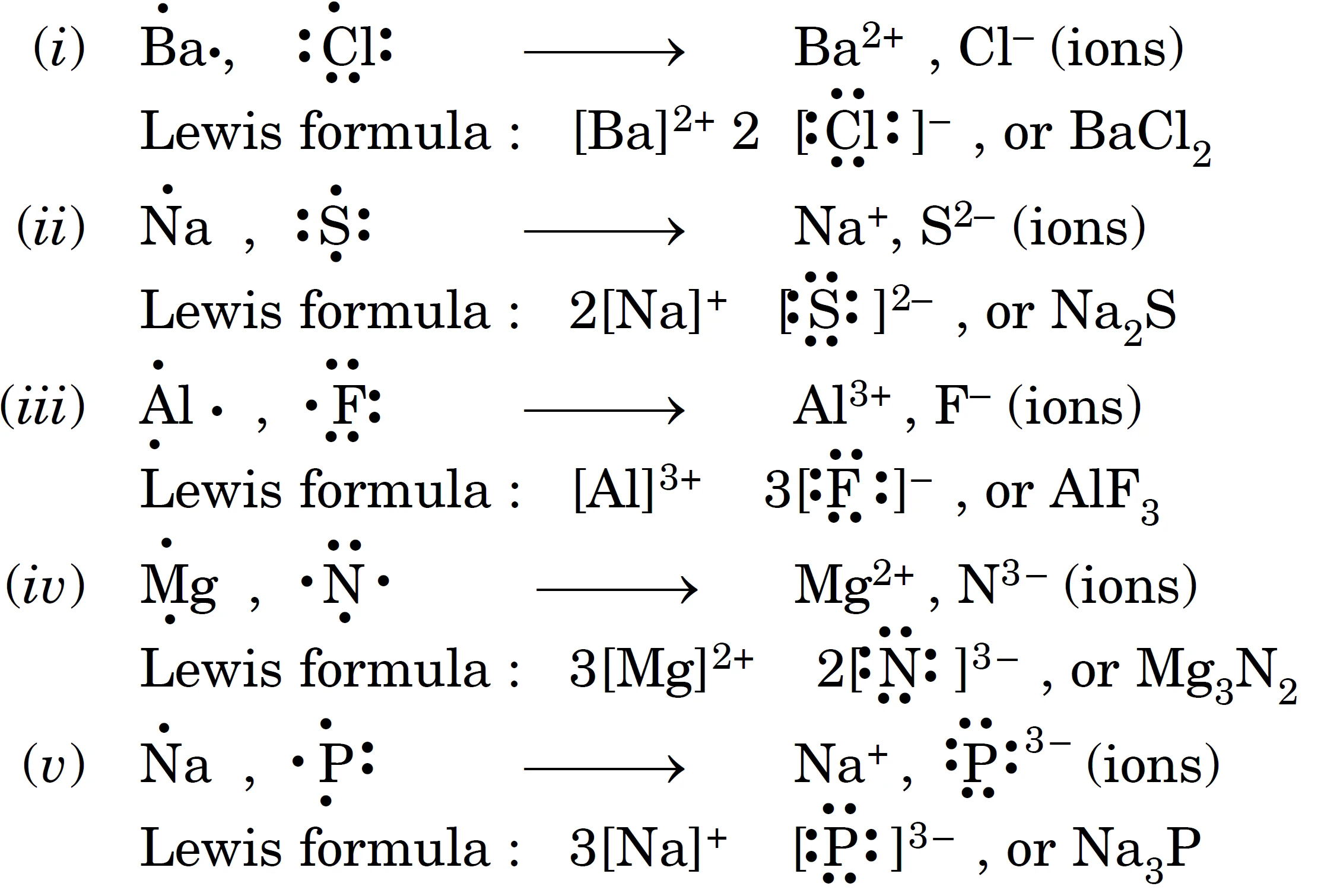
Example.1 : Give the Lewis structures and empirical formulae for the ionic compounds formed between the following pairs of elements :
(i) Ba, Cl (ii) Na, S (iii) Al, F (iv) Mg, N (v) Na, P
From the charges on the ions, the number of positive and negative ions in the compound can be found out. This gives the empirical formula (E.F.)
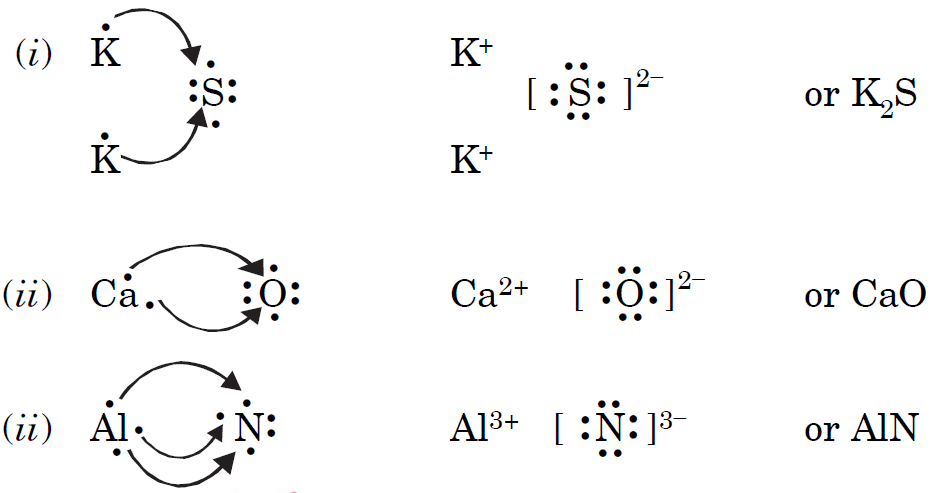
Example.2 : Use Lewis symbols to show electron transfer between the following atoms to form cations and anions :
(i) K and S (ii) Ca and O (iii) Al and N
Lewis symbols to show electron transfer between the following atoms to form cations and anions :
Short Answer Conceptual Types Questions (SAT) on Formation of Ionic (Electrovalent) Bond
What is an ionic or electrovalent bond?
An ionic or electrovalent bond is a chemical bond formed by the complete transfer of one or more electrons from one atom to another. This transfer produces positively and negatively charged ions that are held together by strong electrostatic forces of attraction.
Why do atoms form ionic bonds?
Atoms form ionic bonds to achieve stable electronic configurations, usually by completing their outermost shells. This stability is similar to the electronic configuration of the nearest noble gas.
Which types of elements generally form ionic bonds?
Ionic bonds are usually formed between metals and non-metals. Metals tend to lose electrons and form cations, while non-metals gain electrons and form anions.
How is sodium chloride (NaCl) formed?
Sodium chloride is formed when a sodium atom transfers one electron to a chlorine atom. Sodium becomes Na⁺ and chlorine becomes Cl⁻, and the oppositely charged ions attract each other to form NaCl.
What is electrovalency?
Electrovalency is the number of electrons lost or gained by an atom during the formation of an ionic bond. It is also equal to the charge present on the resulting ion.
What are cations and anions?
Cations are positively charged ions formed by the loss of electrons, whereas anions are negatively charged ions formed by the gain of electrons.
What is the role of ionization enthalpy in ionic bond formation?
Low ionization enthalpy makes it easier for an atom to lose electrons and form a positive ion. Therefore, elements with low ionization enthalpy generally form ionic compounds more readily.
How does electron gain enthalpy affect ionic bond formation?
Atoms with high negative electron gain enthalpy can gain electrons more easily. Such atoms readily form negative ions and promote the formation of ionic compounds.
What is lattice enthalpy?
Lattice enthalpy is the energy released when oppositely charged gaseous ions combine to form one mole of an ionic crystal. A higher lattice enthalpy increases the stability of the ionic compound.
Why is lattice enthalpy important for the stability of ionic compounds?
Lattice enthalpy represents the strength of attraction between ions in the crystal lattice. Greater lattice enthalpy means stronger ionic bonding and higher compound stability.
What conditions favor the formation of ionic compounds?
The formation of ionic compounds is favored when :
The cation-forming atom has low ionization enthalpy.
The anion-forming atom has high negative electron gain enthalpy.
The resulting ionic crystal has high lattice enthalpy.
How is calcium fluoride (CaF₂) formed?
Calcium loses two valence electrons to form a Ca²⁺ ion, while two fluorine atoms each gain one electron to form two F⁻ ions. The electrostatic attraction between these ions results in the formation of calcium fluoride.
What is meant by an electropositive element?
An electropositive element is one that readily loses electrons to form positive ions. Most metals are electropositive in nature.
What is meant by an electronegative element?
An electronegative element is one that readily gains electrons to form negative ions. Non-metals such as fluorine, chlorine, and oxygen are highly electronegative.
What are some common examples of ionic compounds?
Common ionic compounds include sodium chloride (NaCl), calcium fluoride (CaF₂), calcium chloride (CaCl₂), magnesium oxide (MgO), sodium sulphide (Na₂S), and calcium sulphide (CaS).
How are the properties of ionic compounds different from their constituent elements?
Ionic compounds often have properties completely different from the elements that form them. For example, sodium is a reactive metal and chlorine is a poisonous gas, but sodium chloride is a stable and edible salt.
Why are ionic compounds generally stable?
Ionic compounds are stable because the ions attain noble gas configurations and are strongly held together by electrostatic forces within the crystal lattice.
What is the significance of Lewis structures in ionic bonding?
Lewis structures help represent the transfer of electrons between atoms and show how ions are formed during the formation of ionic compounds.
Is achieving an octet the only factor responsible for ionic bond formation?
No. Although attaining an octet contributes to stability, the overall energy changes, especially lattice enthalpy, play a major role in determining whether an ionic compound will form.
Why is the formation of ionic compounds considered an energy-driven process?
Ionic compounds form when the total energy released during electron gain and lattice formation exceeds the energy required for ionization. This overall decrease in energy makes the process favorable and stable.