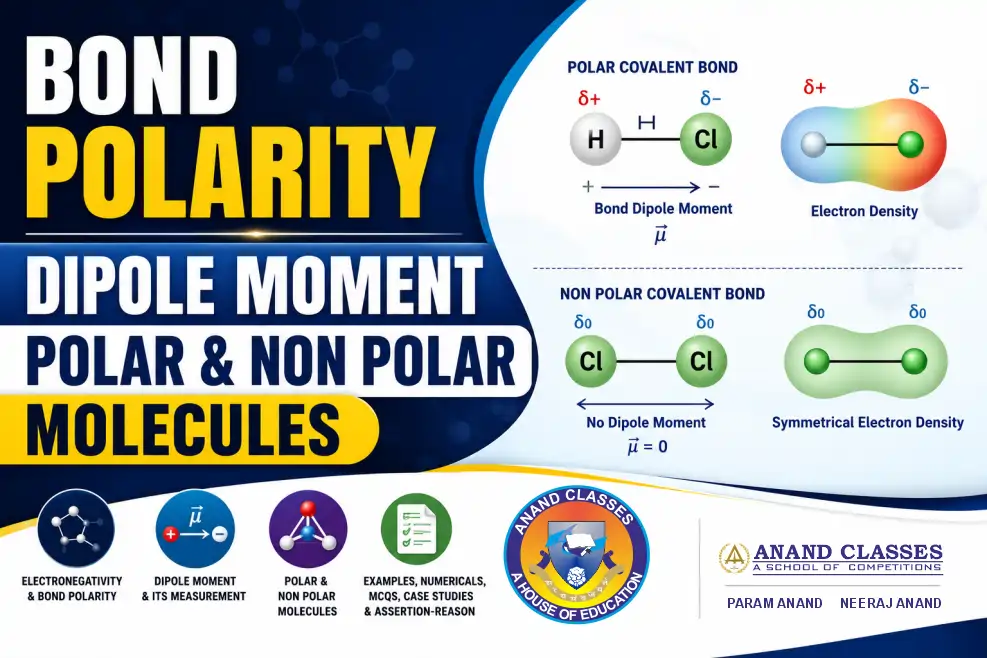
Bond Polarity, Dipole Moment, Polar and Non-Polar Molecules is a comprehensive study resource written by Neeraj Anand of Anand Classes and published by Anand Technical Publishers. This chapter explains how electronegativity difference leads to bond polarity, the formation of polar and non-polar covalent bonds, and the concept of dipole moment as a measure of molecular polarity. It also covers fractional charge, factors affecting dipole moment, molecular geometry, and the distinction between polar and non-polar molecules with solved examples, numericals, MCQs, assertion-reason questions, and case studies. This resource is ideal for CBSE Class 11, JEE Main, JEE Advanced, and NEET preparation.
How to Measure Polarity of Bond ?
The existence of a hundred percent ionic bond or a covalent bond represents an ideal situation. However, in reality no bond is completely covalent or completely ionic. Even in the case of covalent bond between two hydrogen atoms, there is some ionic character.
When a covalent bond is formed between two similar atoms, the shared pair of electrons is equally attracted by the two atoms. As a result of this, the electron pair is situated exactly in between two identical nuclei as shown below :
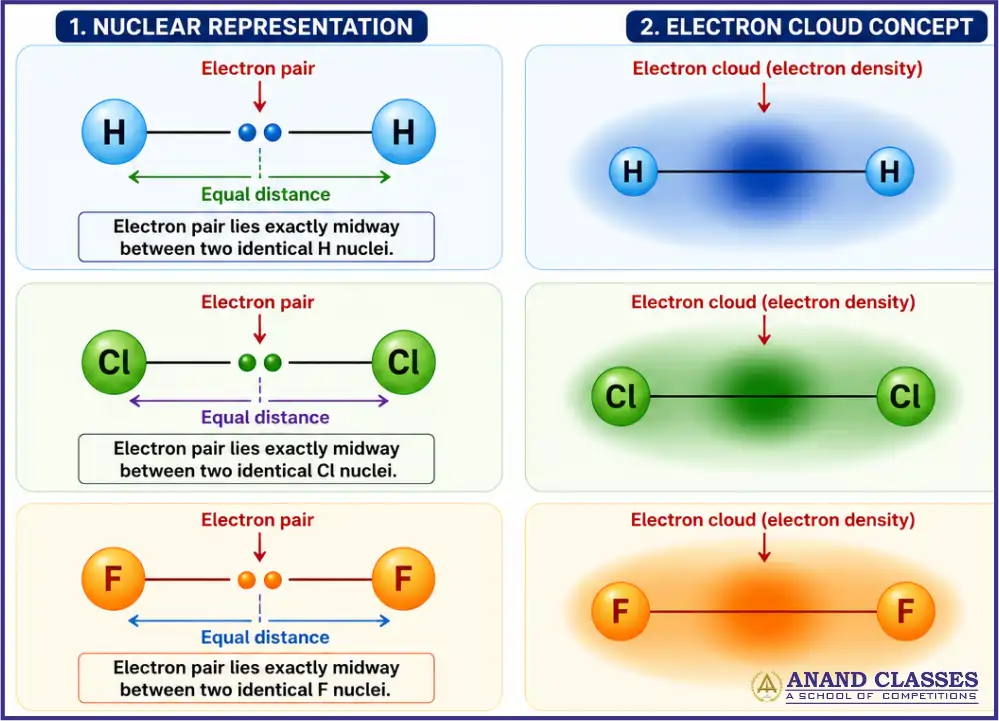
The common examples are H2, O2, N2, Cl2, F2, etc. The bond is known as non-polar covalent bond.
On the other hand, if the atoms forming bonds are different, the electron attracting powers of the two atoms in a bond may differ. Consequently, the shared pair will be displaced towards the atom having more electronegativity.
The electronegativity measures the tendency of an atom to attract the shared pair of electrons towards itself in a covalent bond.
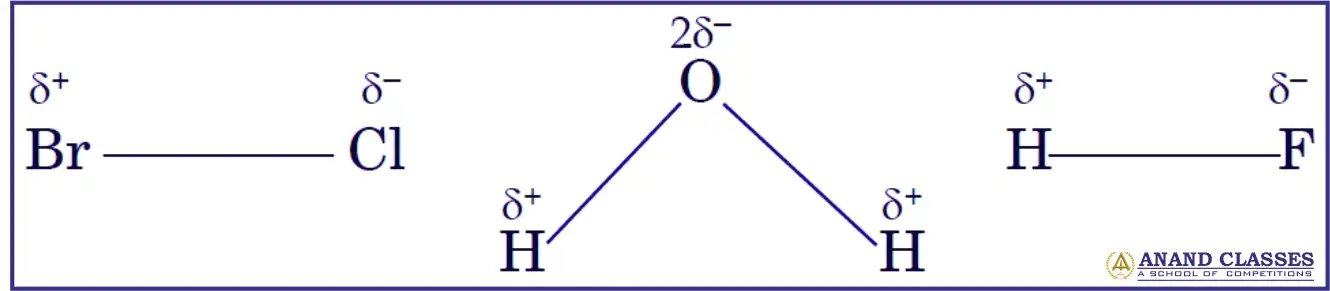
For example, let us consider a molecule of HCl. The electronegativities of Cl and H are 3.0 and 2.1 respectively. Due to the larger electronegativity of chlorine, the bonding pair will be attracted more towards chlorine atom. Therefore, chlorine atom will experience more negative charge around it and the other atom will experience as if it has lost some of its negative charge. Due to this, the chlorine end of the molecule will acquire slightly negative charge and the hydrogen end
will have slightly positive charge. These are represented as δ – and δ+ (delta meaning small) charges. Such molecules having two oppositely charged poles are called polar molecules and the bond is said to be polar covalent bond.

The magnitude of electronegativity difference reflects the degree of polarity. Greater the difference in the electronegativities of the atoms forming the bond, greater will be the charge separation and hence greater will be the polarity of the molecule.
Similarly, molecules such as BrCl, H2O, HF, etc. are also polar molecules.
Important concepts connected to this topic are Resonance Structures characteristics, conditions, Resonance energy
What is Dipole Moment ? Why Dipole Moment is a measure of Degree of Polarity ?
In the case of polar molecules, the centre of negative charge does not coincide with the centre of positive charge. Such molecules having two equal and opposite charges separated by certain distance are said to possess electric dipole.
For example, a molecule like HCl behaves like a dipole. Since the molecule as a whole is electrically neutral, the negative charge is always equal to the positive charge. The degree of polarity in the molecule is expressed by a term known as dipole moment.
Define Dipole Moment
Dipole moment is defined as the product of the magnitude of the charge and the distance of separation between the charges.
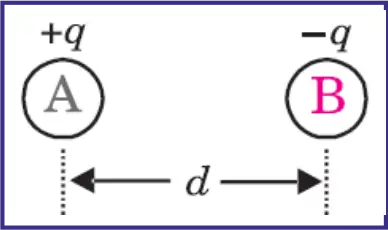
It is usually represented by a Greek letter ‘μ’.
Mathematically,
dipole moment (μ) = charge (q) × distance of separation (d)
μ = q × d
where q = charge on any of the atoms
d = distance between the atoms
Since the charge ‘q’ is of the order of 10–10 e.s.u and the intermolecular distance ‘d’ is of the order of 10–8 cm (i.e., 1 Å), therefore, the dipole moment ‘μ’ is of
the order of 10–10 × 10–8 i.e., 10–18 esu cm. This quantity is called 1 Debye and is denoted by the symbol ‘D’. Thus,
1D = 1 × 10–18 esu cm
For example, dipole moment of HCl molecule is 1.03 D and that of H2O is 1.85 D.
In SI units, dipole moment is expressed in the units of Cm (Coulomb meter); as
1 esu = (1.602 × 10⁻¹⁹/4.803 10-10) = 3.335 × 10⁻¹⁰C
and 1 cm = 10–2 m
1 D = 10–18 esu cm = 10–18 (3.335 × 10⁻¹⁰C) × (10–2 m) = 3.335 × 10⁻³⁰ Cm
Dipole moment is a vector quantity and is represented by a small arrow with tail at the positive centre and head pointing towards the negative centre.
For example, the dipole of HCl may be represented as :
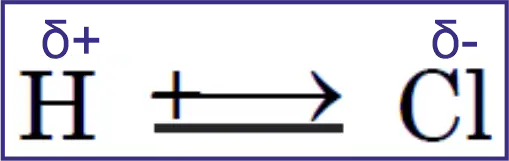
The shift in electron density is symbolised by crossed arrow (↣) above the Lewis structure to indicate the direction of the shift.
Important exam-related topics include Bond Parameters-Bond length, Bond angle, Bond dissociation energy (enthalpy)
CBSE Board Question
The dipole moment of an HBr molecule is 0.78 D and the bond length is 1.41 Å. Calculate the fractional charges (δ) on the H and Br atoms. (Electronic charge, e = 4.8 × 10⁻¹⁰ esu)
Solution :
The dipole moment is given by:
μ = q × r
Therefore,
q = μ / r
Given:
- Dipole moment, μ = 0.78 D = 0.78 × 10⁻¹⁸ esu·cm
- Bond length, r = 1.41 Å = 1.41 × 10⁻⁸ cm
Substituting the values,
q = (0.78 × 10⁻¹⁸) / (1.41 × 10⁻⁸) = 0.55 × 10⁻¹⁰ esu
Now,
Fractional charge (δ) = Charge present / Electronic charge
δ = q / e
Substituting the values,
δ = (0.55 × 10⁻¹⁰) / (4.8 × 10⁻¹⁰)
δ = 0.11
Hence,
δ(H) = +0.11
δ(Br) = –0.11
The fractional charges on the atoms in the HBr molecule are:
Bromine (Br): –0.11
Hydrogen (H): +0.11
To understand this topic better, learn about Characteristic Properties of Covalent Compounds
One or Two Mark Conceptual Questions and Answers for Class 11 Chemistry CBSE Board Exam
Why is the H₂ molecule non-polar while the HCl molecule is polar?
In the H₂ molecule, both hydrogen atoms have the same electronegativity. Therefore, the shared electron pair is attracted equally by both atoms and remains exactly midway between them. As a result, no charge separation occurs, making H₂ a non-polar covalent molecule.
In HCl, chlorine is more electronegative than hydrogen. Hence, the shared electron pair is pulled towards the chlorine atom, creating partial charges (δ⁺ on H and δ⁻ on Cl). Therefore, HCl is a polar covalent molecule.
Learn more about Octet Rule Exceptions, Incomplete and Expanded Octet of central atom, Odd Electron molecules
What is the effect of electronegativity difference on bond polarity?
Bond polarity depends upon the difference in electronegativity between the bonded atoms.
- Smaller electronegativity difference → Lower polarity
- Larger electronegativity difference → Higher polarity
Thus, the greater the electronegativity difference, the greater is the separation of charges and the more polar is the bond.
To understand this topic better, learn about Formal Charge Calculation Formula from Lewis structure
Why does every polar molecule possess a dipole moment?
A polar molecule contains partial positive and partial negative charges separated by a certain distance. This separation of opposite charges creates an electric dipole. Therefore, every polar molecule possesses a dipole moment whose magnitude depends on both the amount of charge separation and the distance between the charges.
For better understanding, also read What is Chemical Bond ? Why do Atoms Combine ? How do Atoms Combine ?
Why is dipole moment considered the measure of bond polarity?
Dipole moment depends on both:
- Magnitude of the charge developed on the atoms.
- Distance between the charges.
Since both these factors increase with increasing polarity, dipole moment provides a direct measure of the degree of polarity of a bond or molecule.
Students should also study Lewis Electron Dot (Symbols) Structure Theory and its Significance
Multiple Choice Questions (MCQs) for Class 11 Chemistry CBSE Board Exam
Which of the following molecules is non-polar?
A. HF
B. HCl
C. Cl₂
D. H₂O
Answer: C. Cl₂
Which of the following has the highest bond polarity?
A. H₂
B. Cl₂
C. HF
D. Br₂
Answer: C. HF
The SI unit of dipole moment is
A. Debye
B. Coulomb metre (Cm)
C. esu
D. Newton
Answer: B. Coulomb metre (Cm)
One Debye is equal to
A. 10⁻¹⁶ esu cm
B. 10⁻¹⁸ esu cm
C. 10⁻²⁰ esu cm
D. 10⁻¹² esu cm
Answer: B. 10⁻¹⁸ esu cm
The direction of dipole moment is from
A. Negative end to positive end
B. Positive end to negative end
C. Towards the larger atom only
D. Depends upon bond length
Answer: B. Positive end to negative end
Master related concepts such as Ionic or Electrovalent Bond Explanation, Examples, Factors Affecting Formation of Ionic Bonds
Numerical Problems for Class 11 Chemistry CBSE Board Exam
Calculate the dipole moment of a molecule if the charge on each atom is 1.6 × 10⁻¹⁰ esu and the distance between them is 1.5 Å.
Solution
Given:
Charge, q = 1.6 × 10⁻¹⁰ esu
Distance, d = 1.5 Å = 1.5 × 10⁻⁸ cm
Using, μ = q × d
μ = (1.6 × 10⁻¹⁰) × (1.5 × 10⁻⁸)
μ = 2.4 × 10⁻¹⁸ esu cm
μ = 2.4 D
Answer: 2.4 Debye
A molecule has a dipole moment of 2.0 D and bond length of 2.0 Å. Calculate the magnitude of charge on each atom.
Solution
Given: Dipole moment, μ = 2.0 × 10⁻¹⁸ esu cm
Bond length, r = 2.0 × 10⁻⁸ cm
Using, q = μ / r
q = (2.0 × 10⁻¹⁸) / (2.0 × 10⁻⁸)
q = 1.0 × 10⁻¹⁰ esu
Answer: Charge on each atom = 1.0 × 10⁻¹⁰ esu
Calculate the fractional charge if the charge on an atom is 0.72 × 10⁻¹⁰ esu. (Electronic charge = 4.8 × 10⁻¹⁰ esu)
Solution
Using, δ = q / e
δ = (0.72 × 10⁻¹⁰) / (4.8 × 10⁻¹⁰)
δ = 0.15
Answer: Fractional charge = 0.15
Arrange the following bonds in increasing order of polarity:
H–H, H–Cl, H–F, Cl–Cl
Answer:
H–H = Cl–Cl < H–Cl < H–F
Bond polarity increases with increasing electronegativity difference.
Assertion and Reason Questions for Class 11 Chemistry CBSE Board Exam
Assertion (A): H₂ is a non-polar molecule.
Reason (R): The bonding electron pair is equally shared between the two hydrogen atoms.
Answer: A and R are true, and R is the correct explanation of A.
Assertion (A): HCl is a polar covalent molecule.
Reason (R): Chlorine is more electronegative than hydrogen.
Answer: A and R are true, and R is the correct explanation of A.
Assertion (A): Dipole moment is zero for every covalent molecule.
Reason (R): Covalent bonds involve sharing of electrons.
Answer: Assertion is false, but Reason is true.
Assertion (A): Greater the electronegativity difference between two bonded atoms, greater is the bond polarity.
Reason (R): Larger electronegativity difference causes greater displacement of the shared electron pair.
Answer: A and R are true, and R is the correct explanation of A.
Assertion (A): HF has a higher dipole moment than HCl because fluorine is more electronegative than chlorine.
Reason (R): Dipole moment depends only on electronegativity difference.
Answer: Assertion is true, but Reason is false.
(Dipole moment depends on both charge separation and bond length.)
Assertion (A): Dipole moment is a vector quantity.
Reason (R): It has both magnitude and direction.
Answer: A and R are true, and R is the correct explanation of A.
Assertion (A): A molecule may contain polar bonds but still have zero dipole moment.
Reason (R): The bond dipoles may cancel each other because of molecular geometry.
Answer: A and R are true, and R is the correct explanation of A.
Assertion (A): CO₂ is a non-polar molecule.
Reason (R): The dipole moments of the two C=O bonds cancel because the molecule is linear.
Answer: A and R are true, and R is the correct explanation of A.
Case Study–1: Bond Polarity
Three students were discussing chemical bonding.
- Student A says that H₂ and Cl₂ are non-polar molecules.
- Student B says that HCl is a polar molecule because chlorine attracts the shared electron pair more strongly.
- Student C says that the greater the electronegativity difference between two atoms, the greater is the polarity of the bond.
Answer the following questions.
Q1. Why are H₂ and Cl₂ non-polar molecules?
Answer:
Because the bonded atoms have the same electronegativity and share the bonding electrons equally.
Q2. Which atom carries partial negative charge in HCl?
Answer:
Chlorine (Cl) carries the partial negative charge (δ⁻).
Q3. Which property is responsible for bond polarity?
Answer:
Difference in electronegativity between the bonded atoms.
Q4. Which of the following has the highest bond polarity?
(a) H₂
(b) Cl₂
(c) HCl
(d) HF
Answer: (d) HF
Q5. Which statement is correct?
(a) All covalent bonds are non-polar.
(b) All polar molecules contain dipole moment.
(c) Every molecule containing hydrogen is polar.
(d) Electronegativity has no effect on polarity.
Answer: (b) All polar molecules contain dipole moment.
Case Study–2: Dipole Moment
A chemist measured the dipole moments of several molecules.
| Molecule | Dipole Moment (D) |
|---|---|
| H₂ | 0 |
| Cl₂ | 0 |
| HCl | 1.03 |
| H₂O | 1.85 |
| NH₃ | 1.47 |
Based on the above data, answer the following.
Q1. Which molecules are non-polar?
Answer:
H₂ and Cl₂
Q2. Which molecule has the highest dipole moment?
Answer:
H₂O
Q3. What does zero dipole moment indicate?
Answer:
It indicates that the centres of positive and negative charges coincide, making the molecule non-polar.
Q4. Arrange the molecules in increasing order of dipole moment.
Answer:
H₂ = Cl₂ < HCl < NH₃ < H₂O
Q5. Which statement is correct?
(a) Dipole moment is a scalar quantity.
(b) Dipole moment is measured in Debye.
(c) Non-polar molecules always have ionic bonds.
(d) Bond length has no effect on dipole moment.
Answer: (b) Dipole moment is measured in Debye.