
Dipole Moment of diatomic and polyatomic molecules and Molecular Structure
Dipole moment of diatomic and polyatomic molecules is an important concept in CBSE Class 11 Chemistry that helps explain the distribution of electrical charge within a molecule. It depends on both the polarity of individual chemical bonds and the overall molecular geometry. While diatomic molecules have a dipole moment determined by the difference in electronegativity between the two bonded atoms, the dipole moment of polyatomic molecules is influenced by the vector sum of all bond dipoles and the molecular shape. Understanding the relationship between dipole moment and molecular structure enables students to predict molecular polarity, bond characteristics, and various physical and chemical properties of substances.
Dipole Moments of Diatomic Molecules
A diatomic molecule has two atoms bonded to each other by a covalent bond. In such a molecule, the dipole moment of the bond (known as bond dipole) also gives the dipole moment of the molecule. Thus, a diatomic molecule is polar, if the bond formed between the atoms is polar. For example, dipole moment of HCl molecule is the same as that of H—Cl bond, (μ = 1.07 D).
Greater the electronegativity difference between the atoms, more will be the dipole moment of such molecules. For example, the dipole moment of hydrogen halides decreases with decreasing electronegativity of the halogen atom.
| Bond | H–F | H–Cl | H–Br | H–I |
|---|---|---|---|---|
| Electronegativity of halogen atom | 4.0 | 3.0 | 2.8 | 2.5 |
| Dipole moment (D) | 1.78 | 1.07 | 0.79 | 0.38 |
Order of dipole moments : HF > HCl > HBr > HI
Enhance your preparation with Bond Polarity, Dipole Moment, Polar and Non Polar Molecules
Dipole Moments of Polyatomic Molecules
In case of polyatomic molecules (containing more than two atoms), the dipole moment not only depends upon the individual dipole moments of the bonds (called bond dipoles) but also on the spatial arrangement of the various bonds in the molecule. In such cases, the dipole moment of a molecule is the vector sum of the dipole moments of various bonds and the molecular shape.
For complete preparation, also study How to Measure Polarity of Bond ?
Why is carbon dioxide a nonpolar molecule, even though the C-O bonds are polar? Carbon dioxide (CO2) and water (H2O) are both triatomic molecules but why dipole moment of carbon dioxide is zero whereas, that of water is 1.84 D
Carbon dioxide (CO2) and water (H2O) are both triatomic molecules but dipole moment of carbon dioxide is zero whereas, that of water is 1.84 D. This can be explained on the basis of their structures.
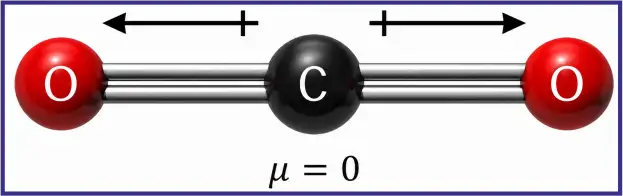
Carbon dioxide is a linear molecule in which the two C = O bonds are oriented in the opposite directions at an angle of 180°. The dipole moment of each C = O bond is 2.3 D but due to linear geometry of CO2, the dipole moment of one C = O bond cancels that of another. Therefore, the resultant dipole moment of the molecule is zero. Hence, CO2 is a non-polar molecule.
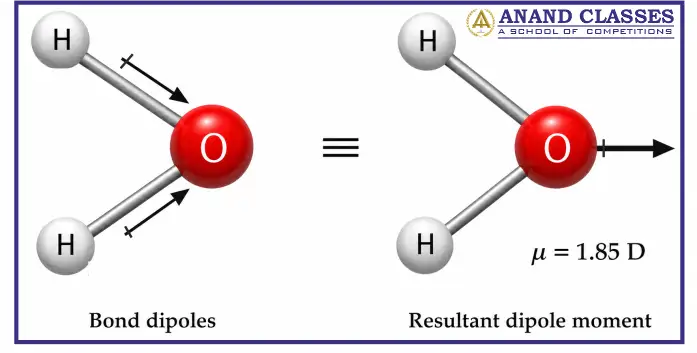
On the other hand, water molecule has a bent structure in which the two O—H bonds are oriented at an angle of 104.5°. The dipole moment of water is 1.85 D (or 1.85 × 3.335 × 10–30 Cm = 6.17 × 10⁻³⁰ Cm) , which is the resultant of the dipole moments of two O—H bonds.
Learn the applications of this concept in What is Resonance ? How to draw resonance structures and why resonance hybrid is most stable structure ? Explain and draw resonance structures of Ozone (O3) molecule ?
Why dipole moment of BeF2 is zero ?
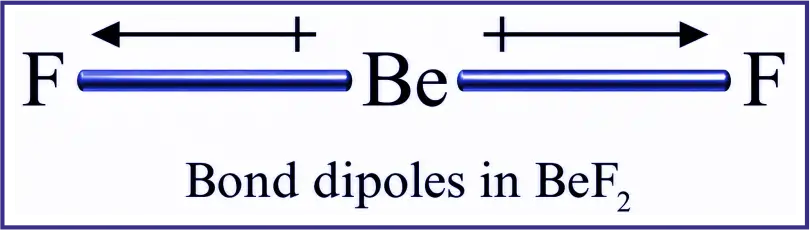
The dipole moment in case of BeF2 is zero. This is because the molecule is linear and the two equal bond dipoles point in opposite directions. These bond dipoles cancel the effect of each other giving a net zero dipole moment.
Gain deeper understanding by studying Explain and draw resonance structures of carbon dioxide (CO2) molecule ?
Why is BF₃ a non-polar molecule and is NH₃ a polar molecule yet both has polar bonds and are triatomic in nature ?
Let us consider tetra-atomic molecules such as BF3 and NH3. The dipole moment of BF3 molecule is zero while that of NH3 is 1.47 D or 4.90 × 10⁻³⁰ Cm. This suggests that BF3 molecule has symmetrical structure in which the three B—F bonds are oriented at an angle of 120° to one another. The three bonds lie in one plane and the dipole moments of these bonds cancel one another giving net dipole moment equal to zero.
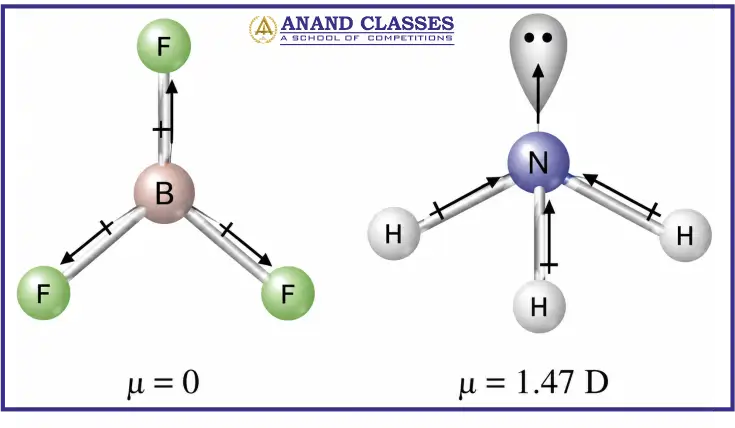
On the other hand, the ammonia molecule has pyramidal structure. The individual bond dipole moments of three N—H bonds give the resultant dipole moment of NH3 molecule as 1.47 D.
Thus, it may be concluded that the presence of polar bonds in a polyatomic molecule does not mean that the molecule as a whole will always have dipole moment. In some cases, the arrangement of individual bonds in the molecule is such that the net dipole moment of the molecule is zero.
Important exam-related topics include What is Bond angle and How Bond angle is expressed ?
Why dipole moments of methane (CH4) and carbon tetrachloride (CCl4) molecules are zero but dipole moment of CHCl3 (chloroform) is non zero yet all are tetratomic molecules and has polar bonds ?
For example, as discussed earlier, the net dipole moments of carbon dioxide and boron trifluoride molecules are zero. Similarly, the dipole moments of methane (CH4) and carbon tetrachloride (CCl4) molecules are zero because of the symmetrical tetrahedral shapes of these molecules.
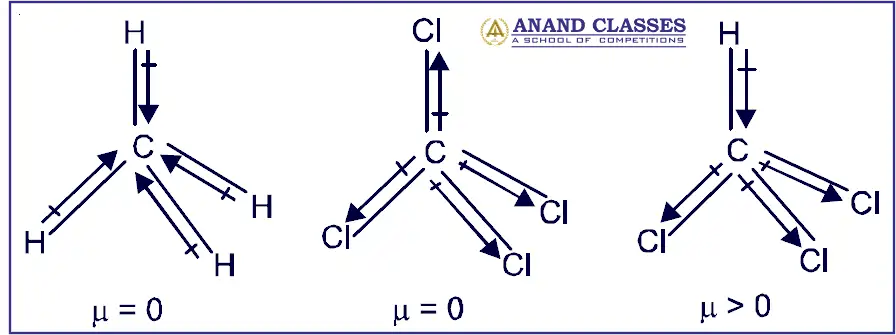
However, the dipole moment of CHCl3 (chloroform) is not zero because all the bonds are not same. The resultant of bond dipole moments of three C—Cl bonds is not cancelled by bond dipole moment of C—H bond.
For complete preparation, also study Define bond dissociation enthalpy and Why is bond dissociation enthalpy considered a measure of bond strength?
Why dipole moment of ammonia (NH3) is larger than nitrogen trifluoride (NF3) ?
Both NH3 and NF3 molecules have pyramidal shape with one lone pair on nitrogen atom. Fluorine is more electronegative than hydrogen and therefore, the N–F bonds should be more polar than N–H bonds. Consequently, the resultant dipole moment of NF3 should be much larger than that of NH3.
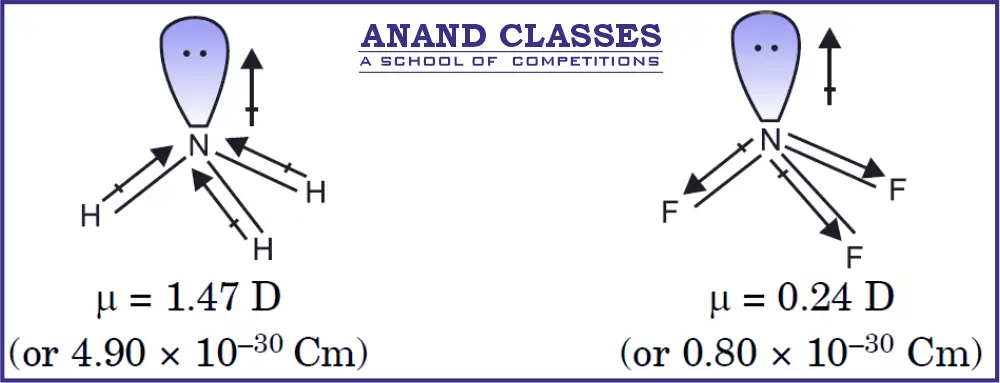
However, the dipole moment of ammonia (μ = 1.47 D) is larger than that of NF3 (μ = 0.24 D). The anomalous behaviour can be explained due to the presence of lone pair on nitrogen. In case of NH3, nitrogen is more electronegative than H [electronegativity of N(3.0) and of H(2.1)] and therefore, the dipole of N–H bond is from H to N. The orbital dipole due to lone pair is in the same direction as the resultant dipole moment of the three N–H bonds. Therefore, it adds on the resultant dipole moment of the N–H bonds.
On the other hand, in case of NF3, fluorine is more electronegative than nitrogen [electronegativity of F(4.0) and of N(3.0)] and therefore, the dipole of N–F bond is from N to F. The orbital dipole is in the opposite direction to the resultant dipole moment of the three N–F bonds. Thus, the lone pair moment cancels the resultant N–F bond moments. Consequently, the dipole moment of NF3 is low.
Explore detailed notes on Learn Lattice Enthalpy of Ionic Crystals and Important General Properties of Ionic Compounds for Class 11 Chemistry Chapter 4 Chemical Bonding and Molecular Structure
Important Dipole Moments and Molecular Geometries of Common Molecules for CBSE Class 11 Chemistry
The dipole moments of some molecules are given in following Table.
| Type of Molecule | Example | Dipole Moment, μ (D) | Geometry |
|---|---|---|---|
| AB | HF | 1.78 | Linear |
| HCl | 1.07 | Linear | |
| HBr | 0.79 | Linear | |
| HI | 0.38 | Linear | |
| H₂ | 0.00 | Linear | |
| AB₂ | H₂O | 1.85 | Bent |
| H₂S | 0.95 | Bent | |
| CO₂ | 0.00 | Linear | |
| BeF₂ | 0.00 | Linear | |
| CS₂ | 0.00 | Linear | |
| AB₃ | NH₃ | 1.47 | Trigonal pyramidal |
| NF₃ | 0.24 | Trigonal pyramidal | |
| BF₃ | 0.00 | Trigonal planar | |
| AB₄ | CH₄ | 0.00 | Tetrahedral |
| CHCl₃ | 1.04 | Tetrahedral | |
| CCl₄ | 0.00 | Tetrahedral |
Build strong concepts by studying What is Chemical Bond ? Why do Atoms Combine ? How do Atoms Combine ?
Conceptual Short Questions and Answers for CBSE Class 11 Chemistry
What is a dipole moment?
Answer
A dipole moment is the measure of the polarity of a bond or a molecule. It indicates how much the positive and negative charges are separated within a molecule.
When two atoms form a covalent bond, they may not share electrons equally. The atom with higher electronegativity attracts the shared electrons more strongly. As a result:
- The more electronegative atom develops a partial negative charge (δ–).
- The less electronegative atom develops a partial positive charge (δ+).
This separation of charges creates a dipole, and the strength of this dipole is called the dipole moment.
The symbol for dipole moment is μ (mu).
The common unit of dipole moment is Debye (D).
What is a diatomic molecule?
Answer
A diatomic molecule is a molecule made up of only two atoms joined together by a covalent bond.
Examples include: HF, HCl, HBr, HI, CO
Since a diatomic molecule has only one bond, it has only one bond dipole.
Why is the dipole moment of a diatomic molecule equal to its bond dipole?
Answer
A diatomic molecule contains only one covalent bond. Since there are no other bonds, there is only one bond dipole present. Therefore, the dipole moment of the bond itself becomes the dipole moment of the entire molecule.
For example, in HCl:
- Chlorine is more electronegative than hydrogen.
- The shared electrons move closer to chlorine.
- Hydrogen becomes partially positive.
- Chlorine becomes partially negative.
Thus, the HCl molecule has the same dipole moment as the H–Cl bond.
When is a diatomic molecule polar?
Answer
A diatomic molecule is polar when its two atoms have different electronegativities. Because of the difference in electronegativity, the electrons are shared unequally, producing one positive end and one negative end.
Examples: HF, HCl, HBr, HI
These are all polar molecules.
If both atoms have the same electronegativity, the electrons are shared equally and no dipole is formed.
Example: H₂, O₂, Cl₂
These molecules are non-polar.
Why does dipole moment increase with electronegativity difference?
Answer
Electronegativity is the tendency of an atom to attract shared electrons. When the electronegativity difference between two atoms is large:
- Electrons are pulled more strongly toward one atom.
- The positive and negative charges become more separated.
- The bond becomes more polar.
Therefore, the dipole moment increases.
In hydrogen halides, fluorine is the most electronegative atom, followed by chlorine, bromine, and iodine.
As the electronegativity decreases from fluorine to iodine, the dipole moment also decreases.
| Bond | Electronegativity of Halogen | Dipole Moment |
|---|---|---|
| H–F | 4.0 | 1.78 D |
| H–Cl | 3.0 | 1.07 D |
| H–Br | 2.8 | 0.79 D |
| H–I | 2.5 | 0.38 D |
Order of Dipole Moments : HF > HCl > HBr > HI
Why does HF have the highest dipole moment among hydrogen halides?
Answer
Fluorine is the most electronegative element. Because of this :
- It attracts the bonding electrons much more strongly than chlorine, bromine, or iodine.
- The H–F bond has the greatest polarity.
- The separation of charges is the largest.
As a result, HF has the highest dipole moment among all hydrogen halides.
On what factors does the dipole moment of a polyatomic molecule depend?
Answer
In polyatomic molecules, the dipole moment depends on two important factors.
1. Bond Dipoles
Each polar bond has its own dipole moment. The greater the bond polarity, the larger the bond dipole.
2. Molecular Shape
The arrangement of the bonds determines whether the individual bond dipoles add together or cancel each other. Therefore, the molecular dipole moment depends on both bond polarity and molecular geometry.
What is meant by the vector sum of dipole moments?
Answer
A dipole moment has both magnitude and direction, so it behaves like a vector. When a molecule contains several bonds, the individual bond dipoles combine according to their directions. There are three possibilities.
Case 1: Bond dipoles act in the same direction
They add together and results large dipole moment.
Case 2: Bond dipoles act in opposite directions
They cancel each other and results zero dipole moment.
Case 3: Bond dipoles are at an angle
They cancel only partially and results a non-zero dipole moment.
Why is carbon dioxide non-polar although each C=O bond is polar?
Answer
Each carbon-oxygen bond is polar because oxygen is more electronegative than carbon. However, the molecule has a linear shape.
Structure:
O = C = O
The bond angle is 180°. The two C=O bond dipoles are equal in magnitude but point in exactly opposite directions. One dipole pulls toward the left oxygen, while the other pulls toward the right oxygen. Since they are equal and opposite, they completely cancel each other. Therefore, the overall dipole moment of carbon dioxide is zero. Hence, CO₂ is a non-polar molecule.
Why is the dipole moment of CO₂ zero?
Answer
Each C=O bond has the same dipole moment. Because CO₂ is linear, the two equal bond dipoles point in opposite directions. As a result, one dipole cancels the other completely. Therefore, the net dipole moment is zero.
Why is water a polar molecule?
Answer
Water contains two polar O–H bonds. However, unlike CO₂, water is not linear. It has a bent (V-shaped) structure with a bond angle of about 104.5°.
Since the bond dipoles are not opposite to each other, they cannot cancel completely. Instead, they combine to produce a net dipole moment. Therefore, water has a dipole moment of 1.85 D and is a polar molecule.
Why do CO₂ and H₂O have different dipole moments even though both are triatomic molecules?
Answer
Both molecules contain three atoms, but their shapes are different.
Carbon dioxide (CO₂):
- Linear shape
- Bond angle of 180°
- Bond dipoles cancel completely
- Dipole moment is zero
- Non-polar molecule
Water (H₂O):
- Bent shape
- Bond angle of 104.5°
- Bond dipoles do not cancel
- Dipole moment is 1.85 D
- Polar molecule
Thus, molecular shape determines whether bond dipoles cancel or add together.
Why is BeF₂ a non-polar molecule?
Answer
Beryllium fluoride (BeF₂) contains two highly polar Be–F bonds because fluorine is much more electronegative than beryllium. At first glance, one might expect the molecule to be polar. However, the shape of the molecule changes everything.
BeF₂ has a linear structure, which means the two fluorine atoms are located on opposite sides of the beryllium atom. The bond angle is 180°. Each Be–F bond has an equal dipole moment, but the dipoles point in opposite directions. Since they are equal and opposite, they completely cancel each other. Therefore, the overall dipole moment becomes zero.
Why is BF₃ a non-polar molecule?
Answer
Each B–F bond in boron trifluoride (BF₃) is highly polar because fluorine is much more electronegative than boron. However, BF₃ has a trigonal planar structure.
In this structure:
- Three fluorine atoms surround the boron atom.
- The bond angle between each bond is 120°.
- All three bonds lie in the same plane.
Since all three B–F bond dipoles are equal and arranged symmetrically, they pull equally in different directions. As a result, the dipoles cancel one another completely. Therefore, the net dipole moment becomes zero.
Why is NH₃ a polar molecule?
Answer
Ammonia (NH₃) contains three N–H bonds. Nitrogen is more electronegative than hydrogen, so each N–H bond is polar. Unlike BF₃, ammonia has a trigonal pyramidal structure. This shape is formed because nitrogen has one lone pair of electrons. The lone pair pushes the three N–H bonds downward, making the molecule asymmetrical. Because of this asymmetrical shape:
- The three bond dipoles cannot cancel each other.
- Their combined effect produces a net dipole moment.
Therefore, ammonia is a polar molecule. Its dipole moment is 1.47 D.
Why is BF₃ non-polar but NH₃ polar?
Answer
Although both BF₃ and NH₃ contain three bonds around the central atom, their molecular shapes are different.
In BF₃
- Shape is trigonal planar.
- The molecule is perfectly symmetrical.
- The three bond dipoles cancel one another.
- Net dipole moment is zero.
In NH₃
- Shape is trigonal pyramidal.
- One lone pair is present on nitrogen.
- The molecule is unsymmetrical.
- Bond dipoles do not cancel.
Therefore, BF₃ is non-polar, whereas NH₃ is polar.
Does every molecule containing polar bonds become a polar molecule?
Answer
No. Having polar bonds does not always mean that the entire molecule will be polar. Whether a molecule is polar depends on the arrangement of the bond dipoles. There are two possibilities.
Case.1 : Symmetrical molecules
If the molecule is symmetrical, the bond dipoles cancel one another. The molecule becomes non-polar.
Examples: CO₂, BF₃, BeF₂, CH₄, CCl₄
Case.2 : Unsymmetrical molecules
If the molecule is unsymmetrical, the bond dipoles do not cancel completely. The molecule becomes polar.
Examples: H₂O, NH₃, CHCl₃
Why are CH₄ and CCl₄ non-polar molecules?
Answer
Methane (CH₄) and carbon tetrachloride (CCl₄) both have a tetrahedral structure. In these molecules:
- Four identical atoms surround the central carbon atom.
- The four bonds are arranged symmetrically.
Although C–Cl bonds are polar in CCl₄, all four bond dipoles are equal. Because of the symmetrical tetrahedral arrangement, the dipoles cancel one another completely.
Similarly, in CH₄ the C–H bonds are arranged symmetrically, resulting in complete cancellation.
Therefore, both CH₄ and CCl₄ have zero dipole moment.
Why is CHCl₃ a polar molecule?
Answer
Chloroform (CHCl₃) also has a tetrahedral structure. However, unlike CCl₄, it is not symmetrical.In CHCl₃ three chlorine atoms are attached to carbon and one hydrogen atom replaces the fourth chlorine. Since hydrogen and chlorine have different electronegativities, the four bond dipoles are not equal.
The stronger C–Cl bond dipoles are not completely balanced by the weaker C–H bond dipole. Therefore, complete cancellation does not occur. As a result, CHCl₃ has a non-zero dipole moment.
Which molecule has the greater dipole moment: NH₃ or NF₃?
Answer
Although fluorine is more electronegative than hydrogen, ammonia (NH₃) has a much larger dipole moment.
- NH₃ = 1.47 D
- NF₃ = 0.24 D
This is due to the effect of the lone pair on nitrogen. (Explain above)
Why would NF₃ be expected to have a larger dipole moment?
Answer
Fluorine is the most electronegative element. Therefore each N–F bond is more polar than an N–H bond and greater bond polarity usually produces a larger dipole moment. Based only on bond polarity, one would expect NF₃ to have a larger dipole moment than NH₃. However, molecular dipole moment also depends on the direction of the bond dipoles and the lone-pair dipole.
Why is the dipole moment of NH₃ greater than that of NF₃?
Answer
The difference is due to the direction of the lone-pair dipole relative to the bond dipoles.
In NH₃, Nitrogen is more electronegative than hydrogen. Therefore, each N–H bond dipole points towards the nitrogen atom. Nitrogen also has one lone pair of electrons. The lone-pair dipole is directed towards the nitrogen atom as well.
Thus the lone-pair dipole and the resultant N–H bond dipole act in the same direction. They reinforce (add to) each other. As a result, NH₃ has a relatively large dipole moment of 1.47 D.
In NF₃, Fluorine is more electronegative than nitrogen. Therefore, each N–F bond dipole points away from the nitrogen atom and towards the fluorine atoms. However, the lone-pair dipole remains directed towards the nitrogen atom. Thus the lone-pair dipole acts in the opposite direction to the resultant of the three N–F bond dipoles. The two effects partially cancel each other. As a result, NF₃ has a much smaller dipole moment of 0.24 D.
| Exam Tip |
|---|
| To determine whether a molecule is polar, always follow these steps : |
| 1. Check whether the bonds are polar. 2. Identify the molecular shape using VSEPR theory. 3. Determine whether the bond dipoles cancel due to symmetry. 4. Consider the effect of lone pairs, if present. 5. Conclude whether the molecule has a zero or non-zero dipole moment. |
Important Classification of Elements and Periodicity in Properties Chapter Interlinks
This section provides a complete and interconnected study of Classification of Elements and Periodicity in Properties, starting with detailed theory and notes for Class 11 Chemistry to build a strong conceptual foundation. You can explore atomic radius and its types including covalent, van der Waals, metallic, and ionic radii to understand periodic trends in atomic size. It also includes Screening Effect (Shielding Effect) : Calculation of Effective or Reduced Nuclear Charge (Slater’s Rules), which explains how inner electrons reduce the nuclear attraction on outer electrons and influence periodic trends. In addition, topics like Radius of Cation is Less and Anion is More Than Its Parent Atom, Size Variation in Isoelectronic Series help explain how ionic size changes due to gain or loss of electrons and how nuclear charge affects size in species with the same number of electrons. The causes of periodicity explain why elements show repeating properties based on electronic configuration, which is further supported by the modern periodic law and structure of the modern periodic table including groups, periods, and blocks for elements even beyond atomic number 100. The historical development is covered through Mendeleev’s periodic law and table, leading to the modern classification of elements into s, p, d, and f blocks with prediction of period, group, and block. To strengthen exam preparation, you can practice JEE Main PYQs, IMU CET PYQs and Merchant Navy sponsorship exam MCQs, and other previous year questions with solutions, along with solved examples, conceptual questions, and practice problems on the modern periodic table. Learn more in this section also to radius of cation is less and anion is more than its parent atom and size variation in Isoelectronic Series. Additionally, complete study material, mock tests, and guidance are provided under Anand Classes Chemistry notes, along with expert support from Er Neeraj Anand, making this section a comprehensive resource for competitive exam preparation.