Diagonal Relationship and Anomalous Properties of Second Period Elements are important concepts in the classification of elements and periodicity in properties. Although elements in the same group generally show similar chemical properties, the first element of each group often differs significantly from the remaining members. This unusual behaviour is called anomalous behaviour and is mainly due to small atomic size, high ionization enthalpy, high electronegativity, and absence of vacant d-orbitals. Certain second period elements also show similarities with diagonally placed third period elements, known as diagonal relationship. Understanding these concepts helps explain periodic trends, chemical bonding, and the unique behaviour of elements in the periodic table.
What are Anomalous Properties of Second Period Elements ?
The first elements of each group in the periodic table, such as lithium, beryllium, and boron, show properties different from the other members of their groups. These unusual properties are called anomalous properties and arise mainly because of their small atomic size, high ionization enthalpy, and high electronegativity.
As we have learnt that the elements in a group show similar physical and chemical properties. However, the first element of each of the groups i.e., lithium (of group 1), beryllium (of group 2) and boron to fluorine (of groups 13–17) differ in many respects from the other members of their respective groups.
For example, lithium shows an anomalous behaviour as compared to sodium and rest of the family members of the alkali metal family. It forms compounds with pronounced covalent character whereas other members of the group predominantly form ionic compounds.
Similarly, beryllium, the first member of alkaline earth metals family differ from other family members. It forms covalent compounds unlike other alkaline earth metals which form mainly ionic compounds. In fact, it has been observed that some elements of second period show similarities with the elements of the third period present diagonally to each other, though belonging to different groups.
For example, lithium resembles with magnesium (of group 2) and beryllium resembles with aluminium (of group 3) and so on (shown in Figure below). This similarity in properties of elements present diagonally is called diagonal relationship.
“To understand this topic better, learn about Periodic Trends and Chemical Reactivity: Metallic and Non-Metallic, Basic, Acidic Character Across a Period and Down a Group“
What is Diagonal Relationship in Periodic Table ?
Diagonal relationship refers to the similarity in properties between certain diagonally adjacent elements of the second and third periods. These similarities occur because the elements have nearly similar sizes, charge density, and electronegativity values.
A diagonal relationship is said to exist between certain pairs of diagonally adjacent elements in the second and the third period (first 20 elements) of the periodic table due to their identical size and similar electronegativity. These diagonally placed elements show similarities in their properties. The examples of the pairs showing diagonal relationships are as follows and shown in Figure below :
- Li of group 1 shows a diagonal relationship with Mg of group 2.
- Be of group 2 shows a diagonal relationship with Al of group 13.
- B of group 13 shows a diagonal relationship with Si of group 14.
- C of group 14 shows a diagonal relationship with P of group 15.
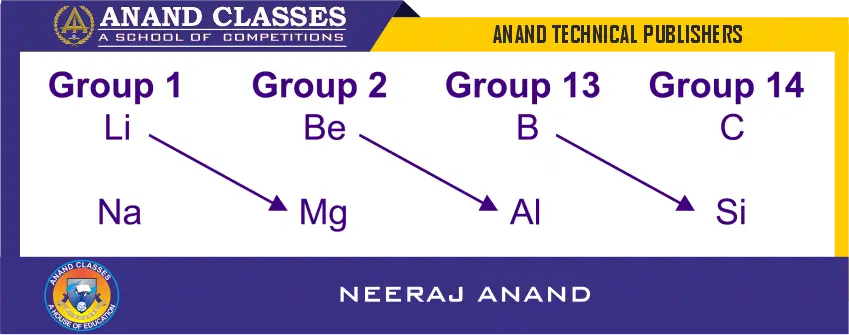
diagonal relationship
The anomalous behaviour of first member of each group as compared to other diagonal group members is mainly due to the following reasons :
(i) Small size of the atom and its ion.
(ii) Large charge / radius ratio.
(iii) High electronegativity.
(iv) Non availability of d-orbitals in their valence shells.
The above factors have strong affects on the chemistry of first element as compared to other elements (specially second). The first member differs from its succeeding members in some of the properties as given below :
(i) As we go down a group, the size goes on increasing, therefore, the first member of each group has the smallest size in its group.
(ii) Because of small size the first member has largest ionization enthalpy and ionization enthalpy decreases down the group.
(iii) All the elements of second period have abnormally low negative electron gain enthalpy than the second member. For example, the electron gain enthalpy decreases as we move down a group but the first member has abnormally lower electron gain enthalpy than the second because of its small size.
(iv) The small size of the atom results in relatively high cohesive properties associated with relatively strong intermetallic bonding. On the other hand, large atoms usually form weak bonds, therefore, the bond strengths of the compounds decrease as we move down the group. For example, lithium has relatively high enthalpy of atomization, melting and boiling points, density and hardness.
(v) The first member has higher electronegativity as compared to other members of the group. Therefore, it has greater tendency to form covalent bonds. For example, lithium halides, are covalent while halides, of other members of group 1 are ionic in nature.
(vi) The first member of the group has no vacant d–orbitals in its valence shell. Therefore, it has only four valence orbitals (2s and 2p) available for bonding. Therefore, the maximum covalency of the first member of each group is only 4.
On the other hand, the elements of third period (second member of the group) have vacant 3d-orbitals in their valence shell. Therefore, these have nine valence orbitals (3s, 3p and 3d) and therefore these elements can expand their valence shell to accommodate more than four pairs of electrons and can show valency more than 4. In other words, elements of second period cannot extend their octets while the elements of higher periods can extend their octets.
For example, boron forms [BF4]– while aluminium froms AlF63– in solution.
Further more, the first member of p–block elements display greater ability to form pπ –pπ multiple bonds to itself (e.g. C = C, C ≡ C, N ≡ N) and to other elements (e.g., C = O, C ≡, N = O, etc.). However, the other members cannot form stable pπ –pπ multiple bonds.
What are similarities in the Properties of Lithium and Magnesium due to Diagonal Relationship between them ?
- Both Li and Mg are harder and lighter.
- Li and Mg react slowly with water.
- Both of their hydroxides are weak bases and decompose on heating.
- Li2O and MgO do not combine with excess oxygen to give either peroxide or superoxides (Superoxide ions cannot be stabilised by Li+ and Mg2+ as they are small cations)
- Their carbonates decompose easily on heating to form oxides and CO2.
- Hydrogen carbonates are not formed by Li and Mg.
- Halides of both of them are deliquescent and crystallise as hydrates (LiCl.2H2O and MgCl2.8H2O).
- Halides of both the metals are soluble in ethanol (according to Fajan’s rule, because of the small sizes of Li+ and Mg2+) due to covalent character.
- Both the metals form nitrides, Li3N and Mg3N2 by direct combination with nitrogen.
- The hydroxides, carbonates, phosphates and fluorides of both Li and Mg are sparingly soluble in water.
What are similarities in the Properties of Beryllium and Aluminium due to Diagonal Relationship between them ?
Like aluminium, beryllium is not readily attacked by acids because of the presence of an oxide film. Al is very reactive towards oxygen and forms a protective oxide layer of Al2O3.
- BeCl2 and AlCl3 both act as a catalyst in Friedel-Crafts reaction.
- The hydroxides and the oxides of beryllium [Be(OH)2, BeO] and aluminium [Al(OH)3, Al2O3] are amphoteric in nature, whereas those of the other elements of Group 2 are basic in nature.
- BeCl2 and AlCl3 have bridged chloride polymeric structures in the solid state
- In the gas phase, AlCl3 exists as Al2Cl6 and BeCl2 exists as Be2Cl4. Hence, in the gas phase, AlCl3 and BeCl2 exist as dimers.
- Be and Al form compounds that have a low melting point and are soluble in the organic solvents.
- They react with NaOH to form beryllate and aluminate and give off H2 gas.
What are similarities in the Properties of Boron and Silicon due to Diagonal Relationship between them ?
Group 13, Period 2 element Boron has various similarities in their chemical and physical properties with Group 14, Period 3 element Silicon, owing to similarities in their polarisation power.
- Both B and Si are non-metallic in nature and are used in semi-conductors,.
- Boron, as well as Silicon, have high melting and boiling points.
- They have very similar densities and low atomic volumes.
- They also tend to form covalent compounds.
- B and Si exist in the amorphous and crystalline state.
- Both Boron and silicon show allotropy.
What are similarities in the Properties of Carbon and Phosphorus due to Diagonal Relationship between them ?
Group 14, Period 2 element Carbon has various similarities with Group 15, Period 3 element Phosphorus, owing to similarities in their polarisation power.
- Carbon and phosphorus exhibit allotropes.
- They exhibit almost similar values of electronegativities. (Carbon-2.55, Phosphorus- 2.19)
- Similar to carbon, phosphorus can also form triple bonds in its gaseous phase diphosphorus allotrope (P2).
FAQs Based on Diagonal Relationship : Anomalous Properties of Second Period Elements
What are the anomalous properties of second period elements?
The first elements of each group in the periodic table, such as lithium, beryllium, and boron, show properties different from the other members of their groups. These unusual properties are called anomalous properties and arise mainly because of their small atomic size, high ionization enthalpy, and high electronegativity.
Why do second period elements show anomalous behaviour?
Second period elements have very small atomic and ionic sizes compared to the elements below them in the group. They also do not have vacant d-orbitals in their valence shell, which affects their bonding and chemical behaviour significantly.
What is diagonal relationship in the periodic table?
Diagonal relationship refers to the similarity in properties between certain diagonally adjacent elements of the second and third periods. These similarities occur because the elements have nearly similar sizes, charge density, and electronegativity values.
Which pairs of elements show diagonal relationship?
Important examples of diagonal relationship include lithium with magnesium, beryllium with aluminium, boron with silicon, and carbon with phosphorus. Although these elements belong to different groups, they show similarities in several physical and chemical properties.
Why does lithium resemble magnesium?
Lithium and magnesium have similar ionic sizes and polarising power, which leads to similarities in their compounds and reactions. Both form nitrides, their carbonates decompose on heating, and many of their compounds show covalent character.
Why does beryllium resemble aluminium?
Beryllium and aluminium both form amphoteric oxides and hydroxides and show covalent bonding in many compounds. Their chlorides also exist as dimers and act as Lewis acids in various chemical reactions.
What is the role of small atomic size in anomalous behaviour?
The small size of second period elements increases their ionization enthalpy, electronegativity, and polarising power. As a result, they often form covalent compounds and differ considerably from the heavier elements of the same group.
Why can second period elements not expand their octet?
Second period elements do not have vacant d-orbitals in their valence shell. Because of this, they cannot accommodate more than eight electrons around the central atom and therefore cannot expand their octet like third period elements.
Why do second period elements form stronger multiple bonds?
Elements like carbon, nitrogen, and oxygen are small in size and can effectively overlap their p-orbitals. This allows them to form strong multiple bonds such as C=C, C≡C, and N≡N, which are less stable for heavier elements.
Why is diagonal relationship important in chemistry?
Diagonal relationship helps explain unusual similarities between elements of different groups and improves understanding of periodic trends. It is an important concept for CBSE, NEET, and JEE examinations because many theoretical and conceptual questions are based on it.
Who provides these chemistry notes and explanations?
These chemistry notes, explanations, and study materials are provided by Chemistry Anand Classes. The content is designed to help students understand important chemistry concepts for CBSE, NEET, JEE, and other competitive examinations.
Who has written these chemistry explanations?
The chemistry explanations and educational content are written by Er. Neeraj Anand. The notes are prepared in a simple and student-friendly manner to improve conceptual understanding and problem-solving skills.
Important Chapter Links
Learn more about related concepts such as modern periodic table, periodic trends, atomic radius trends, ionization enthalpy, electron gain enthalpy, electronegativity, and chemical bonding to understand diagonal relationship more clearly. Similar concepts include periodic classification of elements, valency and oxidation states, anomalous behaviour of elements, and variation of properties across periods and groups. Students should also study electronic configuration and bonding concepts to strengthen their understanding for CBSE, NEET, and JEE examinations.