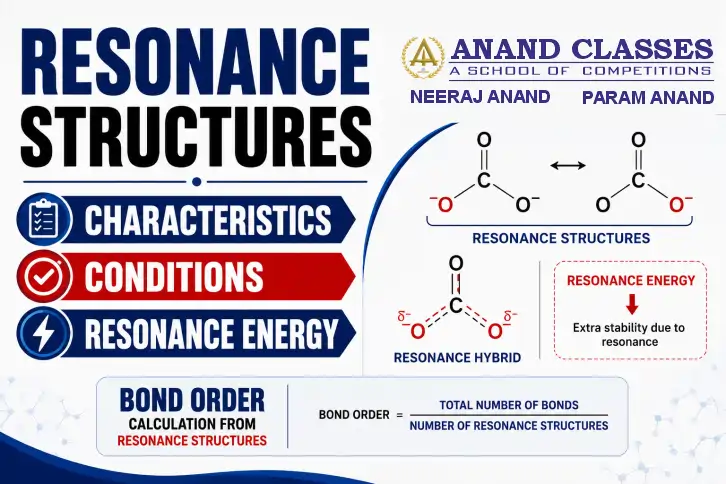
Resonance Structures its Characteristics, Conditions, Resonance Energy, and Bond Order Calculation is a comprehensive study resource written by Neeraj Anand of Anand Classes and published by Anand Technical Publishers. This chapter explains the fundamental concept of resonance in chemistry, including the characteristics and conditions required for resonance, canonical (resonating) structures, resonance hybrid, resonance energy, and the calculation of bond order from resonance structures. With clear explanations, solved examples, and exam-oriented concepts, this resource helps students develop a strong understanding of chemical bonding for CBSE Class 11, JEE Main, JEE Advanced, NEET, and other competitive examinations.
What is Resonance ? How to draw resonance structures and why resonance hybrid is most stable structure ? Explain and draw resonance structures of Ozone (O3) molecule ?
The phenomenon of resonance was put forward by Heisenberg to explain the properties of certain molecules. It is often observed that a single Lewis structure is not adequate for the representation of a molecule in agreement with its experimentally determined parameters. To illustrate this consider a molecule of ozone (O3). Its structure can be written as :
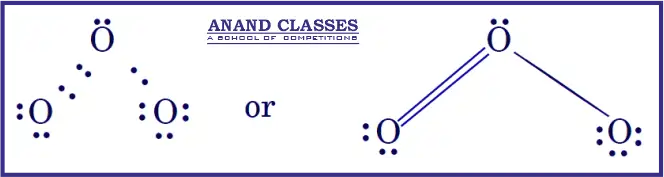
In this case, each oxygen atom has an octet of electrons. According to this structure, there is one single bond (O – O) and one double bond (O = O) in the molecule. The normal O–O and O=O bond lengths are 148 pm and 121 pm respectively.
According to the above structure we would expect the two bond lengths in ozone molecule to be unequal. However, experimentally it is observed that both the bond lengths are equal (128 pm) and the bonds are intermediate between single and double bonds. This means that the above Lewis structure does not account for the observed experimental facts. To solve the problem, an alternative structure may be drawn as :
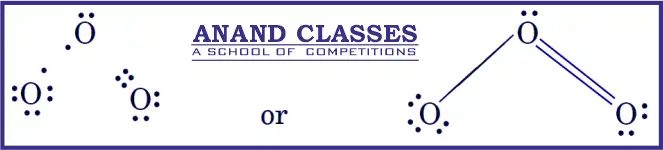
In this case, the double bond and the single bond are interchanged. But none of these two structures explains the observed facts. It is proposed that the actual structure is in between the two structures. In such a case, we say that the actual structure is a resonance hybrid of these two structures. The individual structures are called resonance structures or contributing structures. These are represented by drawing double headed arrows between these structures as shown below :
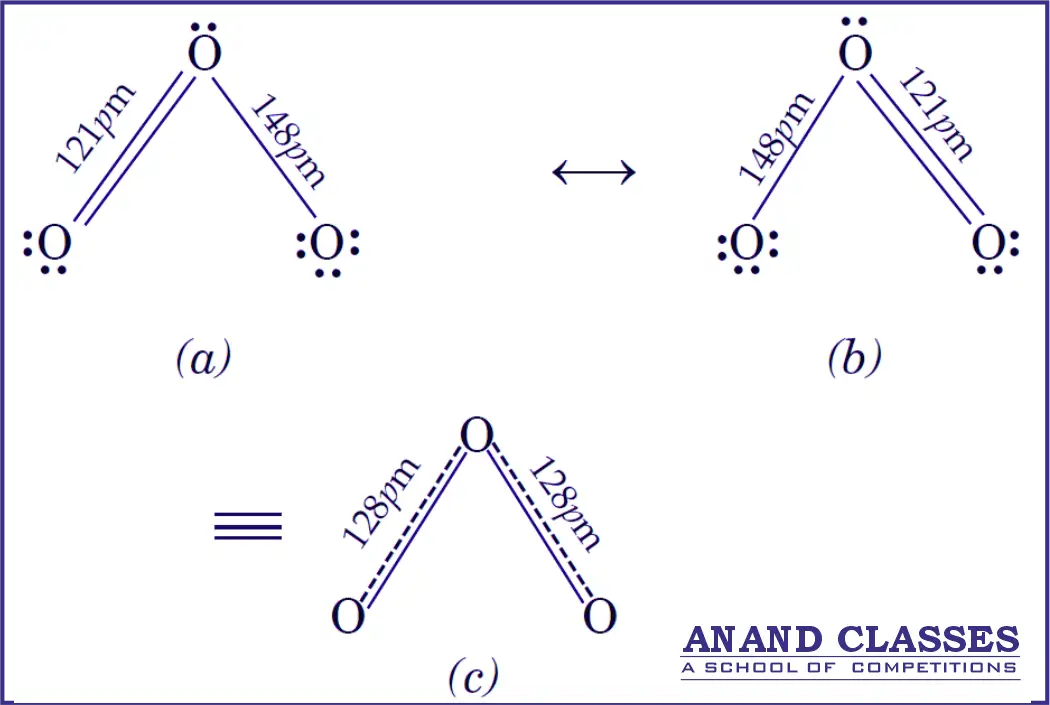
Thus, resonance may be summed up as : when a molecule cannot be represented by a single structure but its characteristic properties can be described by two or more than two structures, then the actual structure is said to be a resonance hybrid of these structures.
For example, ozone molecule may be represented as a resonance hybrid of above two structures (a) and (b). For simplicity, ozone may be represented by structure (c) which shows the resonance hybrid having equal bonds between single and double.
Important concepts connected to this topic are Bond Parameters-Bond length, Bond angle, Bond dissociation energy (enthalpy)
What are the conditions for writing Resonance Structures ?
The following are essential conditions for writing resonating structures :
- The contributing structures should have same atomic positions.
- The contributing structures should have same number of unpaired electrons.
- The contributing structures should have nearly same energy.
- The structures should be so written that negative charge is present on an electronegative atom and positive charge is present on an electropositive atom.
- In contributing structures, the like charges should not reside on adjacent atoms.
The contributing structures should not differ much in energy. This is an important condition. The individual structures of similar energy contribute equally to the resonance hybrid.
Enhance your preparation with Coordinate (Dative) Covalent Bond Characteristics
Explain and draw resonance structures of carbon dioxide (CO2) molecule ?
The simple structure of carbon dioxide molecule is shown below :
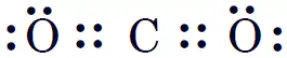
Therefore, we expect a double bond between carbon and oxygen atoms. The experimentally determined carbon to oxygen bond length in CO2 molecule is 115 pm. The normal C = O bond length is 122 pm and C ≡ O bond length is 110 pm. This suggests that carbon-oxygen bond in CO2 molecule is between double and triple bond.
Obviously, a single structure cannot depict the true structure of the molecule and it becomes necessary to write more than one Lewis structures. Therefore, the structure of CO2 is best described as a resonance hybrid of the following three canonical forms :

Explain and draw resonance structures of carbon monoxide (CO) molecule ?
The simple structure of carbon monoxide may be written as :
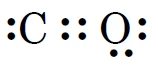
Therefore, we expect a double bond in carbon and oxygen atoms. However, carbon-oxygen bond length has been experimentally determined to be 113 pm. This lies between normal C = O (122 pm) and C ≡ O (1.10 pm). Therefore, carbon monoxide has been proposed to be resonance hybrid of the following structures

What is the Resonance Structure of Sulfur Dioxide (SO₂) ? Why both S–O bond lengths are same and both S–O bonds are identical ?
Sulfur dioxide (SO₂) is a bent molecule consisting of one sulfur atom bonded to two oxygen atoms. The total number of valence electrons in SO₂ is 18 (6 from sulfur and 6 from each oxygen atom).
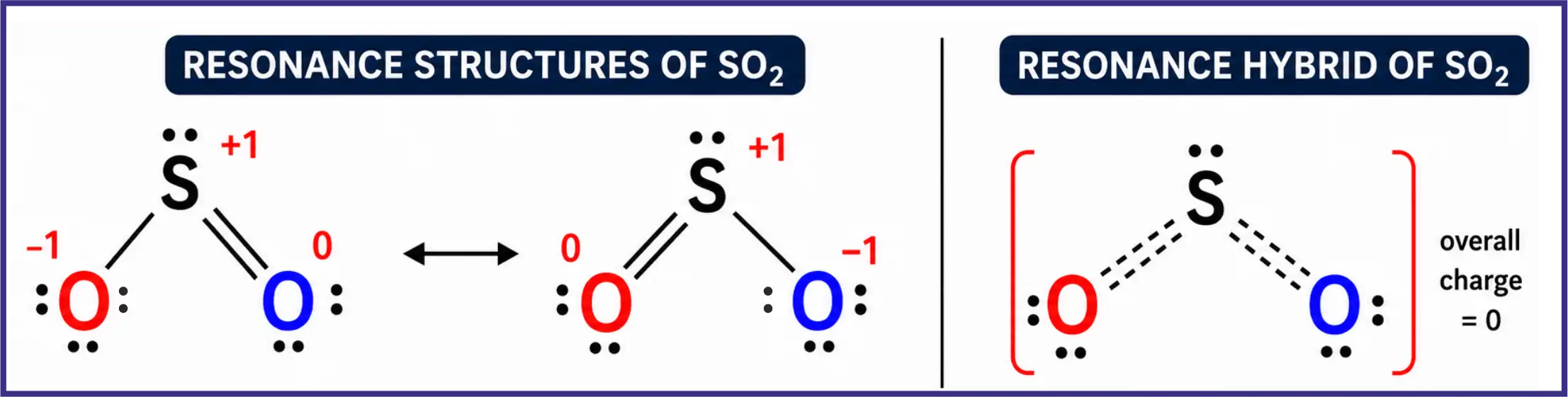
A single Lewis structure cannot accurately represent the electron distribution in SO₂ because the π (pi) electrons are delocalized over both sulfur–oxygen bonds. Therefore, SO₂ is represented by two equivalent resonance structures.
In the first resonance structure, sulfur forms a double bond with one oxygen atom and a single bond with the other oxygen atom. The oxygen connected by the single bond carries a –1 formal charge, while the sulfur atom carries a +1 formal charge.
In the second resonance structure, the positions of the single and double bonds are reversed. The oxygen that was previously double-bonded becomes single-bonded and vice versa. Again, the single-bonded oxygen carries a –1 formal charge, and sulfur carries a +1 formal charge.
These two resonance structures are connected by a double-headed resonance arrow (↔). This arrow indicates that the molecule does not alternate between the two structures. Instead, the actual SO₂ molecule is a resonance hybrid of both structures.
Bond Order of SO₂
The bond order of each sulfur–oxygen bond is calculated using the resonance bond order formula:
Bond Order = (2 + 1) / 2 = 1.5
Thus, each S–O bond in sulfur dioxide has a bond order of 1.5.
In the resonance hybrid, the π electrons are spread equally over both sulfur–oxygen bonds. As a result:
- Both S–O bonds are identical.
- Each S–O bond is shorter than a single bond but longer than a double bond.
- Each bond has a bond order of 1.5, indicating partial double-bond character.
- The negative charge is delocalized equally over both oxygen atoms, making the molecule more stable than either individual resonance structure.
Understand related topics like Characteristic Properties of Covalent Compounds
The resonance structures of a few more molecules and ions are given ahead.
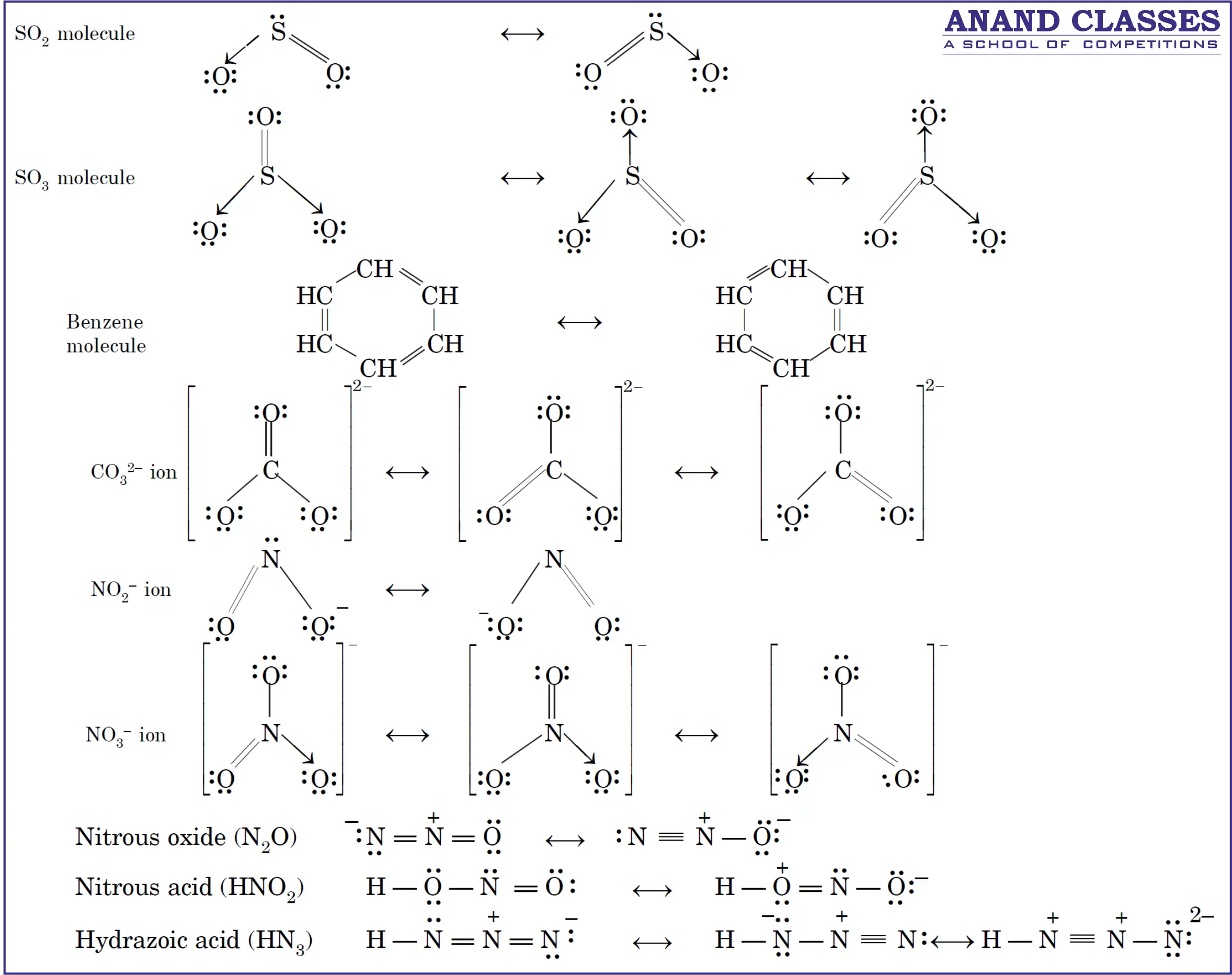
Thus, we may conclude :
- Resonance averages the bond characteristics of a molecule as a whole.
- Resonance stabilizes the molecule because the energy of the resonance hybrid is less than the energy of any single canonical structure.
What is Resonance energy ?
It is the difference between the actual bond energy of the molecule and that of the most stable of the resonating structures (having least energy). Thus,
Resonance energy = Actual bond energy – Energy of the most stable of resonating structures.
For example, the resonance energy of carbon dioxide is 138 kJ/mol. This means that the actual molecule of CO2 is about 138 kJ more stable than the most stable structure among the contributing structures. This can be easily illustrated as given below :
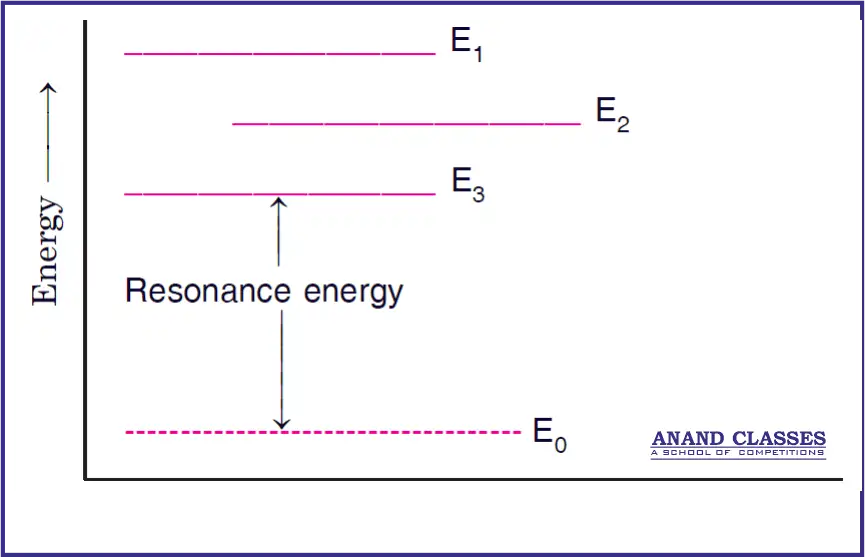
Suppose E1, E2 and E3 are the energies of three resonating structures for a molecule. Their energies are shown in Figure. It is evident that among these, E3 has the lowest energy (most stable contributing structure).
If E0 is the actual energy of the molecule (experimentally determined), then resonance energy is E3 – E0.
What are the characteristics of Resonance ?
- The contributing structures do not have real existence. These are only imaginary proposed to explain the properties of the molecule. Only the resonance hybrid has the real existence.
- Because of resonance, the bond lengths in a resonating structures become equal. For example, both the O—O bond lengths in O3 are equal. All the C–C bonds in benzene are equal.
- The resonance hybrid has lower energy and thus greater stability than any of the contributing structures.
- Greater is the resonance and resonance energy, greater is the stability of the molecule.
- Concept of resonance is a theoretical concept.
How to calculate Bond Order for Molecules Showing Resonance ?
In case of molecules or ions showing resonance, the contribution of each structure should be counted towards bond order.
What is Bond order ?
Bond order is the number of chemical bonds present between two atoms in a molecule. It indicates the strength and stability of a bond. A higher bond order generally means a stronger and shorter bond.
What is Bond Order Formula for Resonance Structures ?
When a molecule has resonance, the bond order is calculated using the following formula:
Bond Order = (Total number of bonds between two atoms in all resonance structures) ÷ (Total number of resonance structures)
Or simply:
Bond Order = Total number of bonds between two atoms in all the resonance structures / Total number of resonating structures
Any two bonded atoms may be selected and a double bond is counted as 2 bonds and a triple bond is counted as 3 bonds.
For example, benzene has two structures having a double bond and a single bond between two carbon atoms.
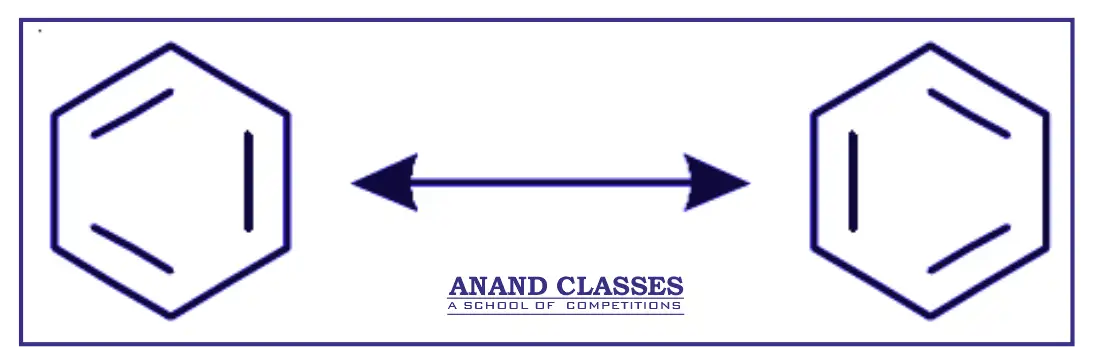
Bond order = (2 + 1)/2 = 1.5
Carbonate ion, CO32– has three resonating structures as:
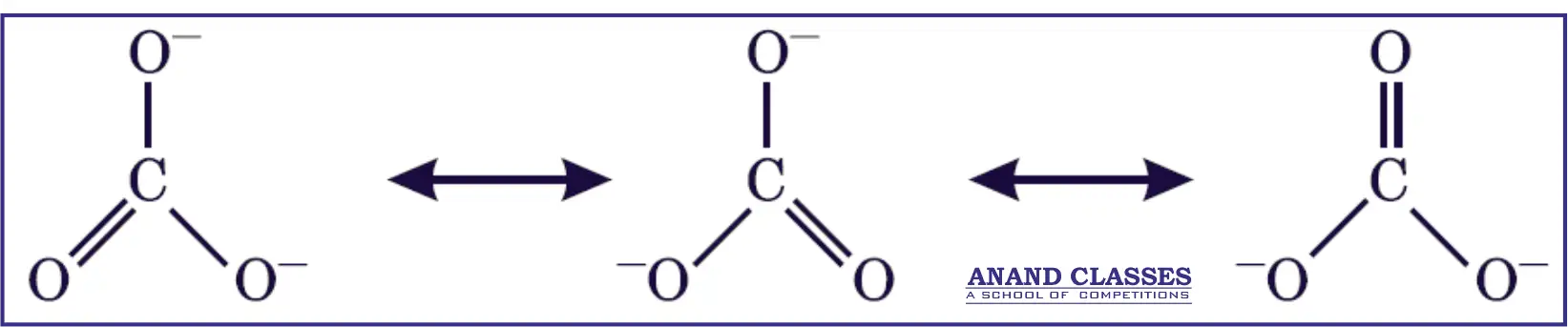
Bond order of C and O = (2 + 1 + 1)/3 = 1.33
Important Classification of Elements and Periodicity in Properties Chapter Interlinks
This section provides a complete and interconnected study of Classification of Elements and Periodicity in Properties, starting with detailed theory and notes for Class 11 Chemistry to build a strong conceptual foundation. You can explore atomic radius and its types including covalent, van der Waals, metallic, and ionic radii to understand periodic trends in atomic size. It also includes Screening Effect (Shielding Effect) : Calculation of Effective or Reduced Nuclear Charge (Slater’s Rules), which explains how inner electrons reduce the nuclear attraction on outer electrons and influence periodic trends. In addition, topics like Radius of Cation is Less and Anion is More Than Its Parent Atom, Size Variation in Isoelectronic Series help explain how ionic size changes due to gain or loss of electrons and how nuclear charge affects size in species with the same number of electrons. The causes of periodicity explain why elements show repeating properties based on electronic configuration, which is further supported by the modern periodic law and structure of the modern periodic table including groups, periods, and blocks for elements even beyond atomic number 100. The historical development is covered through Mendeleev’s periodic law and table, leading to the modern classification of elements into s, p, d, and f blocks with prediction of period, group, and block. To strengthen exam preparation, you can practice JEE Main PYQs, IMU CET PYQs and Merchant Navy sponsorship exam MCQs, and other previous year questions with solutions, along with solved examples, conceptual questions, and practice problems on the modern periodic table. Learn more in this section also to radius of cation is less and anion is more than its parent atom and size variation in Isoelectronic Series. Additionally, complete study material, mock tests, and guidance are provided under Anand Classes Chemistry notes, along with expert support from Er Neeraj Anand, making this section a comprehensive resource for competitive exam preparation.