
Co-ordinate Covalent Bond (Dative Bond) is an important topic in Class 11 Chemistry that explains how a shared pair of electrons can be donated entirely by one atom to another during bond formation. The Class 11 Chemistry notes of Anand Classes, written by Neeraj Anand, explain the concept of coordinate covalent bonds with simple theory, Lewis structures, step-by-step illustrations, and important examples such as NH₄⁺, H₃O⁺, O₃, BF₃, and H₂SO₄. Specially prepared for CBSE, JEE Main, JEE Advanced, and NEET, these study materials help students build strong conceptual understanding and excel in board and competitive examinations.
What is a Coordinate Covalent Bond or Dative Bond ?
In single covalent bonds each atom contributes one electron. In some cases, the shared pair of electrons is provided entirely by one atom, while the other atom merely participates in sharing.
In 1921, N. V. Sidgwick suggested another covalent type bond in which both the electrons in the shared pair come from one atom. This is called a coordinate covalent bond.
A coordinate covalent bond is a type of covalent bond in which both electrons in the shared pair are donated by the same atom (donor), while the other atom (acceptor) only participates in sharing. It is also called a dative bond.
- Co-ordinate covalent bonds are usually strong bonds. This is because the bonds are identical to any other interatomic bonds.
- The coordinate bond is a directional bond.
- Co-ordinate covalent bonds are usually formed in reactions that involve two non-metals, such as a hydrogen atom or during bond formation between metal ions and ligands (Electron donar atoms or ions).
Students should also study Octet Rule Exceptions, Incomplete and Expanded Octet of central atom, Odd Electron molecules
How is a Coordinate Covalent Bond Formed ?
A coordinate covalent bond is formed between a donor atom having at least one lone pair of electrons and an acceptor atom or ion having a vacant orbital or an incomplete octet capable of accepting the electron pair.
- The atom which contributes the electrons is called the donor.
- The atom which only shares the electron pair is called the acceptor.
This bond is usually represented by an arrow (→) pointing from donor to acceptor atom. This type of bond is also known as:
- Dative bond
- Donor-acceptor bond
- Semi-polar bond
- Co-ionic bond
Note : It may be remembered that in the modern terminology, there is no distinction between a covalent bond and a coordinate bond. Once the coordinate bond is formed, it cannot be distinguished from the normal covalent bond.
Continue learning with Characteristic Properties of Covalent Compounds
How is a co-ordinate covalent bond formed between ammonia (NH₃) and hydrogen ion (H⁺) to form ammonium Ion (NH4+) ?
An ammonia molecule (NH₃) has a nitrogen atom with three covalent bonds and one lone pair of electrons. A hydrogen ion (H⁺) has no electrons and requires a pair of electrons to form a bond.
The nitrogen atom in NH₃ donates its lone pair of electrons to the hydrogen ion (H⁺) to form a coordinate covalent bond (H3N→H⁺) between ammonia (NH₃) and hydrogen ion (H⁺) to form ammonium Ion (NH4+). In this bond, both the shared electrons are contributed by the nitrogen atom.
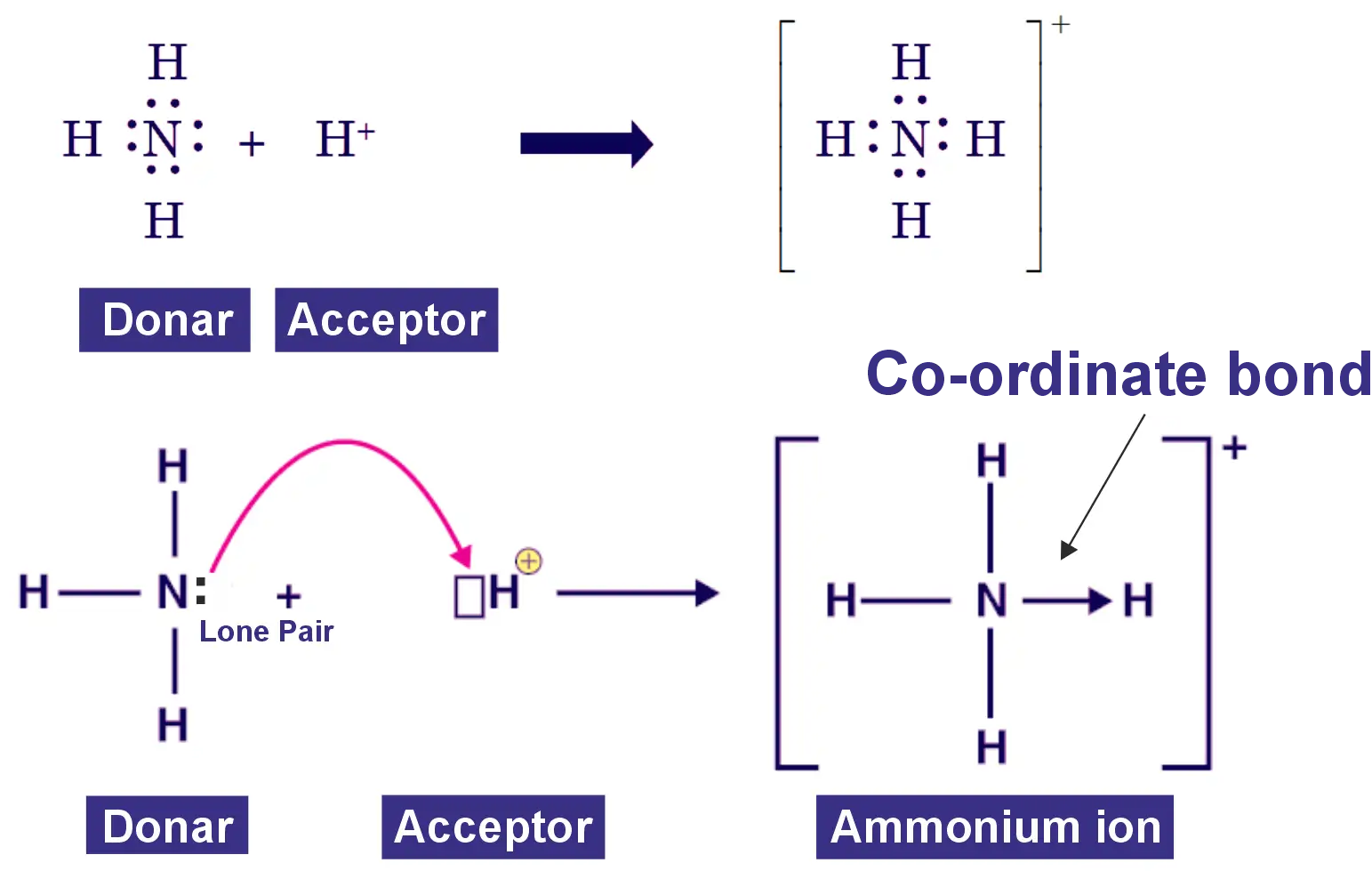
A hydrogen ion (H+) combines with an ammonia molecule (NH3) by a coordinate covalent bond to form the ammonium ion (NH4+) :
NH₃ + H⁺ ⟶ NH₄⁺ (H3N→H⁺)
As a result, the ammonium ion (NH₄⁺) is formed. After its formation, all four N–H bonds in NH₄⁺ become identical, and it is not possible to distinguish the coordinate covalent bond from the ordinary covalent bonds.
To strengthen your concepts, learn about Formal Charge Calculation Formula from Lewis structure
How is a co-ordinate covalent bond formed between oxygen molecule (O2) and oxygen atom (O) to form ozone (O3) molecule?
A molecule of oxygen contains two oxygen atoms joined by double covalent bond so that octet of each of the two atoms is complete. Now, if an atom of oxygen having six electrons comes close to oxygen molecule, the new oxygen atom may share a lone pair of electrons of one of the oxygen atoms of the oxygen molecule.
O₂ + O ⟶ O₃ (O = 0 → O)
As a result, a coordinate covalent bond is formed between the oxygen molecule and the incoming oxygen atom, producing the ozone molecule (O₃).

In ozone, one of the O–O bonds is a coordinate covalent bond. However, due to resonance, both O–O bonds become identical, and it is not possible to distinguish the coordinate bond from the ordinary covalent bond.
One Lewis structure of ozone can be represented using a coordinate covalent bond. However, due to resonance, the two O–O bonds become equivalent with a bond order of 1.5, and neither bond is purely a coordinate bond.
Enhance your preparation with Rules for writing Lewis formula structures of molecules and ions
How is a co-ordinate covalent bond formed between water molecule (H2O) and hydrogen ion (H⁺) to form hydronium Ion (H3O+) ?
A water molecule (H₂O) has two lone pairs of electrons on the oxygen atom, while the hydrogen ion (H⁺) has an empty 1s orbital and no electrons.
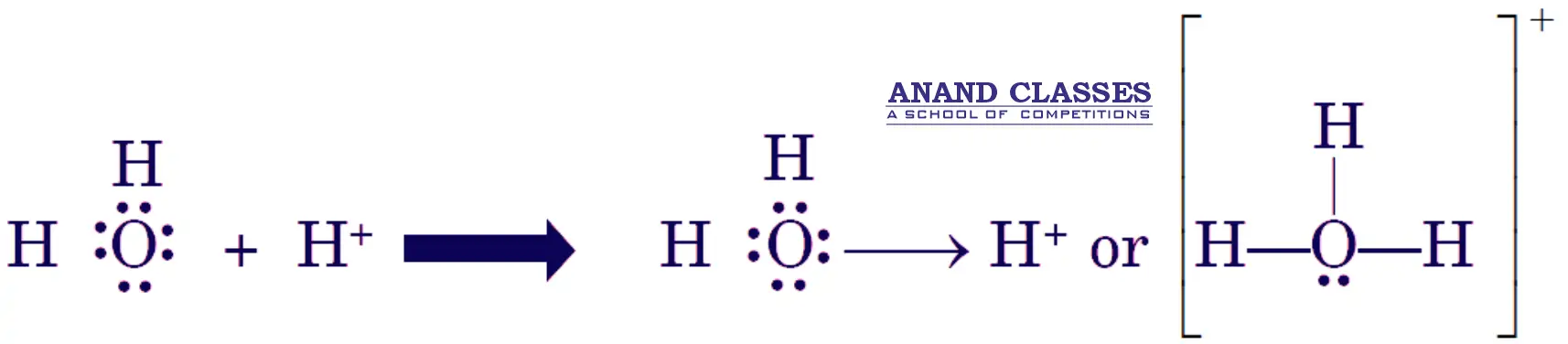
The oxygen atom donates one lone pair of electrons to the hydrogen ion (H⁺) to form a coordinate covalent bond (H₂O → H⁺) between water molecule (H2O) and hydrogen ion (H⁺) to form Hydronium Ion (H3O+). In this bond, both the shared electrons are contributed by the oxygen atom.
H₂O + H⁺ ⟶ H₃O⁺ (H₂O → H⁺)
As a result, the hydronium ion (H₃O⁺) is formed. After its formation, all three O–H bonds in H₃O⁺ become identical, and it is not possible to distinguish the coordinate covalent bond from the ordinary covalent bonds.
Important concepts connected to this topic are Lewis Structures of multiple covalent bonds molecules (O₂, CO₂, N₂, C₂H₄, C₂H₂)
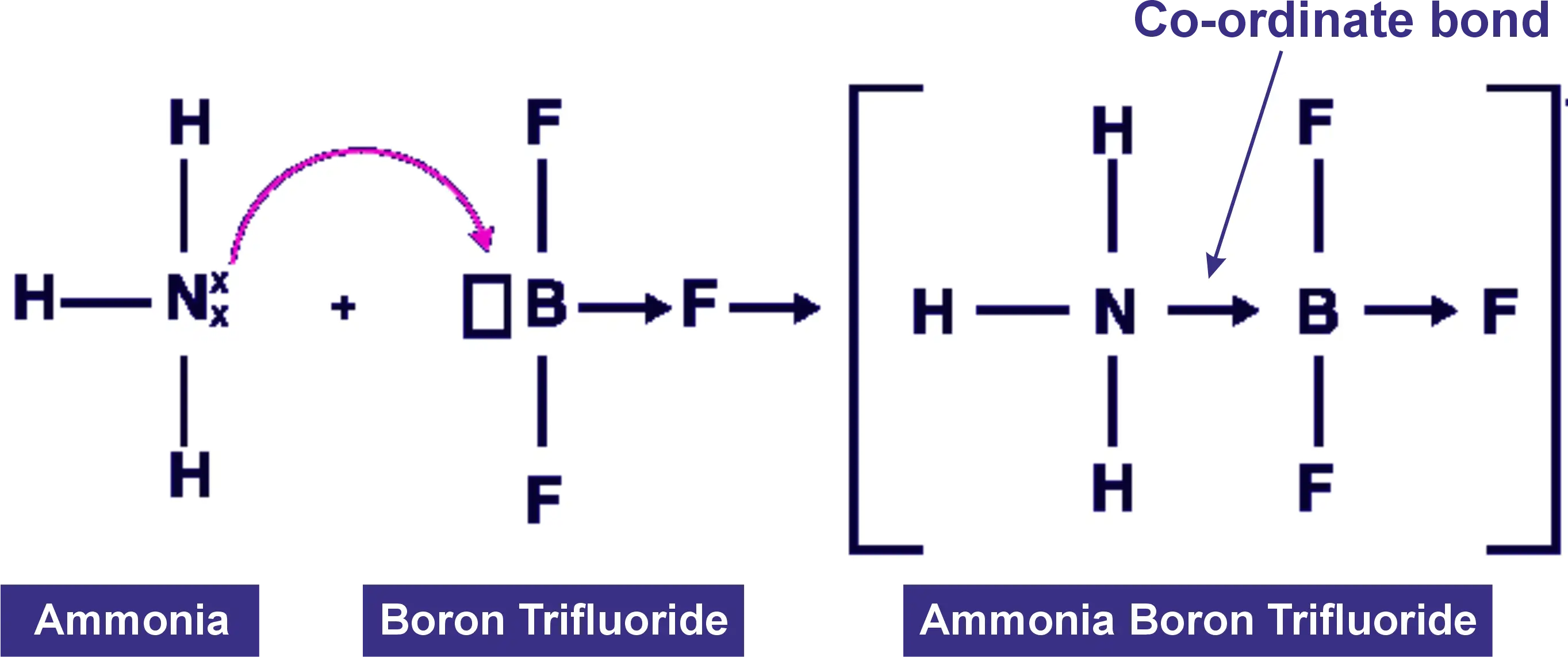
How is a co-ordinate covalent bond formed between Ammonia (NH₃) and Boron Trifluoride (BF₃) to Form of Ammonia Boron Trifluoride adduct ?
Ammonia (NH₃) has a lone pair of electrons on the nitrogen atom, while boron trifluoride (BF₃) has an electron-deficient boron atom with an incomplete octet.
The nitrogen atom of NH₃ donates its lone pair of electrons to the boron atom of BF₃, forming a coordinate covalent bond (H₃N→BF₃) between NH₃ and BF₃ to form ammonia (NH₃) and boron trifluoride (BF₃) adduct. In this bond, both the shared electrons are contributed by the nitrogen atom.
NH₃ + BF₃ ⟶ H₃N→BF₃
As a result, the H₃N→BF₃ adduct is formed. The boron atom completes its octet, making the compound more stable. They combine through a coordinate bond.
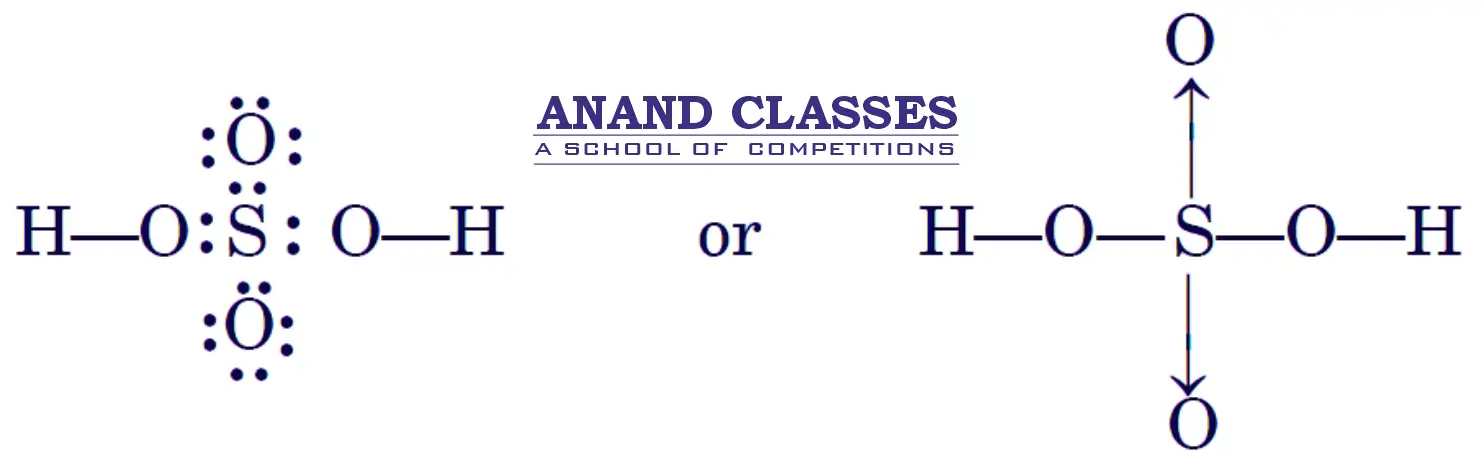
How does Sulphuric Acid (H₂SO₄) have a coordinate bond? How many coordinate bonds are there in H₂SO₄ ?
Sulphuric acid (H₂SO₄) contains two coordinate covalent bonds in its molecule. The sulfur atom is bonded to four oxygen atoms. The bonds between the sulfur atom and the oxygen atoms of the two –OH groups are normal single covalent bonds. The bonds between the sulfur atom and the other two oxygen atoms are coordinate covalent bonds, in which both the shared electrons are donated by the oxygen atoms.
- Valence electrons of sulfur:
Sulfur (S) belongs to Group 16 and has 6 valence electrons. - Oxygen atoms in H₂SO₄:
Sulfur is bonded to four oxygen atoms. Two oxygen atoms are each bonded to a hydrogen atom, forming –OH groups, while the other two oxygen atoms are not bonded to hydrogen. - Formation of normal covalent bonds:
Sulfur shares one electron with each oxygen atom of the two –OH groups, forming two normal single covalent bonds (S–O). - Formation of coordinate covalent bonds:
Each of the remaining two oxygen atoms has a lone pair of electrons. These oxygen atoms donate one lone pair each to the sulfur atom. Thus, both the shared electrons are contributed by the oxygen atoms, forming two coordinate covalent bonds (O→S). - Electron arrangement around sulfur:
- Two normal single covalent bonds = 2 shared pairs = 4 electrons around sulfur.
- Two coordinate covalent bonds = 2 shared pairs = 4 more electrons around sulfur.
- Total from these four bonds = 8 electrons.
- Since the coordinate bonds are commonly represented as S=O after bond formation, sulfur is considered to have 12 electrons around it (two double bonds and two single bonds), which is more than an octet.
- Expanded octet:
Sulfur belongs to the third period of the periodic table and can accommodate more than 8 electrons in its valence shell. Therefore, sulfur in H₂SO₄ has an expanded octet.
Thus, H₂SO₄ contains two normal single covalent bonds and two coordinate covalent bonds, making the sulfur atom surrounded by an expanded octet.
Note : In older theory, the two S=O bonds in H₂SO₄ were often represented as coordinate covalent bonds (O→S). However, according to modern bonding concepts, all S–O bonds are described using covalent bonding and resonance. The coordinate bond representation is retained only as a convenient Lewis structure in elementary chemistry.
What are the characteristics of Coordinate Covalent Bond ?
- In this type of bonding, the atom that shares an electron pair from itself is termed as the donor.
- The other atom which accepts these shared pair of electrons is known as a acceptor.
- The bond is represented with an arrow →, pointing towards the acceptor from the donor atom.
- After sharing of electron pairs, each atom gets stability.
- This type of bonding is central to the Lewis theory.
- Coordinate covalent bonding plays an important role in coordination compounds, transition metal complexes, biological molecules, and many chemical reactions.
Is co-ordinate bonding a strong bond?
Yes, coordinate covalent bonds are usually strong bonds. This is because, after their formation, they are identical to ordinary covalent bonds and have similar strength.
Although both the shared electrons are initially contributed by one atom, once a coordinate covalent bond is formed, it behaves like an ordinary covalent bond. Except for its mode of formation, it is generally indistinguishable from a normal covalent bond.
Is the coordinate bond directional?
Yes, the coordinate covalent bond is a directional bond.
It is formed by the donation of a lone pair of electrons from one atom (the donor) to another atom (the acceptor). Like ordinary covalent bonds, coordinate covalent bonds are directional because the donated electron pair overlaps with a specific vacant orbital of the acceptor atom. This directional nature influences the shape and geometry of molecules.