Octet Rule Exceptions, Incomplete and Expanded Octet of the Central Atom, and Odd Electron Molecules are essential topics in Class 11 Chemistry for understanding why some molecules do not follow the octet rule. The Class 11 Chemistry notes of Anand Classes, written by Neeraj Anand, explain these exceptions with simple concepts, clear diagrams, and step-by-step examples to help students understand incomplete octets, expanded octets, and odd-electron species. Specially prepared for CBSE, JEE Main, JEE Advanced, and NEET, these exam-oriented study materials strengthen conceptual clarity and improve performance in both board and competitive examinations.
What are the four exceptions to the octet rule?
Not all elements and compounds follow the octet rule. Although octet rule is useful in a large number of cases, it has many exceptions also. Some important exceptions of octet rule are explain in this article.
Explore detailed notes on Formal Charge Calculation Formula from Lewis structure
What is the duet rule? Why does hydrogen obey the duet rule instead of the octet rule? Why is an octet not required for hydrogen to attain stability?
Since the first shell can only accommodate two electrons, element such as hydrogen obey the duet rule instead of the octet rule.
Hydrogen has one electron in its first energy shell (n = 1). It needs only one more electron to fill this shell, because the first shell cannot have more than two electrons. This configuration (1s2) is similar to that of noble gas helium and is stable. In this case, therefore, octet is not needed to achieve a stable configuration.
Understand related topics like Rules for writing Lewis formula structures of molecules and ions
What is meant by an incomplete (electron-deficient) octet? Why does the octet rule fail to explain the formation of LiCl, BeH₂, BeCl₂, BH₃, and BF₃?
The octet rule cannot explain the formation of certain molecules of lithium, beryllium, boron, aluminium, etc. (LiCl, BeH2, BeCl2, BH3, BF3) in which the central atom has less than eight electrons in the valence shell.
Incomplete octet of the central Li atom in LiCl
In LiCl, the lithium (Li) atom has only one valence electron. It transfers this electron to the chlorine (Cl) atom, forming Li⁺ and Cl⁻ ions. After losing its electron, the lithium ion has the electronic configuration 1s², which is the stable duplet configuration like helium, not an octet.
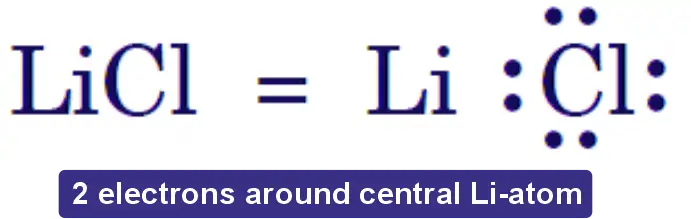
Therefore, the lithium atom does not have eight electrons around it. It is an example of an incomplete octet, because lithium becomes stable by achieving 2 electrons (a duplet) instead of 8 electrons (an octet). This is normal for elements in the first shell, which can hold a maximum of only two electrons.
You may also like to study Lewis Structures of multiple covalent bonds molecules (O₂, CO₂, N₂, C₂H₄, C₂H₂)
Incomplete octet of the central Be atom in BeH₂
In BeH₂, the beryllium (Be) atom has 2 valence electrons. It forms two covalent bonds, one with each hydrogen atom, by sharing one electron with each hydrogen.
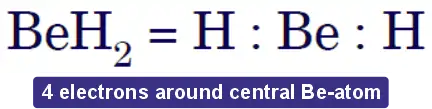
As a result, only 4 electrons surround the central Be atom (2 shared pairs), instead of the 8 electrons required for an octet. Therefore, the beryllium atom has an incomplete octet.
Even though Be does not achieve an octet, BeH₂ is stable because beryllium is an exception to the octet rule and can exist stably with only 4 electrons in its outermost shell.
Important related topics are Covalent Bond, Formation of Hydrogen (H₂), Chlorine (Cl₂), Hydrogen Chloride (HCl), Water (H₂O), Ammonia (NH₃) Molecules
Incomplete octet of the central Be atom in BeCl₂
In BeCl₂, the beryllium (Be) atom has 2 valence electrons. It forms two covalent bonds, one with each chlorine atom, by sharing one electron with each chlorine.
As a result, only 4 electrons surround the central Be atom (2 shared pairs), instead of the 8 electrons required for an octet. Therefore, the beryllium atom has an incomplete octet.
Even though Be does not achieve an octet, BeCl₂ is stable because beryllium is an exception to the octet rule and can exist stably with only 4 electrons in its outermost shell.
Important exam-related topics include JEE Main PYQs Previous Year Questions MCQs : Classification of Elements and Periodicity in Properties
Incomplete octet of the central B atom in BH₃
In BH₃, the boron (B) atom has 3 valence electrons. It forms three covalent bonds, one with each hydrogen atom, by sharing one electron with each hydrogen.
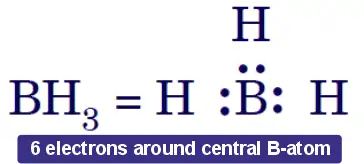
As a result, only 6 electrons surround the central boron atom (3 shared pairs), instead of the 8 electrons required for an octet. Therefore, the boron atom has an incomplete octet.
Even though boron does not achieve an octet, BH₃ is stable because boron is an exception to the octet rule and can exist stably with only 6 electrons in its outermost shell.
Incomplete octet of the central B atom in BF₃
In BF₃, the boron (B) atom has 3 valence electrons. It forms three covalent bonds, one with each fluorine atom, by sharing one electron with each fluorine.
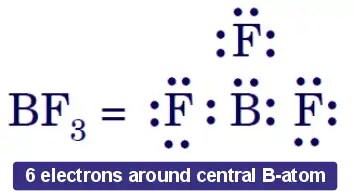
As a result, only 6 electrons surround the central boron atom (3 shared pairs), instead of the 8 electrons required for an octet. Therefore, the boron atom has an incomplete octet.
Even though boron does not achieve an octet, BF₃ is stable because boron is an exception to the octet rule and can exist stably with only 6 electrons in its outermost shell.
What is an expanded octet? What is meant by hypervalency? What are hypervalent compounds?
There are many stable molecules which have more than eight electrons in their valence shells. For example, PF5 has ten; SF6 has twelve and IF7 has fourteen electrons around the central atoms, P, S and I respectively, as shown below :
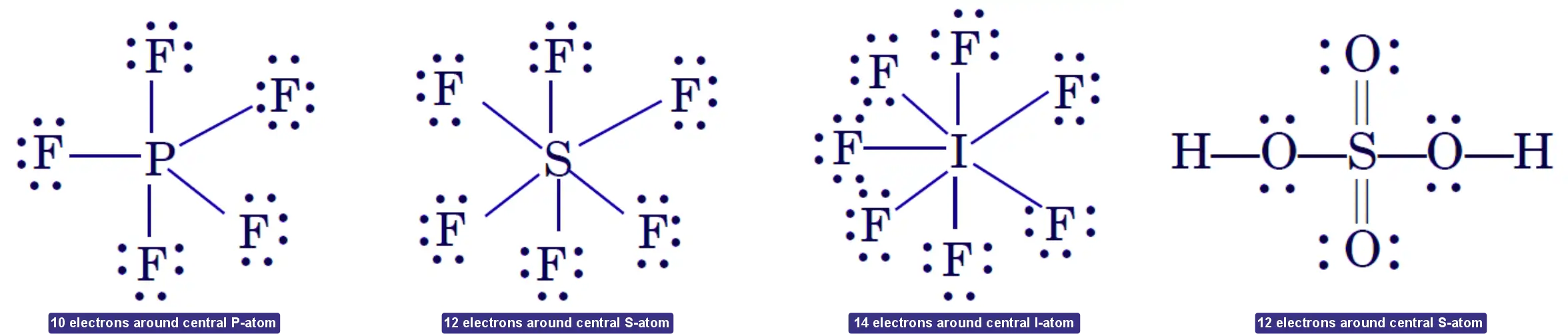
Expanded octet of the central P atom in PF₅
In PF₅, the phosphorus (P) atom has 5 valence electrons. It forms five covalent bonds, one with each fluorine atom, by sharing one electron with each fluorine.
As a result, 10 electrons surround the central phosphorus atom (5 shared pairs), which is more than the 8 electrons required for an octet. Therefore, the phosphorus atom has an expanded octet.
Phosphorus belongs to the third period of the periodic table and has vacant orbitals in its valence shell. Therefore, it can accommodate more than 8 electrons around the central atom. Hence, PF₅ is a stable molecule with an expanded octet.
Expanded octet of the central S atom in SF₆
In SF₆, the sulfur (S) atom has 6 valence electrons. It forms six covalent bonds, one with each fluorine atom, by sharing one electron with each fluorine.
As a result, 12 electrons surround the central sulfur atom (6 shared pairs), which is more than the 8 electrons required for an octet. Therefore, the sulfur atom has an expanded octet.
Sulfur belongs to the third period of the periodic table and has vacant orbitals in its valence shell. Therefore, it can accommodate more than 8 electrons around the central atom. Hence, SF₆ is a stable molecule with an expanded octet.
Expanded octet of the central I atom in IF₇
In IF₇, the iodine (I) atom has 7 valence electrons. It forms seven covalent bonds, one with each fluorine atom, by sharing one electron with each fluorine.
As a result, 14 electrons surround the central iodine atom (7 shared pairs), which is more than the 8 electrons required for an octet. Therefore, the iodine atom has an expanded octet.
Iodine belongs to the fifth period of the periodic table and has vacant orbitals in its valence shell. Therefore, it can accommodate more than 8 electrons around the central atom. Hence, IF₇ is a stable molecule with an expanded octet.
Expanded octet of the central S atom in H₂SO₄
In H₂SO₄, the sulfur (S) atom has 6 valence electrons. It is bonded to four oxygen atoms—two by double covalent bonds and two by single covalent bonds (the single-bonded oxygen atoms are each bonded to a hydrogen atom).
As a result, 12 electrons surround the central sulfur atom (two double bonds and two single bonds), which is more than the 8 electrons required for an octet. Therefore, the sulfur atom has an expanded octet.
Sulfur belongs to the third period of the periodic table and can accommodate more than 8 electrons around the central atom. Hence, H₂SO₄ is a stable molecule with an expanded octet.
These compounds in which the atom has more than 8 electrons around it are called hypervalent compounds.
However, it may be noted that sulphur also forms many compounds in which the octet rule is obeyed. For example, in sulphur dichloride, the S atom has an octet of electrons around it.
Why Odd Electron molecules are exceptions to Octet Rule ?
There are certain molecules which have odd number of electrons, like nitric oxide, NO and nitrogen dioxide, NO2. In these cases, octet rule is not satisfied for all the atoms.
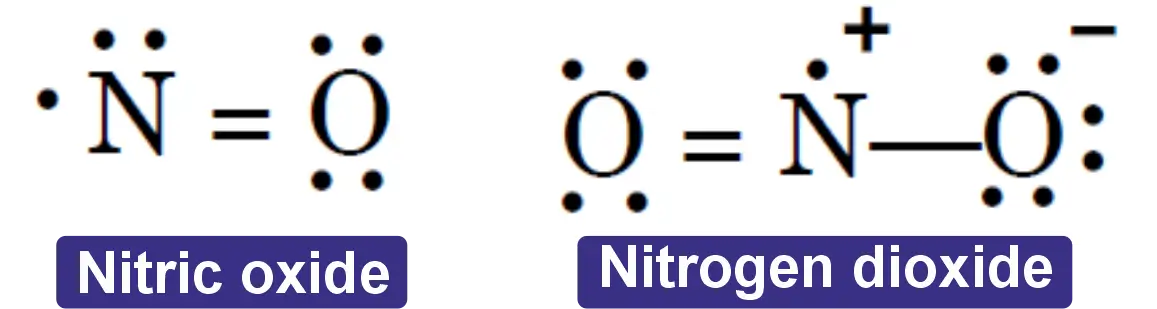
Odd electron molecule example, Nitric Oxide (NO)
In Nitric Oxide (NO), the total number of valence electrons is 11 (5 from nitrogen and 6 from oxygen), which is an odd number.
Since there is an odd number of electrons, it is not possible for both nitrogen and oxygen to complete their octets. One electron remains unpaired, making NO an odd electron molecule.
Because of this unpaired electron, NO does not obey the octet rule. It is stable despite having an odd number of electrons and is therefore an exception to the octet rule.
Odd electron molecule example, Nitrogen dioxide (NO₂)
In Nitrogen dioxide (NO₂), the total number of valence electrons is 17 (5 from nitrogen and 6 × 2 = 12 from two oxygen atoms), which is an odd number.
Since there is an odd number of electrons, it is not possible for all the atoms to complete their octets. One electron remains unpaired, making NO₂ an odd electron molecule.
Because of this unpaired electron, NO₂ does not obey the octet rule. It is stable despite having an odd number of electrons and is therefore an exception to the octet rule.
Other drawbacks of the octet rule
- It may be noted that the octet rule is based upon the chemical inertness of noble gases. However, it has been found that some noble gases (especially xenon and krypton) also combine with oxygen and fluorine to form a large number of compounds such as XeF2, KrF2, XeOF2, XeOF4, XeF6, etc.
- This theory does not account for the shape of the molecules.
- It cannot explain the relative stability of the molecule in terms of the energy.
How do incomplete octet, expanded octet, and odd electron molecules differ from one another?
The three exceptions to the octet rule differ in the number of electrons around the central atom (or total electrons in the molecule).
| Type | Definition | Electrons Around Central Atom | Examples |
|---|---|---|---|
| Incomplete octet | The central atom has less than 8 electrons in its valence shell. | Less than 8 | BeH₂ (4 electrons), BeCl₂ (4 electrons), BH₃ (6 electrons), BF₃ (6 electrons), LiCl (Li⁺ has a duplet) |
| Expanded octet | The central atom has more than 8 electrons in its valence shell because it can accommodate extra electrons. | More than 8 | PF₅ (10 electrons), SF₆ (12 electrons), IF₇ (14 electrons), H₂SO₄ (12 electrons around S) |
| Odd electron molecules | The molecule has an odd total number of valence electrons, so not all atoms can complete their octets. One electron remains unpaired. | Octet cannot be completed for all atoms | NO (11 valence electrons), NO₂ (17 valence electrons) |
Important Classification of Elements and Periodicity in Properties Chapter Interlinks
This section provides a complete and interconnected study of Classification of Elements and Periodicity in Properties, starting with detailed theory and notes for Class 11 Chemistry to build a strong conceptual foundation. You can explore atomic radius and its types including covalent, van der Waals, metallic, and ionic radii to understand periodic trends in atomic size. It also includes Screening Effect (Shielding Effect) : Calculation of Effective or Reduced Nuclear Charge (Slater’s Rules), which explains how inner electrons reduce the nuclear attraction on outer electrons and influence periodic trends. In addition, topics like Radius of Cation is Less and Anion is More Than Its Parent Atom, Size Variation in Isoelectronic Series help explain how ionic size changes due to gain or loss of electrons and how nuclear charge affects size in species with the same number of electrons. The causes of periodicity explain why elements show repeating properties based on electronic configuration, which is further supported by the modern periodic law and structure of the modern periodic table including groups, periods, and blocks for elements even beyond atomic number 100. The historical development is covered through Mendeleev’s periodic law and table, leading to the modern classification of elements into s, p, d, and f blocks with prediction of period, group, and block. To strengthen exam preparation, you can practice JEE Main PYQs, IMU CET PYQs and Merchant Navy sponsorship exam MCQs, and other previous year questions with solutions, along with solved examples, conceptual questions, and practice problems on the modern periodic table. Learn more in this section also to radius of cation is less and anion is more than its parent atom and size variation in Isoelectronic Series. Additionally, complete study material, mock tests, and guidance are provided under Anand Classes Chemistry notes, along with expert support from Er Neeraj Anand, making this section a comprehensive resource for competitive exam preparation. This section also includes detailed study of What is Ionization Enthalpy? Definition, Units, Factors and Successive IE and Ionization Enthalpy Trends Along a Period and Down a Group for better understanding of periodic properties and reactivity of elements.