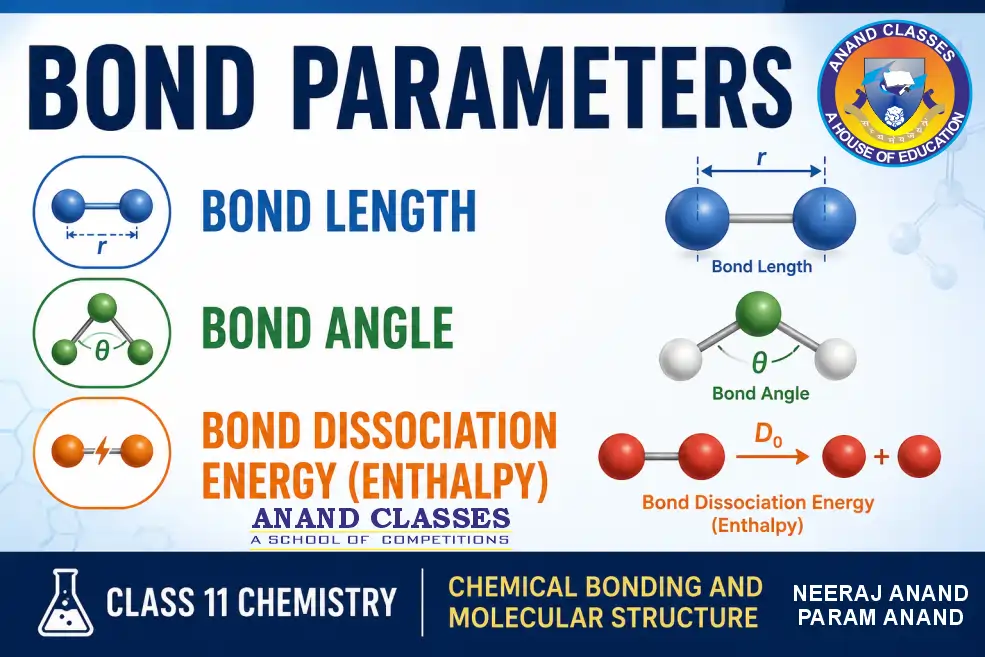
Bond Parameters are fundamental concepts in Class 11 Chemistry that help explain the strength, stability, and geometry of covalent bonds. The Class 11 Chemistry notes of Anand Classes, written by Neeraj Anand, provide a clear and exam-focused explanation of bond length, bond angle, bond enthalpy (bond dissociation enthalpy), average bond enthalpy, bond order, covalent radius, and van der Waals radius with diagrams, tables, solved examples, and important conceptual questions. Specially designed for CBSE, JEE Main, JEE Advanced, and NEET, these study materials help students build a strong foundation in chemical bonding and excel in board and competitive examinations.
What are the different bond parameters that characterize a covalent bond?
Covalent bonds are characterised by certain parameters such as :
- Bond Length
- Bond Angle
- Bond Enthalpy (Bond Dissociation Enthalpy / Bond Energy)
- Bond Order (Bond Multiplicity)
These parameters are discuss as follows.
To understand this topic better, learn about Characteristic Properties of Covalent Compounds
Define Bond length
Bond length is defined as the equilibrium distance between the centres of the nuclei of two bonded atoms in a molecule. Therefore, it represents equilibrium internuclear separation distance of the bonded atoms in a molecule.
What is meant by equilibrium internuclear distance?
The equilibrium internuclear distance is the distance between the nuclei of two bonded atoms at which the molecule has the lowest potential energy and is most stable.
At this distance:
- The attractive forces (between each nucleus and the other atom’s electrons) balance the repulsive forces (between the two nuclei and between the electrons).
- The net force between the atoms is zero, so the atoms remain at a stable separation.
- This distance is also called the bond length of the molecule.
For example, in a hydrogen molecule (H₂), the equilibrium internuclear distance is about 74 pm (0.74 Å).
In simple terms, equilibrium internuclear distance is the optimum distance between two bonded atoms where the bond is strongest and the molecule is most stable.
How is bond length measured?
Scientists measure bond lengths using techniques such as :
- X-ray diffraction (X-ray crystallography) – Used mainly for crystalline solids. It determines the positions of atoms and the distances between their nuclei.
- Electron diffraction – Commonly used for gaseous molecules.
- Spectroscopy (microwave or rotational spectroscopy) – Measures molecular rotational spectra, from which bond lengths can be calculated very accurately.
Units of bond length : Bond length is usually expressed in Angstrom units (Å) or picometers (pm).
1 Å = 10–10 m and 1 pm = 10–12 m.
Example: The bond length of the H–H bond in a hydrogen molecule (H₂) is 74 pm (or 0.74 Å).
What is the relationship between bond length and covalent radius? Write the formula relating bond length and covalent radii.
Each atom of the bonded pair contributes to bond length. In the case of a covalent bond, the contribution from each atom is called the covalent radius of that atom.
The bond length of a covalent bond is directly related to the covalent radii of the bonded atoms.
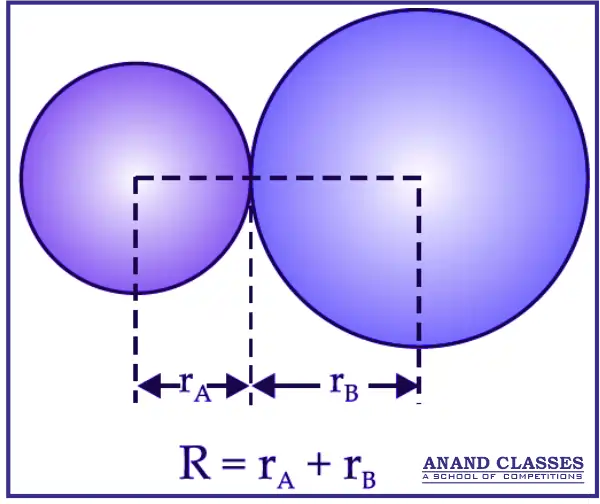
The bond length in a covalent molecule AB (two different atoms) may be expressed as :
Bond length = Covalent radius of atom A + Covalent radius of atom B
R = rA + rB
where R is the bond length and rA and rA are the covalent radii of atoms A and B respectively. Thus, the bond length is approximately the sum of the covalent radii of two atoms.
In HCl molecule :
- Covalent radius of H = 37 pm
- Covalent radius of Cl = 99 pm
- Bond length (H – Cl)= 37 + 99 = 136 pm.
For example, the O – H bond length in ethanol is the sum of the covalent radii of H and O, i.e. 37 + 74 = 111 pm.
The covalent radius is measured approximately as the radius of an atom’s core which is in contact with the core of an atom in a bonded situation.
For a bond between two identical atoms (A – A) :
Bond length = 2 × Covalent radius
In Cl₂, the covalent radius of chlorine is 99 pm.
Bond length = 99 + 99 = 198 pm
Noteworthy Point
The bond length of a covalent bond is equal to the sum of the covalent radii of the two bonded atoms. For identical atoms, the bond length is twice the covalent radius.
On the other hand, the van der Waals radius represents the overall size of the atom which includes its valence shell in a nonbonded situation.
Define van der Waals radius
Van der Waals radius is one half of the distance between two similar adjacent atoms belonging to two nearest neighbouring molecules of the same substance in the solid state.
Covalent and van der Waals radii of chlorine (Cl2) molecule are shown below.
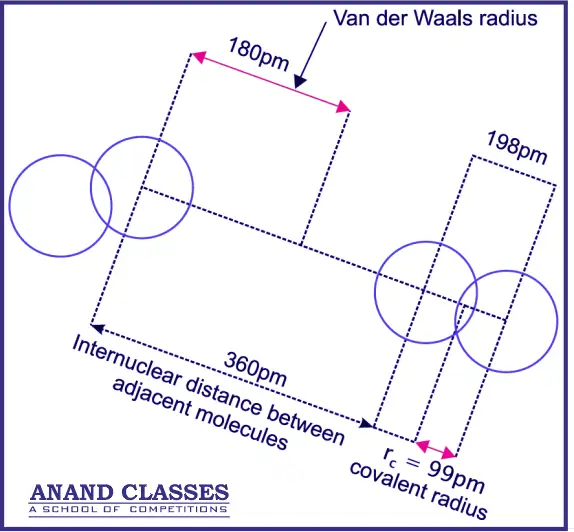
It is clear from Figure above, the internuclear distance between two atoms of the same molecule is 198 pm so that
rcovalent = 198/2 = 99 pm
The internuclear distance between two nonbonded nearest neighbouring atoms is 360 pm so that
rvan der Waals = 360/2 = 180 pm
The van der Waals radii are always larger than covalent radii.
The average bond lengths for some single, double and triple bonds are given in Table below.
| Bond | Average Bond Length (pm) |
|---|---|
| O–H | 96 |
| C–H | 107 |
| C–N | 143 |
| C–C | 154 |
| Si–Si | 234 |
| Ge–Ge | 244 |
| N–O | 136 |
| C=C | 134 |
| C=N | 138 |
| N=O | 122 |
| C≡C | 120 |
| C≡N | 116 |
and the bond lengths for some common molecules are given in Table below.
| Molecule (Bond) | Average Bond Length (pm) |
|---|---|
| H₂ (H–H) | 74 |
| F₂ (F–F) | 144 |
| Cl₂ (Cl–Cl) | 198 |
| Br₂ (Br–Br) | 228 |
| I₂ (I–I) | 267 |
| HF (H–F) | 92 |
| HCl (H–Cl) | 127 |
| HBr (H–Br) | 141 |
| HI (H–I) | 160 |
| N₂ (N≡N) | 109 |
| O₂ (O=O) | 121 |
| Noteworthy Point |
|---|
| Covalent radius is half the bond length between two identical bonded atoms. |
| Van der Waals radius is half the distance between the nuclei of two closest non-bonded atoms and is always greater than the covalent radius. |
What is difference between covalent radius and van der Waals radius ?
The difference between covalent radius and van der Waals radius is as follows:
| Covalent Radius | Van der Waals Radius |
|---|---|
| It is half the distance between the nuclei of two identical atoms joined by a covalent bond. | It is half the distance between the nuclei of two nearest non-bonded atoms. |
| Measured in covalently bonded molecules. | Measured in non-bonded atoms, such as noble gases or neighboring molecules. |
| It represents the size of an atom when it forms a covalent bond. | It represents the effective size of an atom when it is not chemically bonded. |
| It is smaller than the van der Waals radius. | It is larger than the covalent radius because non-bonded atoms remain farther apart. |
Why is the van der Waals radius always larger than the covalent radius?
The van der Waals radius is always larger than the covalent radius because:
- In a covalent bond, two atoms share electrons, and the attractive forces between the nuclei and the shared electron pair pull the atoms closer together. This results in a smaller distance between the nuclei (covalent radius).
- In contrast, van der Waals interactions occur between non-bonded atoms. Since there is no sharing of electrons, the atoms cannot approach as closely. They remain farther apart due to repulsion between their electron clouds, giving a larger radius.
Learn more about Octet Rule Exceptions, Incomplete and Expanded Octet of central atom, Odd Electron molecules
What are the factors affecting bond length?
Bond length is the equilibrium distance between the nuclei of two bonded atoms. It is not the same for all bonds and depends on several factors as discussed in next sections.
- Atomic size
- Bond Multiplicity
- Electronegativity
- Hybridization
To understand this topic better, learn about Formal Charge Calculation Formula from Lewis structure
How does atomic size affect bond length?
The size of the bonded atoms is the most important factor affecting bond length.
- As the size (covalent radius) of the atoms increases, the bond length also increases.
- Larger atoms have their outermost electrons farther from the nucleus, so the nuclei remain farther apart when they form a bond. Consequently, the distance between the bonding nuclei (bond length) increases.
The bond length increases with increase in the size of the atoms. For example,
C — C < Si — Si < Ge — Ge
H–F bond < H–Cl bond < H–Br bond < H–I bond
Thus, larger atoms form longer bonds.
For better understanding, also read What is Chemical Bond ? Why do Atoms Combine ? How do Atoms Combine ?
What is Bond Multiplicity ?
Bond multiplicity is the number of covalent bonds or the number of electron pairs shared between two atoms in a molecule. It is also known as the bond order for ordinary covalent molecules.
The greater the number of shared electron pairs between two atoms, the greater is the bond multiplicity.
Types of Bond Multiplicity
Single Bond (Multiplicity = 1)
- A single bond is formed when one pair of electrons is shared between two atoms.
- It consists of one sigma (σ) bond.
- It is the longest and weakest among the three types of covalent bonds.
Examples : H–H, Cl–Cl, C–C in ethane (C₂H₆)
Double Bond (Multiplicity = 2)
- A double bond is formed when two pairs of electrons are shared between two atoms.
- It consists of one sigma (σ) bond and one pi (π) bond.
- Double bonds are shorter and stronger than single bonds.
Examples : O=O, C=C in ethene (C₂H₄)
Triple Bond (Multiplicity = 3)
- A triple bond is formed when three pairs of electrons are shared between two atoms.
- It consists of one sigma (σ) bond and two pi (π) bonds.
- Triple bonds are the shortest and strongest covalent bonds.
Examples : N≡N, C≡C in ethyne (C₂H₂)
How does bond multiplicity affect bond length?
As bond multiplicity increases, the atoms are held together more strongly because more electron pairs are shared. This stronger attraction pulls the nuclei closer together.
- In a single bond, only one electron pair is shared, so the attraction between the atoms is comparatively weak and the nuclei remain farther apart.
- In a double bond, two electron pairs are shared, increasing the attraction and bringing the nuclei closer.
- In a triple bond, three electron pairs are shared, producing the strongest attraction and the shortest bond length.
Thus, increasing bond multiplicity results in shorter and stronger bonds.
So Bond length decreases with increase in bond multiplicity. Thus, C ≡ C bond length is shorter than C = C bond which in turn is shorter than C – C bond, i.e., Bond length order is as follows and in picometer is tabulated below.
C ≡ C < C = C < C – C
| Bond | Multiplicity | Bond Length (pm) |
|---|---|---|
| C–C | 1 | 154 |
| C=C | 2 | 134 |
| C≡C | 3 | 120 |
Similarly bond length order, N ≡ N < N = N < N — N and O = O < O — O.
Students should also study Lewis Electron Dot (Symbols) Structure Theory and its Significance
How does electronegativity affect bond length?
Electronegativity is the tendency of an atom to attract the shared pair of electrons. If one or both atoms are more electronegative, they attract the bonding electrons more strongly. This increases the attraction between the atoms, bringing the nuclei closer together. Hence, the bond length decreases.
Example:
The H–F bond is shorter than the H–Cl bond because fluorine is more electronegative than chlorine.
Thus, higher electronegativity generally results in shorter bond length.
How does hybridization affect bond length?
Hybridization is the mixing of atomic orbitals of nearly equal energy to form hybrid orbitals. The type of hybridization affects the bond length because it changes the s-character of the hybrid orbitals.
The bond length depends on the percentage of s-character in the hybrid orbital. The greater the s-character, the shorter the bond length. This is because s-orbitals are closer to the nucleus than p-orbitals. As the s-character increases, the bonding electrons remain closer to the nucleus, pulling the bonded atoms closer together. Thus,
- In sp hybridization (50% s-character), the bonding electrons are closest to the nucleus, producing the strongest attraction and the shortest bond.
- In sp² hybridization (33% s-character), the attraction is slightly weaker, so the bond is longer.
- In sp³ hybridization (25% s-character), the bonding electrons are farthest from the nucleus, resulting in the longest bond.
Greater s-character → Stronger attraction → Shorter bond length
Bond lengths in carbon-carbon bonds in different compounds are tabulated as below :
| Compound | Hybridization | Bond Length (pm) |
|---|---|---|
| Ethyne (C≡C) | sp | 120 |
| Ethene (C=C) | sp² | 134 |
| Ethane (C–C) | sp³ | 154 |
Hence, C≡C (sp) is shorter than C=C (sp²) and C=C (sp²) is shorter than C–C (sp³). Therefore, the bond length decreases in the order: sp³ > sp² > sp. Thus Carbon-carbon bond lengths in different hydrocarbons is as follows :
Ethyne < Ethene < Ethane (in terms of bond length)
What is Bond angle and How Bond angle is expressed ?
Bond angle may be defined as the average angle between the orbitals containing bonding electron pairs around the central atom in a molecule.
In simple terms Bond angle is the angle formed between two adjacent covalent bonds having a common central atom in a molecule.
Bond angle is expressed in degree/minute/second. Bond angle gives an idea about the distribution of orbitals around the central atom in a molecule and therefore, determines the shape of a molecule.
For example, the H—C—H bond angle in methane (CH4) is 109.5°, the H—O—H bond angle in water (H2O) is 104.5° and H—N—H bond angle in ammonia (NH3) is 107°.
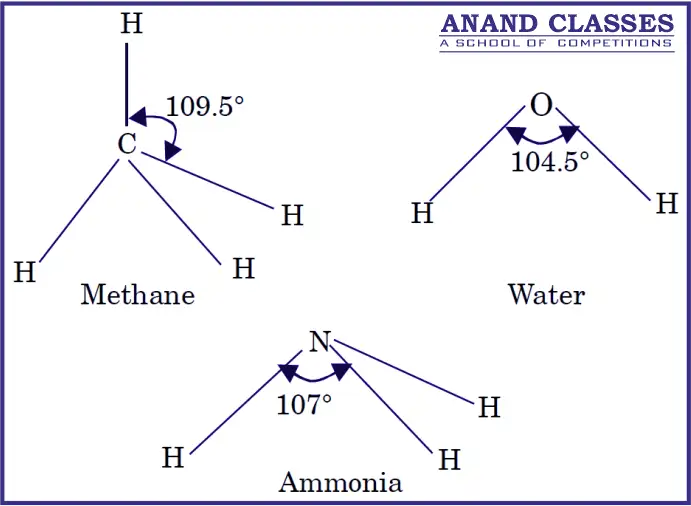
Examples of Bond Angles
| Molecule | Shape | Bond Angle |
|---|---|---|
| BeCl₂ | Linear | 180° |
| BF₃ | Trigonal planar | 120° |
| CH₄ | Tetrahedral | 109.5° |
| NH₃ | Trigonal pyramidal | 107° |
| H₂O | Bent (V-shaped) | 104.5° |
What is the Importance of Bond Angle ?
Bond angle is an important molecular parameter because it:
- Determines the shape (geometry) of a molecule.
- Helps explain the arrangement of atoms in space.
- Influences the physical and chemical properties of compounds, such as polarity and reactivity.
Define bond dissociation enthalpy and Why is bond dissociation enthalpy considered a measure of bond strength?
We have learnt that when a bond is formed between the atoms, energy is released. This means that the bonded atoms have lesser energy than the separated individual atoms. Obviously, the same amount of energy will be needed to break the bond. This is called bond dissociation enthalpy and is measure of bond strength.
Bond dissociation enthalpy may be defined as the amount of energy required to break one mole of bonds of a particular type between the atoms in the gaseous state.
It is generally expressed in terms of kJ mol–1. For example, the bond dissociation enthalpy of H—H bond in hydrogen molecules is 435.8 kJ mol–1.
H2(g) ⟶ H(g) + H(g) ΔaH° = 435.8 kJ mol–1
This means 435.8 kJ of energy is required to break one mole of H–H bonds.
Similarly, the bond dissociation enthalpy of Cl — Cl in Cl2 is 242.5 kJ mol–1, I — I in I2 is 151 kJ mol–1 and H — I in HI is 298.3 kJ mol–1, etc.
Similarly, for molecules containing double bond (O = O) and triple bond (N ≡ N), bond dissociation enthalpies are :
O2 (O = O) ⟶ O (g) + O (g) ΔaH° = 498.0 kJ mol–1
N2 (N ≡ N) ⟶ N (g) + N (g) ΔaH° = 946.0 kJ mol–1
It may be noted that larger the bond dissociation enthalpy, stronger will be the bond in the molecule. The bond dissociation enthalpy of some simple bonds are given in Table below.
| Bond | Bond Dissociation Enthalpy (kJ/mol) |
|---|---|
| H–H | 435.8 |
| H–Cl | 431.7 |
| H–Br | 366.1 |
| H–I | 298.3 |
| F–F | 158.1 |
| Cl–Cl | 243.5 |
| Br–Br | 192.8 |
| I–I | 151.0 |
| N–H | 389.2 |
| O–H | 464 |
| O=O | 498 |
| C–H | 414 |
| C–C | 348 |
| C=C | 619 |
| C≡C | 836 |
| N≡N | 946.0 |
What are the factors affecting bond dissociation enthalpy?
The factors affecting bond dissociation enthalpy are discuss as follows :
Bond Multiplicity
As bond multiplicity increases, the number of shared electron pairs increases. More shared electrons produce stronger attraction between the nuclei. Therefore, more energy is needed to break the bond. Therefore more the Bond multiplicity, greater is the Bond dissociation enthalpy and vice versa.
Example
| Bond | Bond Multiplicity | Bond dissociation enthalpy (kJ mol⁻¹) |
|---|---|---|
| C–C | 1 | ~348 |
| C=C | 2 | ~614 |
| C≡C | 3 | ~839 |
Thus,
Triple bond > Double bond > Single bond
in bond dissociation enthalpy.
Bond Length
Bond strength depends greatly on bond length. Short bonds bring nuclei closer together and attraction between nuclei and shared electrons becomes stronger and hence more energy is required to break such bonds. Therefore lesser the Bond length, greater is the Bond dissociation enthalpy and vice versa.
| Bond | Bond Length | Bond Strength |
|---|---|---|
| C≡C | Shortest | Highest |
| C=C | Intermediate | Moderate |
| C–C | Longest | Lowest |
Atomic Size
The size of bonded atoms also influences bond strength. Larger atoms have bigger atomic radii and their valence orbitals overlap less effectively and hence poor overlap produces weaker bonds. Therefore more the size of bonded atoms, lesser is the Bond dissociation enthalpy and vice versa.
Example : In Hydrogen halides
| Molecule | Bond dissociation enthalpy |
|---|---|
| H–F | Highest |
| H–Cl | Lower |
| H–Br | Lower |
| H–I | Lowest |
The bond dissociation enthalpy of hydrogen halides decreases in the order HF > HCl > HBr > HI because the atomic size of the halogen increases from fluorine to iodine. As the size of the halogen atom increases, the H–X bond length also increases, resulting in less effective overlap between the hydrogen 1s orbital and the halogen p orbital. Poorer orbital overlap produces a weaker covalent bond, which requires less energy to break. Therefore, HF, having the shortest and strongest bond due to the small size of fluorine, has the highest bond dissociation enthalpy, whereas HI, having the longest and weakest bond due to the large size of iodine, has the lowest bond dissociation enthalpy.
Electronegativity
Electronegativity is the ability of an atom to attract shared electrons. Greater electronegativity generally increases bond polarity and Stronger attraction between atoms usually increases bond strength. Hence, Higher electronegativity generally increases bond dissociation enthalpy.
Example: H–F has a much higher bond dissociation enthalpy than H–I because fluorine is much more electronegative and smaller than iodine.
Hybridization
Hybridization affects bond strength through s-character.
Percentage of s-character:
- sp = 50%
- sp² = 33%
- sp³ = 25%
Greater s-character means:
- Electrons remain closer to the nucleus.
- Stronger attraction develops.
- Stronger bond is formed.
Thus, sp > sp² > sp³ (Bond strength)
Therefore, Bond dissociation enthalpy : sp > sp² > sp³
Example: The C–H bond in an alkyne (sp carbon) is stronger than in an alkene (sp² carbon), which is stronger than in an alkane (sp³ carbon).
Resonance
Resonance can strengthen bonds by delocalizing electrons. Delocalized electrons stabilize the molecule and such bonds require more energy to break.
In benzene, Every C–C bond is neither single nor double. Each bond has partial double-bond character. Therefore, benzene C–C bonds are stronger than ordinary single bonds.
Hence, Resonance generally increases bond dissociation enthalpy.
Bond Polarity
Moderately polar covalent bonds are often stronger than non-polar bonds because of additional electrostatic attraction. However, bond strength depends on several factors together, so polarity alone does not determine bond dissociation enthalpy.
Master related concepts such as Ionic or Electrovalent Bond Explanation, Examples, Factors Affecting Formation of Ionic Bonds
Define average bond enthalpy. Why is average bond enthalpy used for polyatomic molecules?
In the case of polyatomic molecules (which contain more than one bond of the same type), the average of the bond enthalpies of the bonds are taken. The average of the bond dissociation enthalpies is called average bond enthalpy or simply as bond enthalpy.
Average bond enthalpy is used for polyatomic molecules because the same type of bond in a polyatomic molecule does not always have exactly the same bond dissociation enthalpy. The energy required to break a particular bond depends on the molecular environment and the order in which the bonds are broken. Therefore, the bond dissociation enthalpies of similar bonds in a polyatomic molecule may differ slightly. To simplify calculations and comparisons, the average of all the bond dissociation enthalpies of that type of bond is taken, which is called the average bond enthalpy.
For example, in the case of water molecule, the enthalpy needed to break the two O – H bonds is not the same.
H2O (g) ⟶ H (g) + OH (g) ΔaH1° = 502 kJ mol–1
OH (g) ⟶ H (g) + O (g) ΔaH2° = 427 kJ mol–1
The difference in the ΔaH° values in water suggests that the second O – H bond undergoes some change because of the changed chemical environment. This is the reason for some difference in energy of same O–H bond in different molecules such as CH3OH (methanol), C2H5OH (ethanol), water, etc. Therefore
for polyatomic molecules, mean or average bond enthalpy is used. It is obtained as the average of the different bond dissociation enthalpies in a molecule.
For example, for water,
Average bond enthalpy = (502 + 427/2) = 464.5 kJ mol–1
Thus bond enthalpy is the average enthalpy required to break bonds of a given type in one mole of the gaseous molecules. Obviously, for diatomic molecules, the bond dissociation enthalpy is same as bond enthalpy.
What is bond energy ? Why is Bond Energy Different from Bond Dissociation Enthalpy?
Bond energy is the average energy required to break one mole of a particular type of covalent bond in gaseous molecules into gaseous atoms. It is expressed in kJ mol⁻¹.
For diatomic molecules, bond energy and bond dissociation enthalpy are the same because there is only one bond to break.
Example:
- H₂(g) → 2H(g)
- Bond energy = Bond dissociation enthalpy = 436 kJ mol⁻¹
In polyatomic molecules, identical bonds do not always have the same strength because each bond is influenced by its surrounding atoms and the molecular environment. Also, after one bond is broken, the structure of the remaining molecule changes, so the energy required to break the next similar bond is usually different. Therefore, the energy needed to break each bond one at a time (bond dissociation enthalpy) is not the same.
To overcome this variation, the average of all the bond dissociation enthalpies of the same type of bond is taken, and this average value is called the bond energy (or average bond enthalpy).
Example: Water (H₂O)
Water has two O–H bonds. Energy to break the first O–H bond ≠ Energy to break the second O–H bond. Therefore, the bond energy of the O–H bond is taken as the average of these two bond dissociation enthalpies.
Difference Between Bond Energy and Bond Dissociation Enthalpy
| Bond Energy | Bond Dissociation Enthalpy |
|---|---|
| It is the average energy required to break one mole of a particular type of bond. | It is the energy required to break one specific covalent bond in one mole of gaseous molecules. |
| Used mainly for polyatomic molecules. | Can be measured for both diatomic and polyatomic molecules. |
| It is an average value. | It is a specific value for a particular bond-breaking step. |
| Different bonds of the same type are averaged. | Refers to breaking a particular bond at a particular stage. |
What is Bond order ?
The bond order is defined as the number of bonds between two atoms in a simple molecule. For example, bond order in H2 (with a single shared electron pair) is one, in O2 (with two shared electron pairs) is two and in N2 (with three shared electron pairs) is three. Bond Order of Some Common Molecules as tabulated as below.
| Molecule | Bond | Bond Order |
|---|---|---|
| H₂ | H–H | 1 |
| O₂ | O=O | 2 |
| N₂ | N≡N | 3 |
| CO | C≡O | 3 |
It may be noted that isoelectronic species (molecules and ions) have same bond order. For example,
F2 , O22– (18 electrons) have bond order 1
N2, CO and NO+ (14 electrons) have bond order = 3
It may be remembered that in general,
With increase in bond order, bond enthalpy increases and bond length decreases.
Note : Bond order will discuss in detail in next article of Bond order.