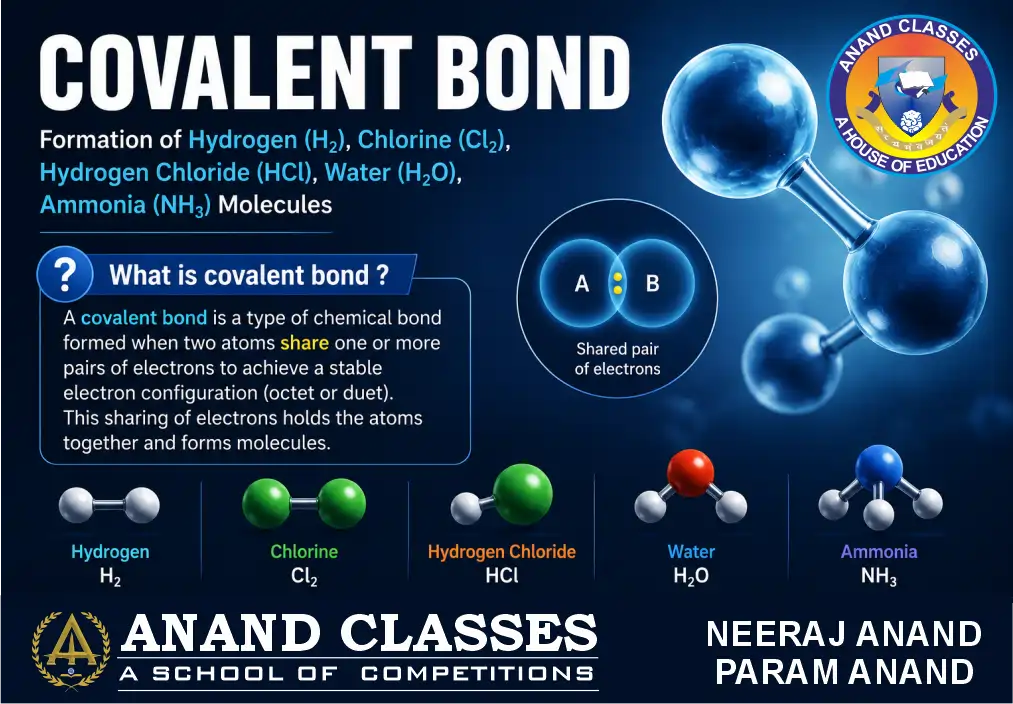
Covalent Bond is one of the most important concepts in Class 11 Chemistry and forms the foundation for understanding molecular structures and chemical bonding. These comprehensive, student-friendly notes by Neeraj Anand for Anand Classes explain the formation of Hydrogen (H₂), Chlorine (Cl₂), Hydrogen Chloride (HCl), Water (H₂O), and Ammonia (NH₃) molecules with clear diagrams, simple explanations, and exam-oriented concepts. Specially designed for CBSE, JEE Main, JEE Advanced, and NEET preparation, these notes help students build strong fundamentals and achieve excellent results in both board and competitive examinations.
What is Covalent Bond ?
Langmuir, in 1919, improved the Lewis concept by suggesting that when both the atoms taking part in a chemical combination are short of electrons relative to the nearest noble gas configuration, they can share their electrons in order to complete their octets. Each atom contributes the same number of electrons to form common pairs which are then shared by both atoms.
Define Covalent Bond
The bond formed between the two atoms by mutual sharing of electrons between them in order to complete their octet or duplet (in case of hydrogen having only one shell) is called a covalent bond or covalent linkage, and the number of electrons contributed by each atom is known as covalency.
What is Langmuir Theory ?
In 1919, Langmuir refined the Lewis postulations and introduced the term covalent bond. According to Lewis–Langmuir theory, atoms can combine by sharing of electrons between them. This type of bond is called covalent bond and each atom contributes equal number of electrons for sharing in order to acquire configuration of nearest noble gas. Thus,
the bond formed by mutual sharing of electrons between the combining atoms of the same or different elements is called a covalent bond.
The compounds so formed are called covalent compounds.
To strengthen your concepts, learn about Lattice Enthalpy of Ionic Crystals, Properties of Ionic Compounds
How does a Hydrogen molecule (H₂) form ?
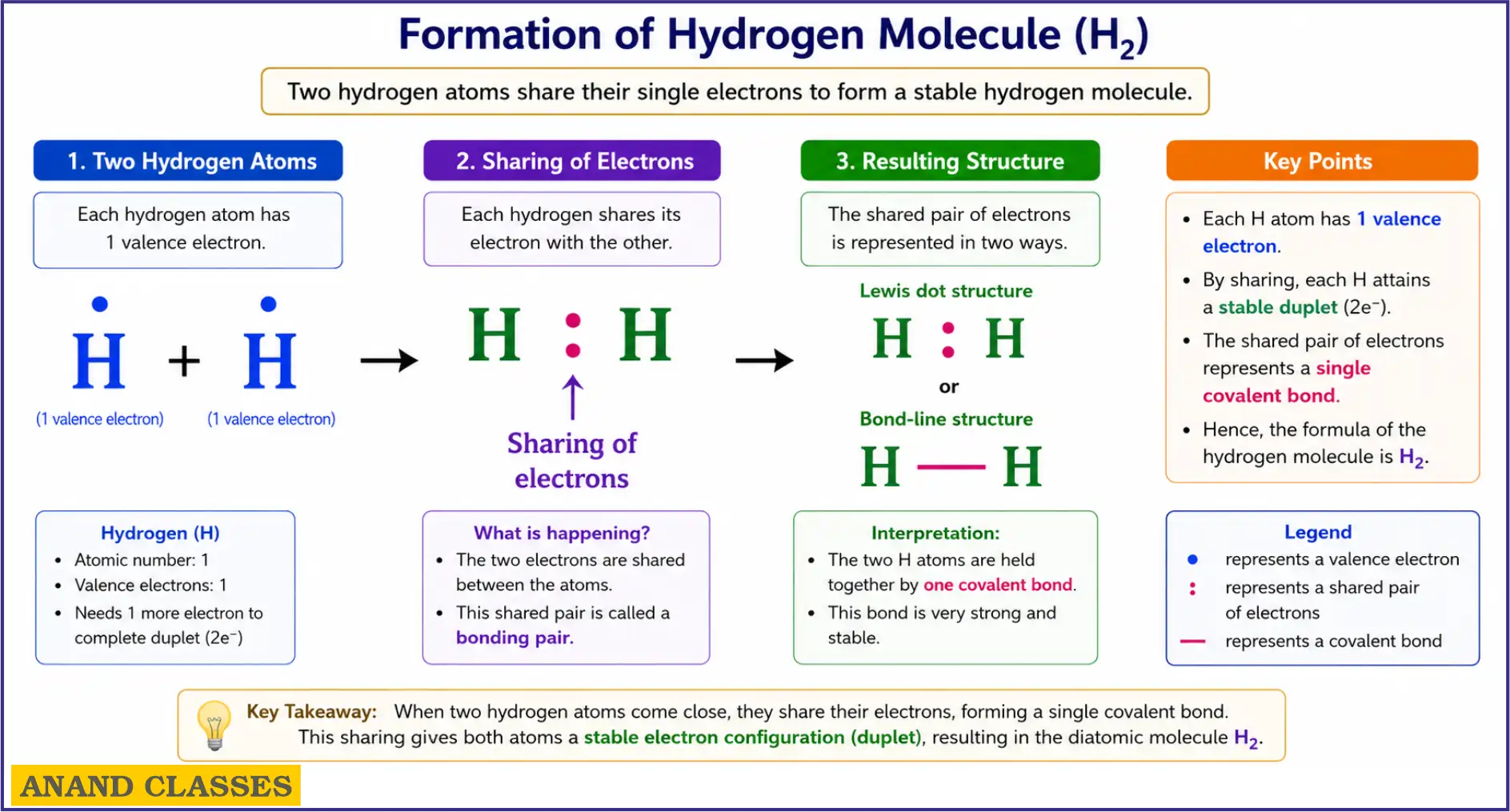
A hydrogen molecule (H₂) is formed when two hydrogen atoms share one pair of electrons. This type of bond is called a single covalent bond.
Each hydrogen atom has one electron in its only shell (1s¹). To attain a stable duplet configuration like helium (1s²), each hydrogen atom requires one more electron.
When two hydrogen atoms come close to each other, each atom contributes one electron. These two electrons form a shared pair of electrons. The shared pair belongs simultaneously to both hydrogen atoms and is contained within the electron shells of both atoms.
As a result:
- Each hydrogen atom effectively has two electrons in its outermost shell.
- Both hydrogen atoms attain the stable duplet electronic configuration of helium (1s²).
Therefore, a hydrogen (H₂) molecule is formed by the mutual sharing of one pair of electrons, resulting in a single covalent bond (H–H). Since both hydrogen atoms have the same electronegativity, they attract the shared electron pair equally. Hence, the H–H bond is a non-polar covalent bond.
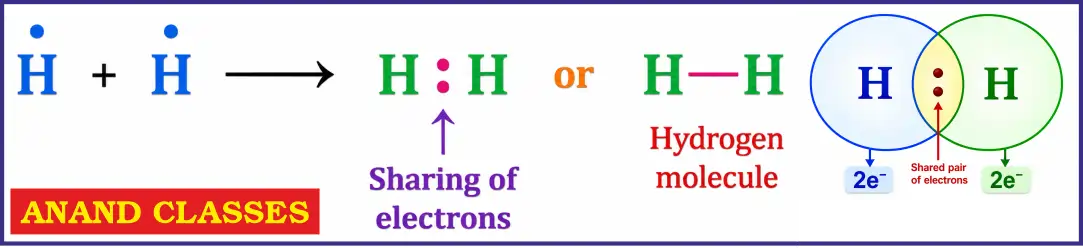
The shared pair of electrons (:) or the single line (—) represents the single covalent bond between the two hydrogen atoms. For example, H2 molecule is shown as below.
The sharing of electrons can also be shown by drawing a circle around each atom. This also helps us to count the electrons around any atom; the shared electron pair is thought of as belonging exclusively to that atom.
Understand related topics like Ionic or Electrovalent Bond Explanation, Examples, Factors Affecting Formation of Ionic Bonds
How does a Chlorine molecule (Cl₂) form ?
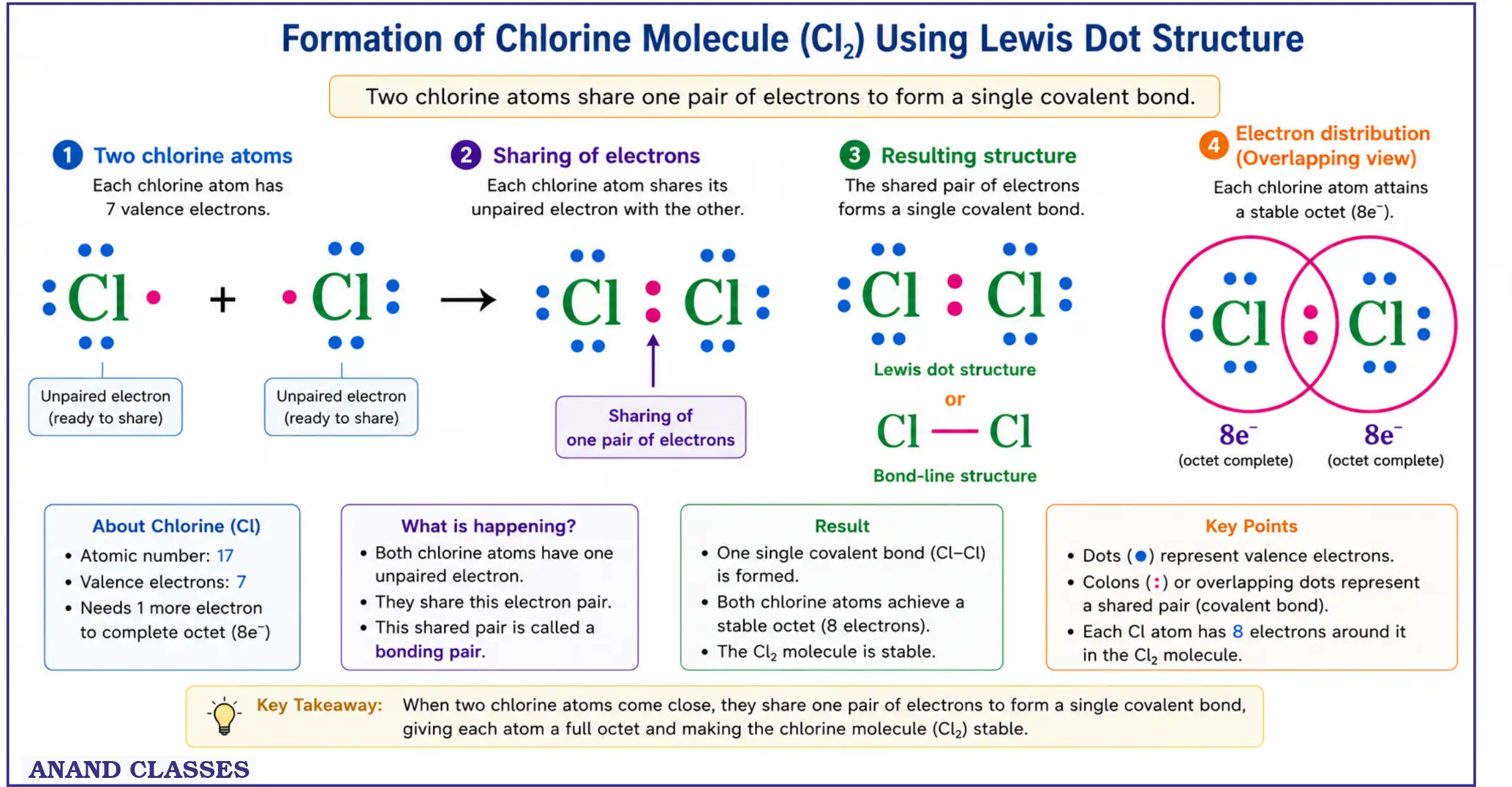
Two chlorine atoms combine with each other to form a chlorine (Cl₂) molecule by sharing one pair of electrons. This type of bond is called a single covalent bond.
Each chlorine atom has the electronic configuration 2, 8, 7 (or [Ne] 3s² 3p⁵). Thus, each chlorine atom has seven electrons in its outermost (valence) shell and requires one more electron to complete its octet and attain the stable electronic configuration of argon.
When two chlorine atoms come close to each other, each atom contributes one electron to form a shared pair of electrons. This shared pair belongs to both chlorine atoms and forms a single covalent bond between them.
As a result:
- Each chlorine atom attains a stable octet by sharing one electron with the other chlorine atom.
- Both atoms achieve the electronic configuration of the nearest noble gas, argon.
Therefore, a chlorine (Cl₂) molecule is formed by the mutual sharing of one pair of electrons, resulting in a single covalent bond (Cl–Cl). Since both atoms are identical and have the same electronegativity, the shared electron pair is attracted equally by both atoms. Hence, the Cl–Cl bond is a non-polar covalent bond.
The shared pair of electrons (:) represents the single covalent bond between the two chlorine atoms. Each chlorine atom also has three lone pairs of electrons that are not involved in bonding.
Build strong concepts by studying Lewis Electron Dot (Symbols) Structure Theory and its Significance
Is Covent Bond fromed between similar atoms ? Give Example
No, a covalent bond is not only formed between similar atoms but it may also be formed between dissimilar atoms. For example, hydrogen atom and chlorine atom form a covalent bond between their atoms to form hydrogen chloride (HCl) molecule.
Strengthen your fundamentals with What is Chemical Bond ? Why do Atoms Combine ? How do Atoms Combine ?
How does a hydrogen chloride (HCl) molecule form ?
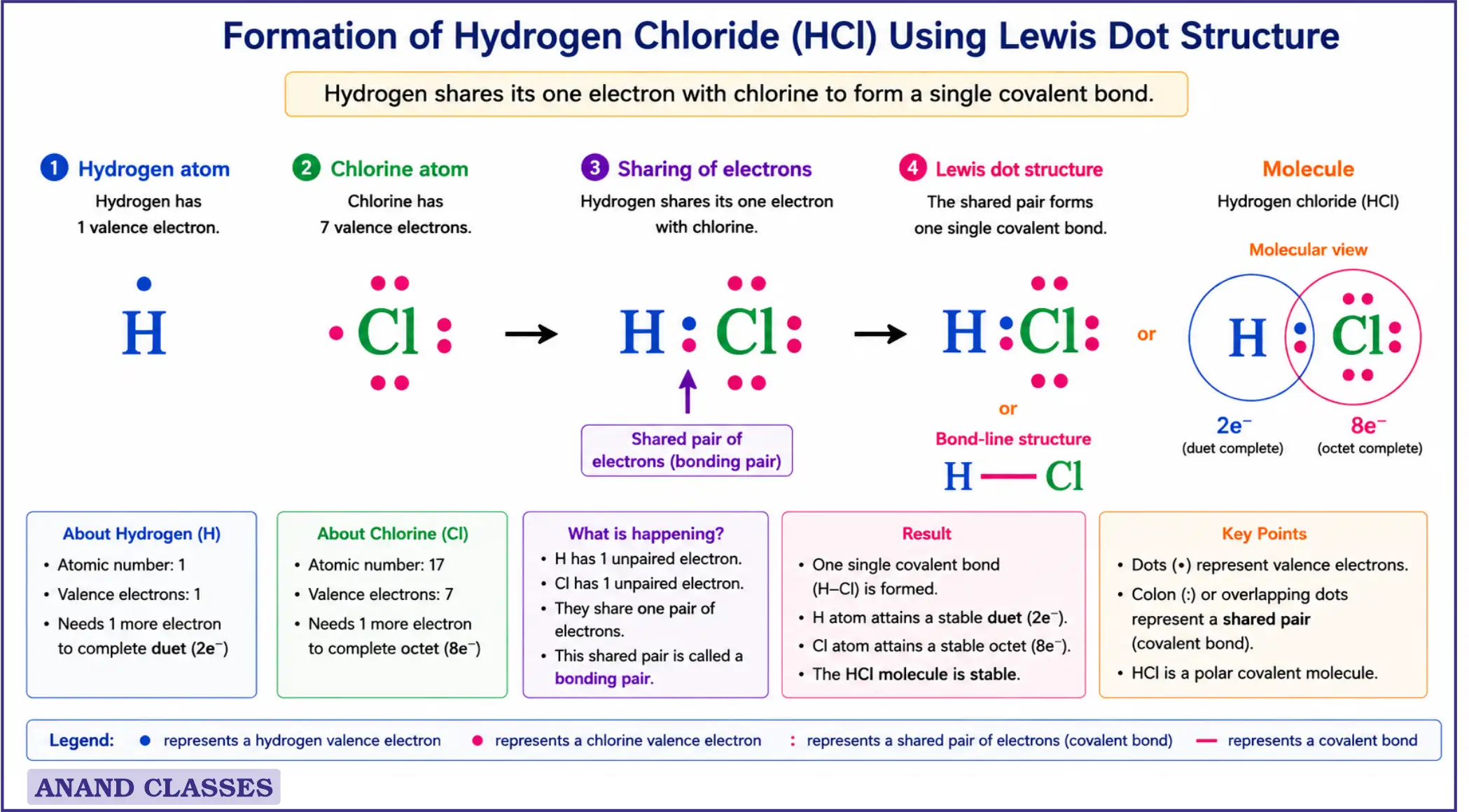
A hydrogen chloride (HCl) molecule is formed by the sharing of one pair of electrons between a hydrogen atom and a chlorine atom. This type of bond is called a single covalent bond.
A hydrogen atom has one electron in its only shell (K shell). It needs one more electron to achieve the stable electronic configuration of helium, which has two electrons in its outer shell.
A chlorine atom has the electronic configuration 2, 8, 7, which means it has seven electrons in its outermost (valence) shell. It requires one more electron to complete its octet and attain the stable electronic configuration of argon (2, 8, 8).
Instead of transferring an electron, the hydrogen atom and the chlorine atom share one electron each, forming a shared pair of electrons. This shared electron pair belongs to both atoms and holds them together by a covalent bond.
As a result:
- The hydrogen atom attains a stable duplet configuration like helium.
- The chlorine atom attains a stable octet configuration like argon.
Thus, the HCl molecule is formed by the mutual sharing of one pair of electrons, and the shared pair forms a single covalent bond between hydrogen and chlorine. Since chlorine attracts the shared electrons more strongly than hydrogen, the bond is polar covalent, with chlorine acquiring a slight negative charge (δ⁻) and hydrogen acquiring a slight positive charge (δ⁺). This polarity is responsible for many of the characteristic properties of hydrogen chloride.
Gain deeper understanding by studying JEE Main Solved Question Papers PYQs Important MCQs Periodic Table and Periodicity
Discuss the Lewis Structures and Covalent Bond Conditions for writing the Lewis dot structures of molecules
The main conditions for writing the electron dot (or Lewis) structures of covalent molecules are :
(i) Each bond is formed as a result of sharing of an electron pair between the atoms.
(ii) Each combining atom contributes one electron to the shared pair.
(iii) Both the combining atoms attain the stable outer shell noble gas configurations as a result of sharing of the electrons. In other words, octets of both the atoms get completed.
Electron dot (or Lewis) structures of covalent molecules are written in accordance with octet rule. According to this, all the atoms in a formula will have a total of eight electrons in the valence shell (shown) except the hydrogen atom. Hydrogen will have only two electrons because only two electrons complete its first shell as in helium. Thus, the elements of group 17 (containing seven valence electrons) such as Cl, would share one electron to attain stable octet; the elements of group 16 (containing six valence electrons) such as O and S would share two electrons; the elements of group 15 (containing five valence electrons) would share three electrons and so on.
How does a Water (H₂O) Molecule form ?
An oxygen atom has the electronic configuration 2, 6, which means it has six electrons in its outermost (valence) shell. To achieve a stable octet (eight electrons in the valence shell), oxygen needs two more electrons.
Each hydrogen atom has one electron in its only shell and requires one more electron to attain the stable duplet configuration of helium.
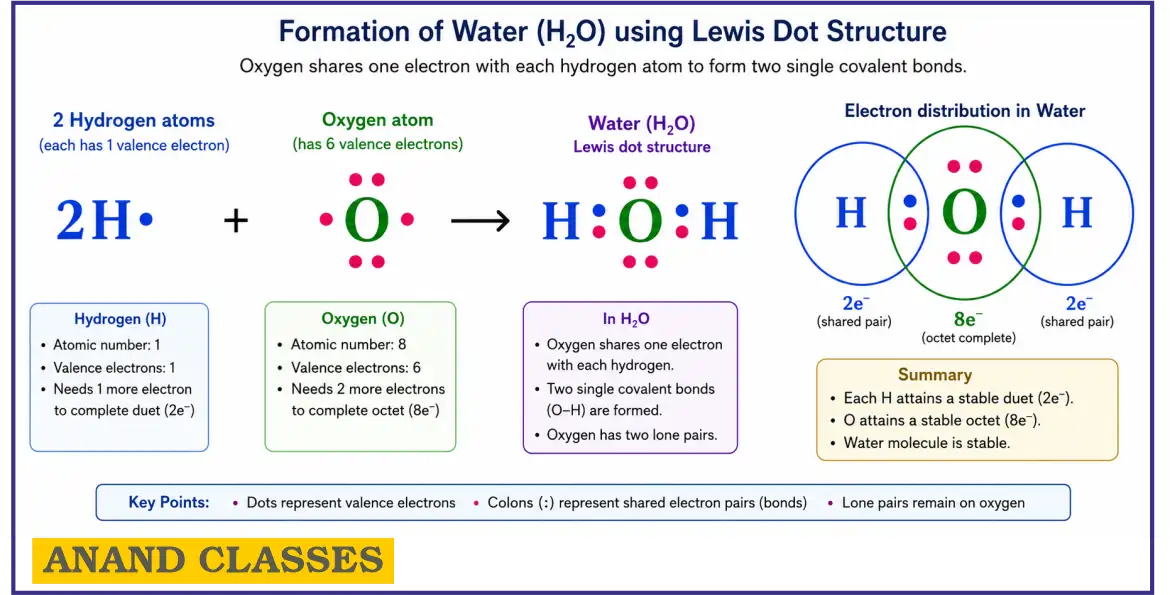
The oxygen atom shares one of its valence electrons with one hydrogen atom and another valence electron with a second hydrogen atom. At the same time, each hydrogen atom shares its one electron with the oxygen atom. Thus, two pairs of electrons are shared, one pair between oxygen and each hydrogen atom.
As a result:
- Each hydrogen atom attains a stable duplet configuration like helium.
- The oxygen atom attains a stable octet configuration by sharing two electron pairs with the two hydrogen atoms.
Therefore, a water (H₂O) molecule is formed by two single covalent bonds (O–H). Oxygen still has two lone pairs of electrons that are not involved in bonding. Since oxygen attracts the shared electrons more strongly than hydrogen, the O–H bonds are polar covalent, making the water molecule polar.
How does a Ammonia (NH₃) Molecule form ?
A nitrogen atom has the electronic configuration 2, 5, which means it has five electrons in its outermost (valence) shell. To achieve a stable octet (eight electrons in the valence shell), nitrogen needs three more electrons.
Each hydrogen atom has one electron in its only shell and requires one more electron to attain the stable duplet configuration of helium.
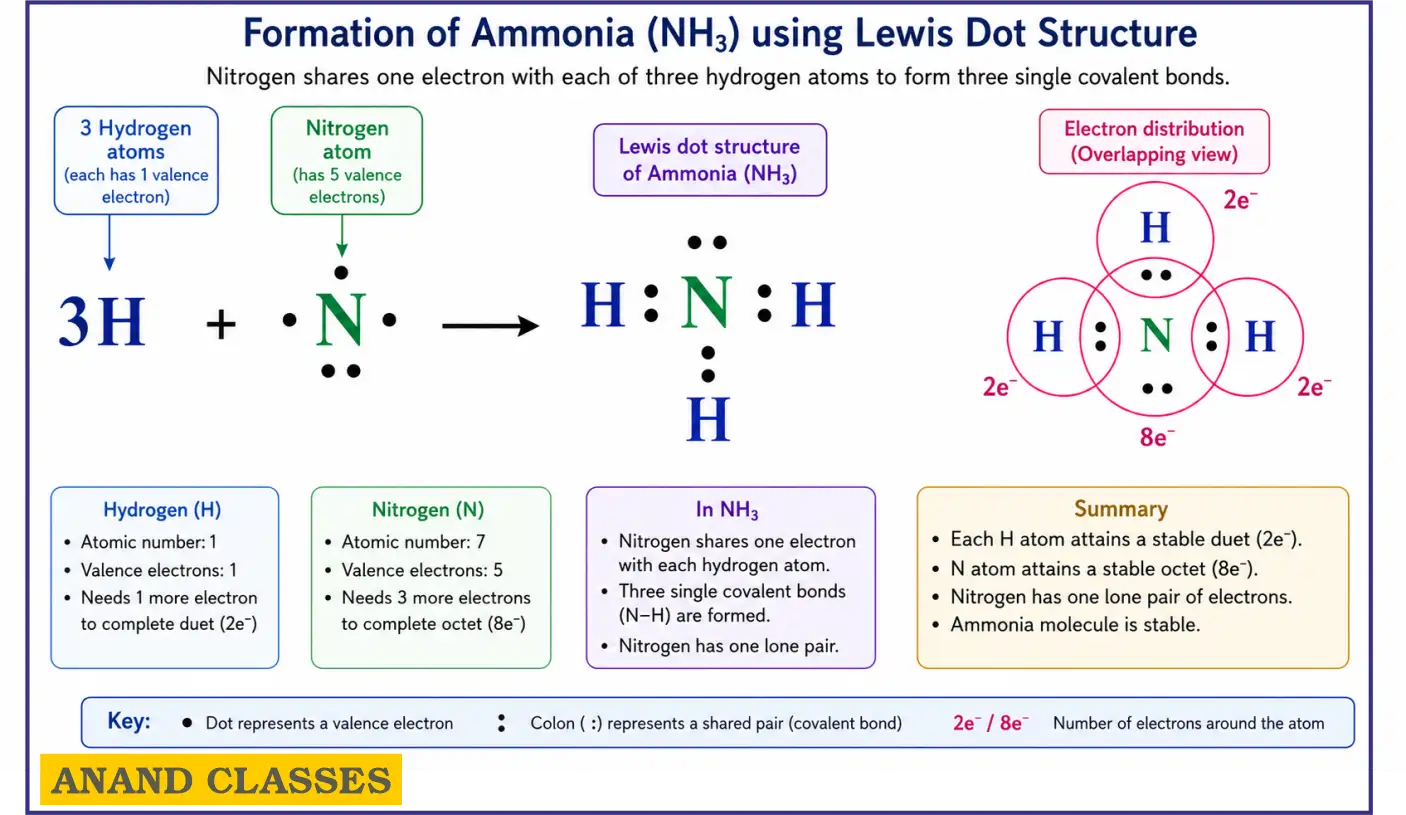
The nitrogen atom shares one of its valence electrons with each of the three hydrogen atoms. At the same time, each hydrogen atom shares its one electron with the nitrogen atom. Thus, three pairs of electrons are shared, one pair between nitrogen and each hydrogen atom.
As a result:
- Each hydrogen atom attains a stable duplet configuration like helium.
- The nitrogen atom attains a stable octet configuration by sharing three electron pairs with the three hydrogen atoms.
Therefore, an ammonia (NH₃) molecule is formed by three single covalent bonds (N–H). Nitrogen also has one lone pair of electrons that is not involved in bonding. Since nitrogen attracts the shared electrons more strongly than hydrogen, the N–H bonds are polar covalent, making the ammonia molecule polar.
How does a Carbon Tetrachloride (CCl₄) Molecule form ?
A carbon atom has the electronic configuration 2, 4, which means it has four electrons in its outermost (valence) shell. To achieve a stable octet (eight electrons in the valence shell), carbon needs four more electrons.
Each chlorine atom has the electronic configuration 2, 8, 7, which means it has seven electrons in its outermost (valence) shell. Each chlorine atom requires one more electron to complete its octet and attain the stable electronic configuration of argon.
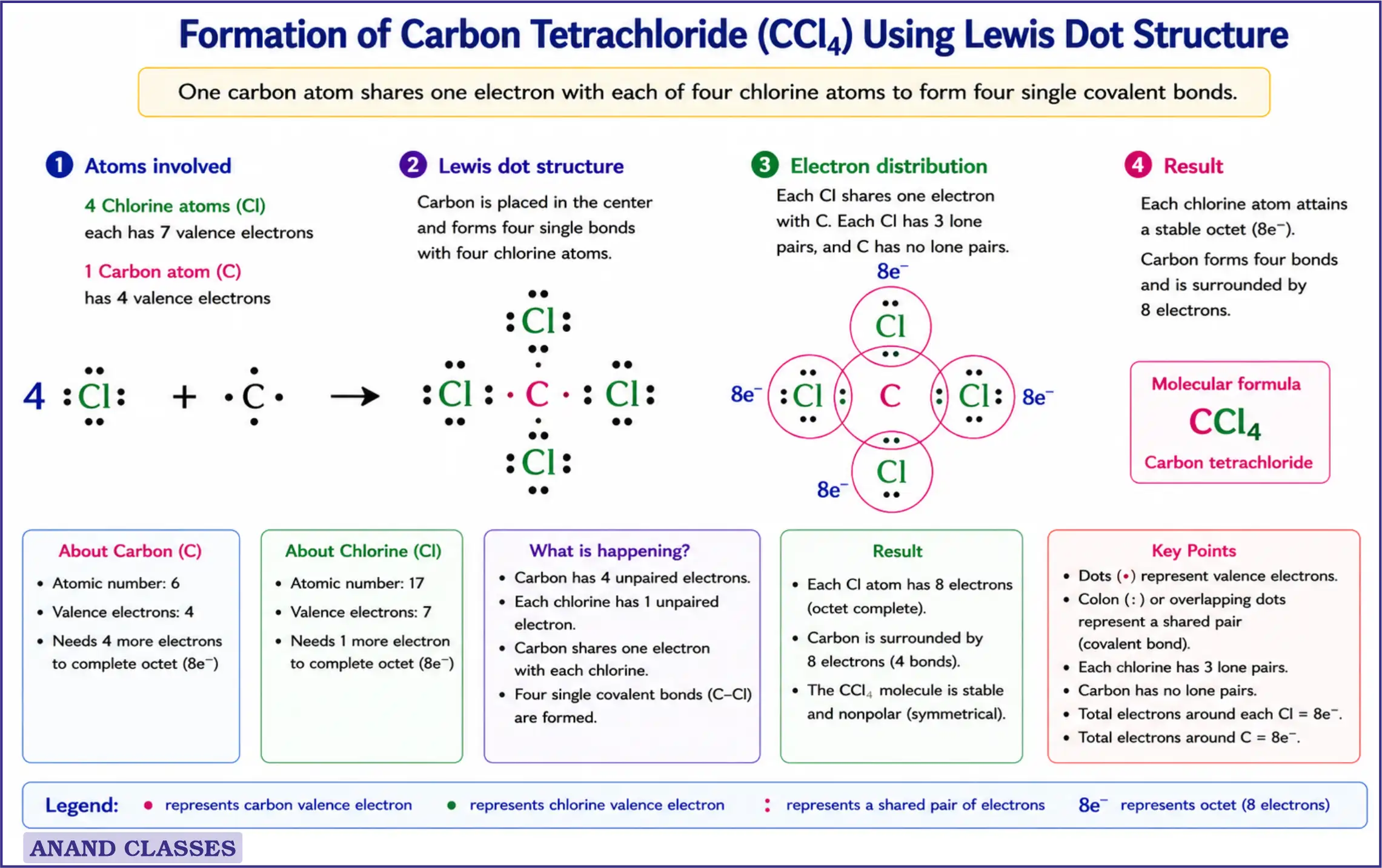
The carbon atom shares one of its four valence electrons with each of the four chlorine atoms. At the same time, each chlorine atom shares one electron with the carbon atom. Thus, four pairs of electrons are shared, one pair between carbon and each chlorine atom.
As a result:
- The carbon atom attains a stable octet by sharing four pairs of electrons.
- Each chlorine atom also attains a stable octet by sharing one electron with the carbon atom.
Therefore, a carbon tetrachloride (CCl₄) molecule is formed by four single covalent bonds (C–Cl). Each chlorine atom has three lone pairs of electrons, while the carbon atom has no lone pairs. Although each C–Cl bond is polar covalent, the molecule has a symmetrical tetrahedral shape, so the bond polarities cancel each other. As a result, carbon tetrachloride is a non-polar molecule.
Important Classification of Elements and Periodicity in Properties Chapter Interlinks
This section provides a complete and interconnected study of Classification of Elements and Periodicity in Properties, starting with detailed theory and notes for Class 11 Chemistry to build a strong conceptual foundation. You can explore atomic radius and its types including covalent, van der Waals, metallic, and ionic radii to understand periodic trends in atomic size. It also includes Screening Effect (Shielding Effect) : Calculation of Effective or Reduced Nuclear Charge (Slater’s Rules), which explains how inner electrons reduce the nuclear attraction on outer electrons and influence periodic trends. In addition, topics like Radius of Cation is Less and Anion is More Than Its Parent Atom, Size Variation in Isoelectronic Series help explain how ionic size changes due to gain or loss of electrons and how nuclear charge affects size in species with the same number of electrons. The causes of periodicity explain why elements show repeating properties based on electronic configuration, which is further supported by the modern periodic law and structure of the modern periodic table including groups, periods, and blocks for elements even beyond atomic number 100. The historical development is covered through Mendeleev’s periodic law and table, leading to the modern classification of elements into s, p, d, and f blocks with prediction of period, group, and block. To strengthen exam preparation, you can practice JEE Main PYQs, IMU CET PYQs and Merchant Navy sponsorship exam MCQs, and other previous year questions with solutions, along with solved examples, conceptual questions, and practice problems on the modern periodic table. Learn more in this section also to radius of cation is less and anion is more than its parent atom and size variation in Isoelectronic Series. Additionally, complete study material, mock tests, and guidance are provided under Anand Classes Chemistry notes, along with expert support from Er Neeraj Anand, making this section a comprehensive resource for competitive exam preparation.