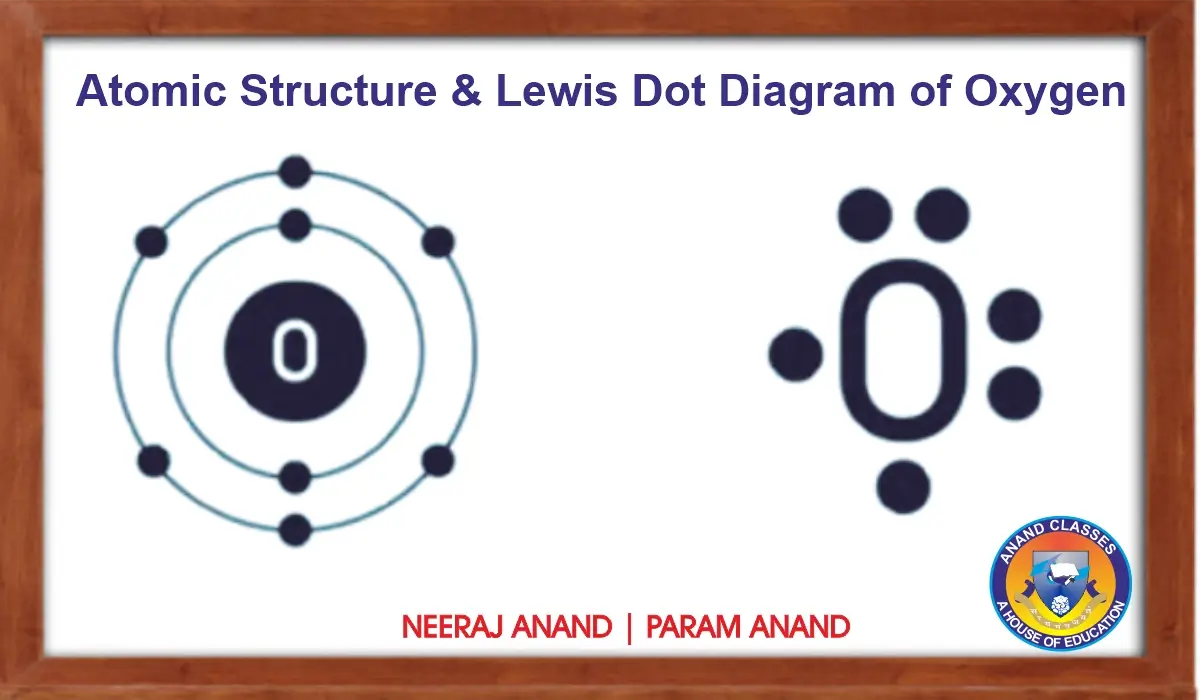
Lewis Electron Dot Structure Theory is a simple and effective method used to represent the valence electrons of atoms and molecules. Introduced by Gilbert N. Lewis, this theory helps explain how atoms combine to form chemical bonds by gaining, losing, or sharing electrons. Lewis symbols and electron dot structures provide a visual representation of valence electrons, making it easier to understand bond formation, molecular structure, and chemical stability. This concept is an important part of Class 11 Chemistry and serves as a foundation for studying chemical bonding in JEE Main, JEE Advanced, NEET, and other competitive examinations.
Class 11 Chemistry Notes for Chapter 4 Chemical Bonding and Molecular Structure With Detail Theory and Explanation
Strengthen your understanding of Lewis Electron Dot Structures with easy-to-follow notes, illustrations, solved examples, and practice questions. This study material is designed to help Class 11 students build a strong foundation in chemical bonding and prepare effectively for school examinations as well as competitive exams such as JEE Main, JEE Advanced, NEET, and IMUCET.
Explore more concepts related to What is Chemical Bond ? Why do Atoms Combine ? How do Atoms Combine ?
Why is it important to study concepts step by step in Chemistry?
Learning concepts in a systematic manner helps students develop a strong foundation, improve retention, and understand advanced topics more effectively.
Important exam-related topics include Lattice Enthalpy of Ionic Crystals, Properties of Ionic Compounds
How can regular practice improve performance in competitive examinations?
Regular practice enhances accuracy, boosts confidence, improves time management, and helps students become familiar with different types of examination questions.
What is Lewis Structure Theory ?
In the formation of molecules, only the electrons present in the outermost shell of an atom participate in chemical bonding. These electrons are known as valence electrons. The electrons present in the inner shells generally do not take part in bond formation.
To represent valence electrons conveniently, G. N. Lewis introduced a simple notation known as Lewis Symbols or Electron Dot Symbols.
You may also like to study Modern Periodic Law and Table (Groups, Periods, Blocks) : Elements with Atomic Numbers More than 100
What are Lewis Symbols or Electron Dot Symbols ?
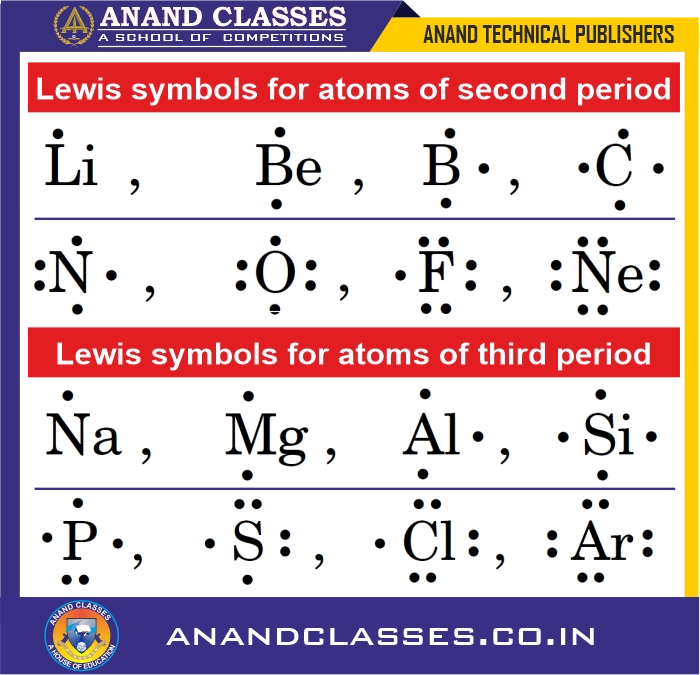
According to Lewis notations, the symbol of the element represents the whole of the atom except the valence electrons (i.e., nucleus and the electrons in the inner energy shells). The valence electrons are represented by placing dots (·) or crosses (×) around the symbol. For example, the Lewis symbols for the atoms of second and third period are shown in following Figure.
What is the Significance of Lewis Symbols ?
The number of dots around the symbol gives the number of electrons present in the outermost shell. This number of electrons helps to calculate the common valency of the elment. That is why these electrons are called vqlence shell electrons. Hence the significance of Lewis Symbols are :
1. Indicate the Number of Valence Electrons
Lewis symbols directly show the number of electrons present in the outermost shell of an atom. This makes it easier to understand the bonding behavior of elements.
2. Help Predict the Valency of Elements
The number of valence electrons helps determine the combining capacity or valency of an element. For example :
Lithium (Li) has 1 valence electron and is monovalent.
Beryllium (Be) has 2 valence electrons and is divalent.
Boron (B) has 3 valence electrons and is trivalent.
Carbon (C) has 4 valence electrons and is tetravalent.
For elements having more than four valence electrons, the common valency is usually calculated by subtracting the number of valence electrons from eight. For example :
Nitrogen (N) has 5 valence electrons and its valency is 8 – 5 = 3
Oxygen (O) has 6 valence electrons and its valency is 8 – 6 = 2
Fluorine (F) has 7 valence electrons and its valency is 8 – 7 = 1
Neon (Ne) has 8 valence electrons and its valency is 8 – 8 = 0
Thus, the common valency of an element is either equal to the number of valence electrons or equal to 8 minus the number of valence electrons.
Solved Examples Based On Lewis Structure Theory
Example.1 : CBSE Board
Write Lewis dot symbols for the following atoms and ions :
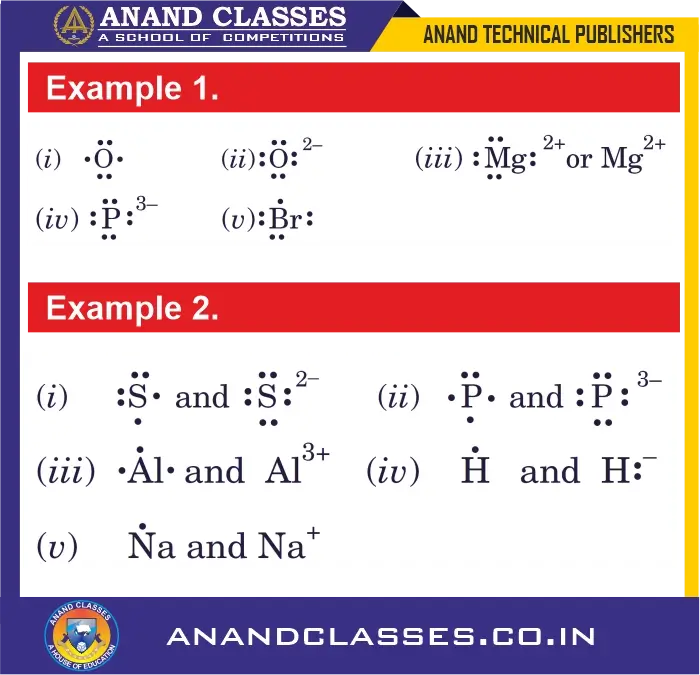
(i) O (ii) O²⁻ (iii) Mg²⁺ (iv) P³⁻ (v) Br
Solution
(i) Oxygen (O)
Oxygen has atomic number 8 and electronic configuration 1s² 2s² 2p⁴. Therefore, it contains 6 valence electrons. Its Lewis symbol consists of the symbol O surrounded by six dots.
(ii) Oxide Ion (O²⁻)
An oxygen atom gains two electrons to form O²⁻. The ion now contains 8 valence electrons and attains a stable octet. Its Lewis symbol consists of O²⁻ surrounded by eight dots.
(iii) Magnesium Ion (Mg²⁺)
Magnesium has atomic number 12 and electronic configuration 1s² 2s² 2p⁶ 3s². It loses two valence electrons to form Mg²⁺. Therefore, the ion is represented without any dots.
(iv) Phosphide Ion (P³⁻)
Phosphorus has atomic number 15 and contains 5 valence electrons. After gaining three electrons, it forms P³⁻ with a complete octet of 8 electrons. Hence, its Lewis symbol contains eight dots around P³⁻.
(v) Bromine (Br)
Bromine has atomic number 35 and electronic configuration [Ar] 3d¹⁰ 4s² 4p⁵. It contains 7 valence electrons. Therefore, its Lewis symbol consists of Br surrounded by seven dots.
Explore more concepts related to NCERT Exemplar Solutions Classification of Elements and Periodicity in Properties Class 11 Chemistry
Example.2 : CBSE Board
Write Lewis dot symbols for the following atoms and ions :
(i) S and S²⁻ (ii) P and P³⁻ (iii) Al and Al³⁺ (iv) H and H⁻ (v) Na and Na⁺
Solution
(i) Sulphur (S) and Sulphide Ion (S²⁻)
Sulphur has atomic number 16 and contains 6 valence electrons. Therefore, its Lewis symbol has six dots.
The sulphide ion, S²⁻, is formed by gaining two electrons. It contains 8 valence electrons and is represented by eight dots around the symbol.
(ii) Phosphorus (P) and Phosphide Ion (P³⁻)
Phosphorus has 5 valence electrons and is represented by five dots.
The phosphide ion gains three electrons and attains an octet. Hence, P³⁻ is represented by eight dots.
(iii) Aluminium (Al) and Aluminium Ion (Al³⁺)
Aluminium contains 3 valence electrons and is represented by three dots around the symbol.
After losing three electrons, Al³⁺ has no valence electrons left in its outermost shell and is represented without dots.
(iv) Hydrogen (H) and Hydride Ion (H⁻)
Hydrogen contains one valence electron and is represented by one dot.
The hydride ion gains one electron and attains a stable duplet configuration. Therefore, H⁻ is represented by two dots.
(v) Sodium (Na) and Sodium Ion (Na⁺)
Sodium has one valence electron and is represented by one dot.
The sodium ion, Na⁺, is formed by losing one electron and is represented without any dots.
The electron-dot structures for these species can be represented diagrammatically using the appropriate number of dots around the atomic symbol as shown in Following Figure for example 1 and example 2.
Related topics include IMU CET Merchant Navy Sponsorship Exam MCQs (PYQs) on Periodic Table and Periodicity
What are Valence Electrons?
Valence is the number of electrons an atom must lose or gain to attain the nearest noble gas or inert gas electronic configuration. “Electrons in the outer shells that are not filled are called valence electrons”.
The valence electrons are part of the chemical reactions because they contain more energy compared to the electrons present in inner orbits. Meanwhile, the number of valence electrons present also helps us determine a specific element’s chemical properties, such as its valence or valency, the formation of bonds with other elements. It also gives us an idea of how readily the atoms can form bonds, the number of unpaired electrons and how many atoms can take part.
What are the Characteristics of Valence Electrons ?
Electrons are involved in the chemical bonding and reactions of the atom. It is said to occupy orbitals in an atom. The number of valence electrons of an atom can be obtained from the periodic table because it is equal to the group number of the atom. Atoms are most stable if they have a filled valence shell of electrons. Atoms transfer or share electrons in such a way that they can attain a filled shell of electrons.
Some key characteristics of a valence electron are :
- For the main group elements, the valence electron exists only in the outermost electron shell.
- A valence electron can exist in the inner shell of a transition metal.
- An atom consisting of a full shell of valence electrons will usually be chemically inert.
- A valence electron can either absorb or release energy in the form of a photon.
- Valence electrons also determine the electrical conductivity of an element. Depending on the nature of elements can be metal, non-metal, or metalloid.
How to Determination of Valence Electrons ?
One of the easiest ways to find valence electrons is by checking out the elements’ place in the periodic table. The valence electrons of an element can be found by closely examining the vertical column in which the elements are grouped. By looking at the group number that is given we can identify the number of valence electrons that an element which is listed under that specific column has.
Another way to find or determine valence electrons is by knowing the electronic configuration.
However, if we take the transition metals (groups 3-12), finding the valence electron is quite complicated. These elements’ atomic structure is rigid and the d-subshell is incomplete and sits lower than the outer shell.
What are the Valence Electrons of Elements of Important Elements in Chemistry ?
Here is a list of the number of valence electrons present in the different groups.
| Periodic Table Group | Valence Electrons |
| Alkali metals – Group 1 (I) | 1 |
| Alkaline earth metals – Group 2 (II) | 2 |
| Boron group – Group 13 (III) | 3 |
| Carbon group – Group 14 (IV) | 4 |
| Nitrogen group – Group 15 (V) | 5 |
| Oxygen group – Group 16 (VI) | 6 |
| Halogens – Group 17 (VII) | 7 |
| Noble gases – Group 18 (VIII or 0) | 8 |
Short Answer Conceptual Type Questions and Answers
What electrons do Lewis structures show?
The outermost central level of energy-containing electrons is called the level of valence and includes electrons of valence. Lewis symbols are diagrams showing the number of valence electrons of a specific element with dots indicating lone pairs.
How do electron dot structures represent shared electrons?
Electron dot structure-valence electrons are represented by dots around the symbol of elements.
What is the purpose of Lewis structures?
The aim of Lewis structures is to provide a simple way for chemists to view molecules that allows accurate predictions about the actual molecules and structure and properties to be made.
What is the Lewis dot structure in chemistry?
Lewis structures, also known as electron-dot or electron-dot diagrams, are diagrams showing the bonding between a molecule’s atoms and the lone pairs of electrons that may occur in the molecule.
Why are Lewis structures important?
For the prediction of geometry, polarity and reactivity of (in)organic compounds, Lewis structures are actually very important. The Lewis structure is drawn for individual atoms by putting a dot for each available valence electron around the atom.
How do you find the valence electrons?
For neutral atoms, the number of valence electrons is equal to the atom’s main group number. The main group number for an element can be found from its column on the periodic table. For example, carbon is in group 4 and has 4 valence electrons. Oxygen is in group 6 and has 6 valence electrons.
What is a valence electron with example?
The total number of electrons present in last shell orbit is known as valence electron. For example: Oxygen has 6 electrons present in last orbital shell hence 6 is valence electron.
What is called valency?
Valency is the combining power of an element. Elements in the same group of the periodic table have the same valency. The valency of an element is related to how many electrons are in the outer shell.
What is the purpose of valence electrons?
Valence electrons are the outer-shell electrons of an atom. Valence electrons determine the reactivity of an atom.
How do valence electrons work?
Valence electrons are the electrons located at the outermost shell of an atom. … Because when two atoms interact, the electrons in the outermost shells are the first ones to come into contact with each other and are the ones that determine how an atom will react in a chemical reaction.
Important Classification of Elements and Periodicity in Properties Chapter Interlinks
This section provides a complete and interconnected study of Classification of Elements and Periodicity in Properties, starting with detailed theory and notes for Class 11 Chemistry to build a strong conceptual foundation. You can explore atomic radius and its types including covalent, van der Waals, metallic, and ionic radii to understand periodic trends in atomic size. It also includes Screening Effect (Shielding Effect) : Calculation of Effective or Reduced Nuclear Charge (Slater’s Rules), which explains how inner electrons reduce the nuclear attraction on outer electrons and influence periodic trends. In addition, topics like Radius of Cation is Less and Anion is More Than Its Parent Atom, Size Variation in Isoelectronic Series help explain how ionic size changes due to gain or loss of electrons and how nuclear charge affects size in species with the same number of electrons. The causes of periodicity explain why elements show repeating properties based on electronic configuration, which is further supported by the modern periodic law and structure of the modern periodic table including groups, periods, and blocks for elements even beyond atomic number 100. The historical development is covered through Mendeleev’s periodic law and table, leading to the modern classification of elements into s, p, d, and f blocks with prediction of period, group, and block. To strengthen exam preparation, you can practice JEE Main PYQs, IMU CET PYQs and Merchant Navy sponsorship exam MCQs, and other previous year questions with solutions, along with solved examples, conceptual questions, and practice problems on the modern periodic table. Learn more in this section also to radius of cation is less and anion is more than its parent atom and size variation in Isoelectronic Series. Additionally, complete study material, mock tests, and guidance are provided under Anand Classes Chemistry notes, along with expert support from Er Neeraj Anand, making this section a comprehensive resource for competitive exam preparation.