
Rules for writing Lewis formula structures of molecules are fundamental to understanding chemical bonding and molecular geometry in Class 11 Chemistry. These comprehensive notes of Anand Classes written by Neeraj Anand for explain the step-by-step rules for drawing accurate Lewis structures, including the arrangement of valence electrons, selection of the central atom, formation of covalent bonds, and completion of octets. Designed for CBSE, JEE Main, JEE Advanced, and NEET students, these exam-focused study materials simplify complex concepts and help build a strong foundation for board and competitive examinations.
What are the rules for writing Lewis Formula Structures?
The following steps are adopted for writing the Lewis dot structures or Lewis structures :
Step 1. Calculate the total number of electrons required for writing the structure by adding the valence electrons of the combining atoms. For example, in methane, CH4 molecule, there are 8 valence electrons (4 from carbon and 4 from four H atoms).
Step 2. For anions, each negative charge means addition of an electron to the valence electrons and for cations, each positive charge means subtraction of one electron from the valence electrons.
Step 3. Knowing the chemical symbols of the combining atoms and guessing the skeletal structure of the compound, distribute the total number of electrons as bonding shared pairs between the atoms in proportion to the total bonds.
Step 4. In general, the least electronegative atom occupies the central position in the molecule. Hydrogen and fluorine generally occupy the terminal positions.
Step 5. After distributing the shared pairs of electrons for single bonds, the remaining electron pairs are used either for multiple bonds or they constitute lone pairs.
The basic requirement is that each bonded atom gets an octet of electrons.
Let us learn these steps by writing Lewis structures for some molecules or ions.
You may also like to study Lewis Structures of multiple covalent bonds molecules (O₂, CO₂, N₂, C₂H₄, C₂H₂)
Write the Lewis formula strcuture for carbon monoxide (CO) molecule
The following steps are adopted for writing the Lewis dot structures or Lewis structures for carbon monoxide, CO molecule :
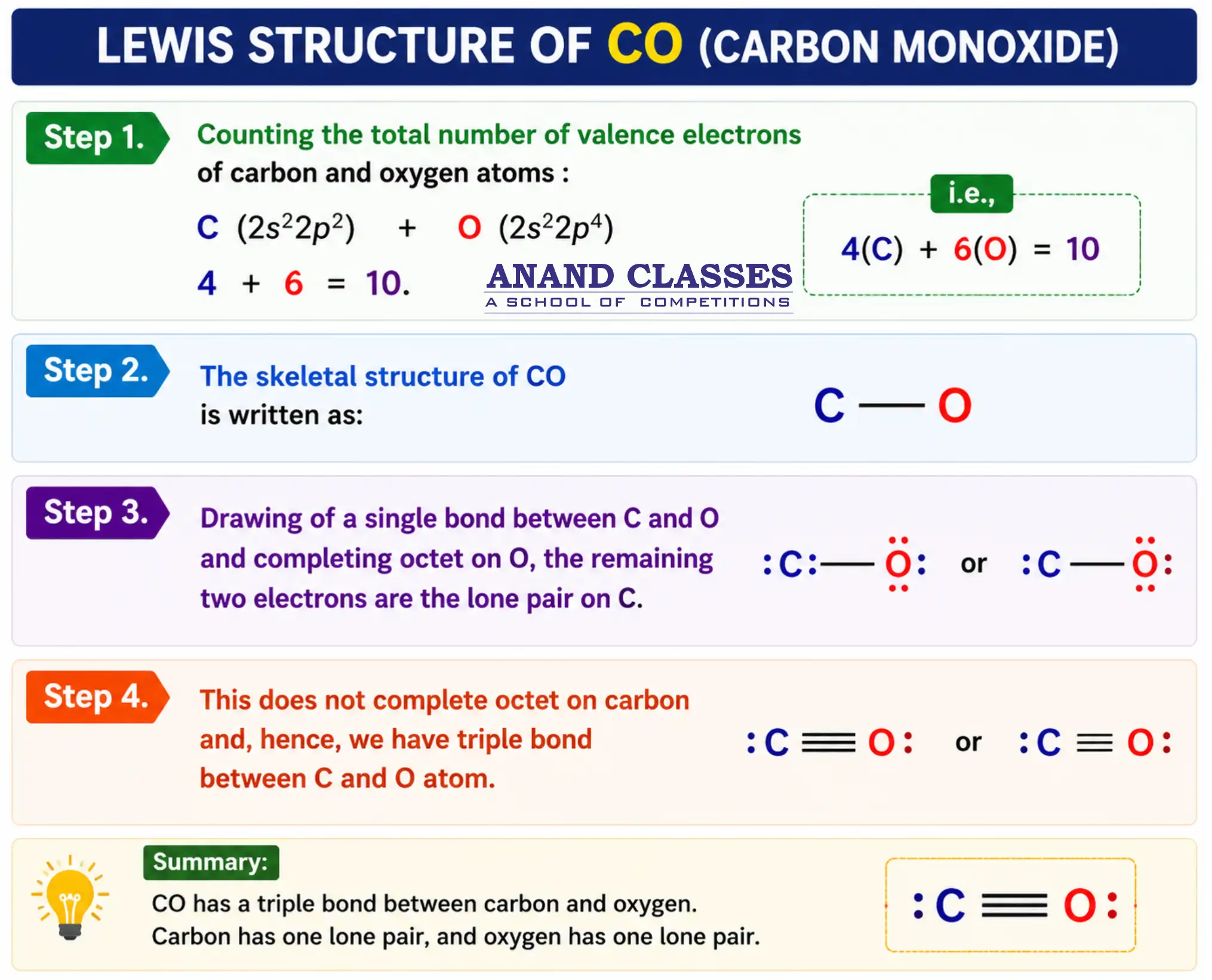
This satisfies octet rule condition for both carbon and oxygen atoms.
Important related topics are Covalent Bond, Formation of Hydrogen (H₂), Chlorine (Cl₂), Hydrogen Chloride (HCl), Water (H₂O), Ammonia (NH₃) Molecules
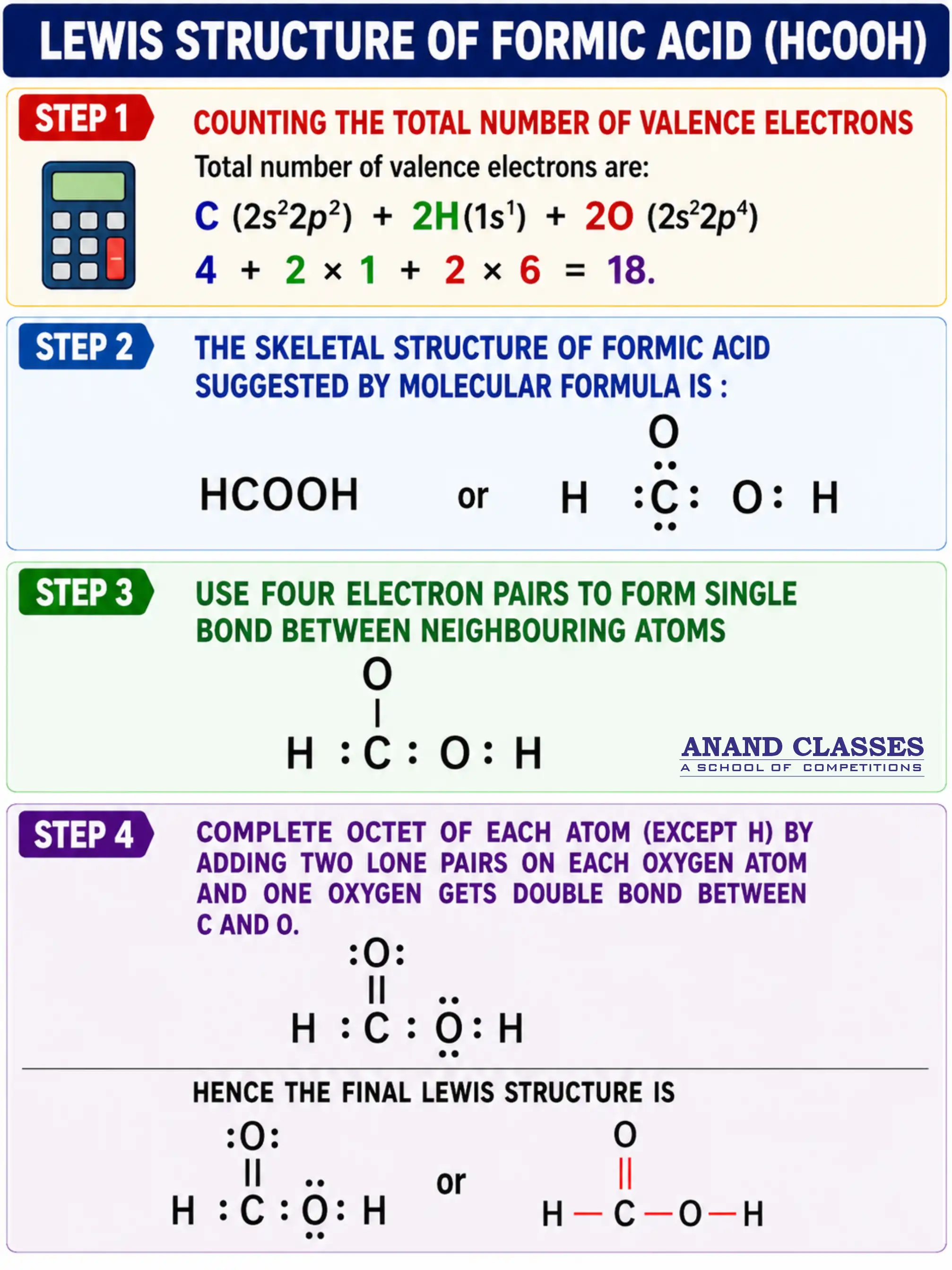
Write the Lewis formula strcuture for formic acid (HCOOH) molecule
The following steps are adopted for writing the Lewis dot structures or Lewis structures for formic acid (HCOOH) molecule :
Important exam-related topics include JEE Main PYQs Previous Year Questions MCQs : Classification of Elements and Periodicity in Properties
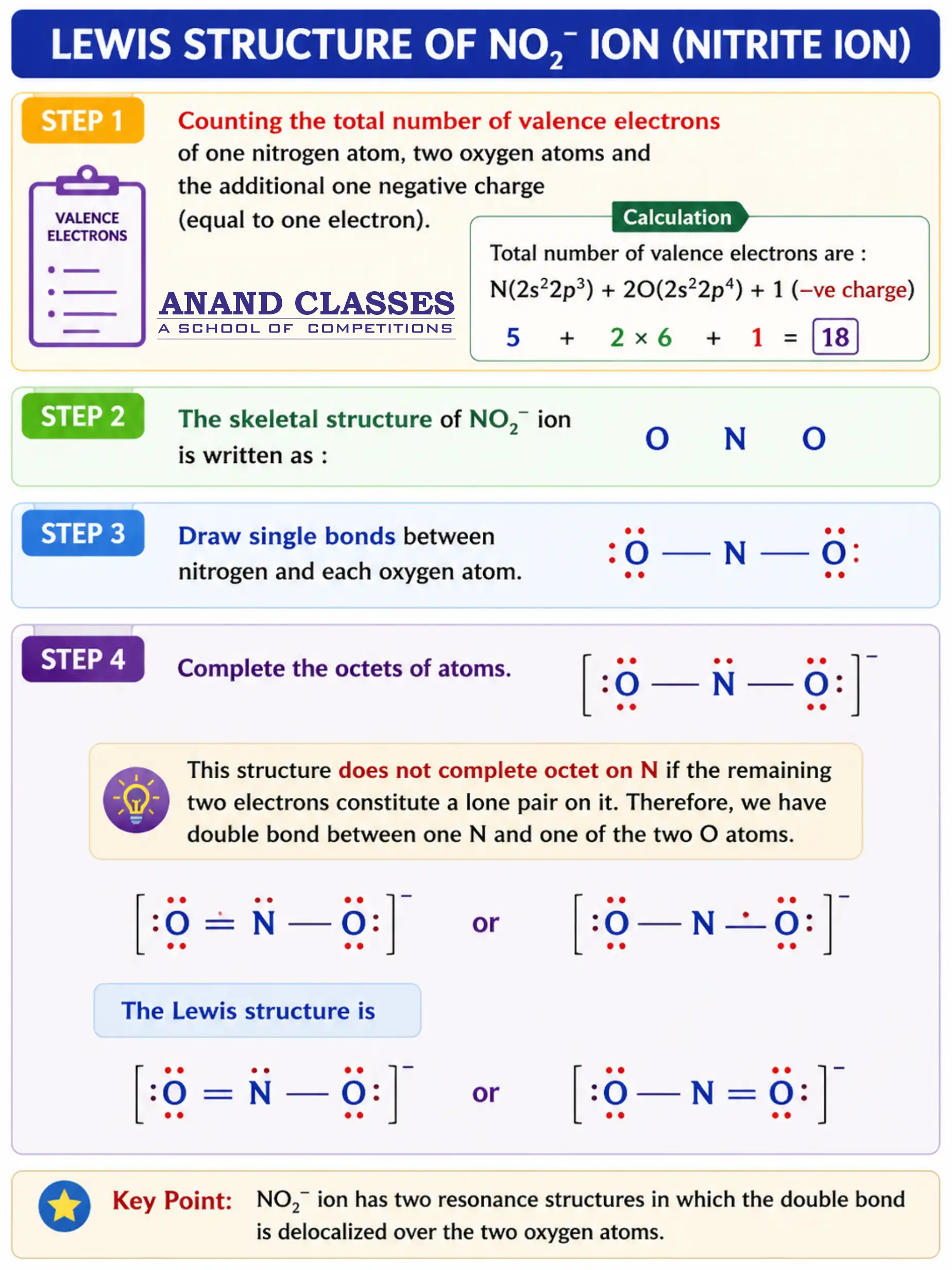
Write the Lewis formula strcuture for nitrite (NO2– ) ion
The following steps are adopted for writing the Lewis dot structures or Lewis structures for nitrite (NO2– ) ion :
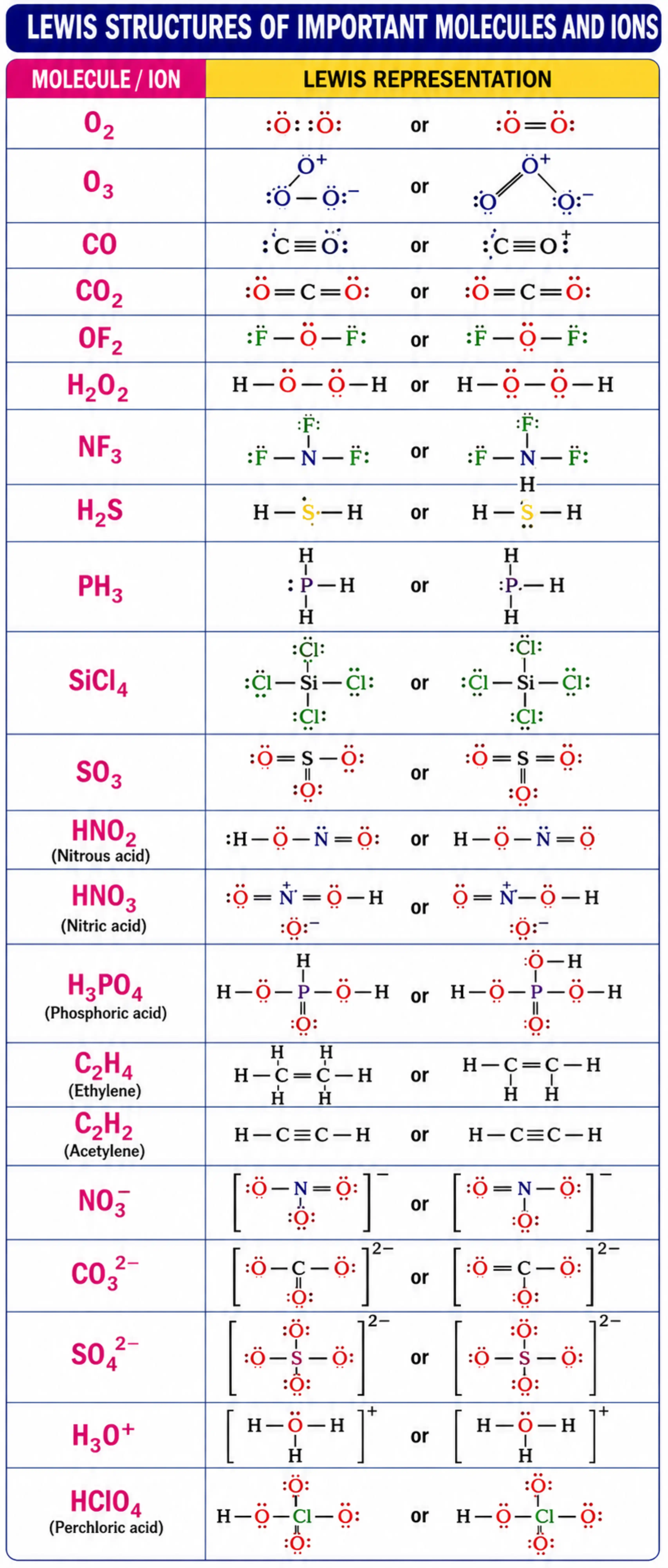
Lewis dot structures of important molecules or ions
Lewis dot representation of some molecules or ions are summarized below.
Important Classification of Elements and Periodicity in Properties Chapter Interlinks
This section provides a complete and interconnected study of Classification of Elements and Periodicity in Properties, starting with detailed theory and notes for Class 11 Chemistry to build a strong conceptual foundation. You can explore atomic radius and its types including covalent, van der Waals, metallic, and ionic radii to understand periodic trends in atomic size. It also includes Screening Effect (Shielding Effect) : Calculation of Effective or Reduced Nuclear Charge (Slater’s Rules), which explains how inner electrons reduce the nuclear attraction on outer electrons and influence periodic trends. In addition, topics like Radius of Cation is Less and Anion is More Than Its Parent Atom, Size Variation in Isoelectronic Series help explain how ionic size changes due to gain or loss of electrons and how nuclear charge affects size in species with the same number of electrons. The causes of periodicity explain why elements show repeating properties based on electronic configuration, which is further supported by the modern periodic law and structure of the modern periodic table including groups, periods, and blocks for elements even beyond atomic number 100. The historical development is covered through Mendeleev’s periodic law and table, leading to the modern classification of elements into s, p, d, and f blocks with prediction of period, group, and block. To strengthen exam preparation, you can practice JEE Main PYQs, IMU CET PYQs and Merchant Navy sponsorship exam MCQs, and other previous year questions with solutions, along with solved examples, conceptual questions, and practice problems on the modern periodic table. Learn more in this section also to radius of cation is less and anion is more than its parent atom and size variation in Isoelectronic Series. Additionally, complete study material, mock tests, and guidance are provided under Anand Classes Chemistry notes, along with expert support from Er Neeraj Anand, making this section a comprehensive resource for competitive exam preparation. This section also includes detailed study of What is Ionization Enthalpy? Definition, Units, Factors and Successive IE and Ionization Enthalpy Trends Along a Period and Down a Group for better understanding of periodic properties and reactivity of elements.