Lattice Enthalpy of Ionic Crystals is an important concept in Chemical Bonding that measures the strength of attraction between oppositely charged ions in an ionic solid. Lattice enthalpy plays a crucial role in determining the stability, melting point, boiling point, solubility, and other properties of ionic compounds. This topic is an essential part of Class 11 Chemistry and is frequently asked in CBSE, JEE Main, JEE Advanced, NEET, and other competitive examinations.
Learn Lattice Enthalpy of Ionic Crystals and Important General Properties of Ionic Compounds for Class 11 Chemistry Chapter 4 Chemical Bonding and Molecular Structure
Master the concept of Lattice Enthalpy of Ionic Crystals with comprehensive notes, detailed explanations, solved examples, and practice questions. This study material is designed to help Class 11 Chemistry students strengthen their understanding of chemical bonding and prepare effectively for CBSE board exams, JEE Main, JEE Advanced, NEET, and other competitive examinations.
Strengthen your fundamentals with Lewis Electron Dot (Symbols) Structure Theory and its Significance
Why is Chemical Bonding considered an important chapter in Chemistry?
Chemical Bonding forms the foundation for understanding the structure, properties, and behavior of substances. A strong grasp of this chapter helps students learn advanced chemistry topics more effectively.
How can students improve their performance in Chemistry examinations?
Students can improve their performance by studying concepts regularly, revising important topics, practicing questions consistently, and focusing on conceptual understanding rather than memorization alone.
Read more about What are the factors affecting the formation of Ionic Bonds ?
What is Lattice Enthalpy of Ionic Crystals ?
The stability of ionic crystals is determined in terms of their lattice enthalpy.
Lattice enthalpy is defined as the amount of energy released when one mole of ionic crystal is formed from its constituent ions in the gaseous state.
The formation of one mole of the ionic solid from its constituent gaseous ions may be represented as :
M⁺(g) + X⁻(g) → MX(s) ; ΔH = Lattice enthalpy = –U
The lattice enthalpy is expressed by U. The negative sign is used because energy is released in the process. Since ionic bond is formed as a consequence of electrostatic attractions between the oppositely charged ions, there is a considerable decrease of potential energy of the system. On the other hand, if one mole of solid ionic compound is broken into its constituent gaseous ions, energy will be needed which will be numerically equal to the lattice energy. Thus,
MX(s) → M⁺(g) + X⁻(g) ; ΔH = = +U
In this case, U has + ve sign because energy is absorbed in the process. Thus,
Lattice enthalpy may also be defined as the energy required to completely separate one mole of a solid ionic compound into gaseous ionic constituents.
It is obvious that if the compound is stable, a large amount of energy will be needed (numerically equal to lattice enthalpy). This means that the higher the lattice enthalpy of an ionic compound, greater will be its stability. The magnitude of lattice enthalpy gives an idea about the interionic forces. It depends upon the following factors :
(i) Size of the ions.
Smaller the size of the ions, lesser is the internuclear distance. Consequently, the interionic attractions will be high and the lattice enthalpy will also be large. For example, ionic radius of K+ (133 pm) is larger than that of Na+ (95 pm), therefore, the lattice enthalpy of NaCl (758.7 kJ mol–1) is greater than that of KCl (681.4 kJ mol–1).
(ii) Charge on the ions.
Larger the magnitude of charge on the ions, greater will be the attractive forces between the ions. Consequently, the lattice enthalpy will be high. Lattice enthlpies of some ionic compounds are given in Table.
Table: Lattice Enthalpies of Some Ionic Solids
| Uni-univalent Solids | Lattice Enthalpy (kJ mol⁻¹) | Bi-univalent Solids | Lattice Enthalpy (kJ mol⁻¹) | Bi-bivalent Solids | Lattice Enthalpy (kJ mol⁻¹) |
|---|---|---|---|---|---|
| LiF | −1033 | CaF₂ | −2581 | BeO | −3125 |
| CsF | −748 | CaCl₂ | −2254 | MgO | −3932 |
| NaCl | −758 | MgF₂ | −2882 | MgS | −3254 |
| NaBr | −752 | MnCl₂ | −2525 | ZnO | −4032 |
| LiI | −140 | ||||
| CsI | −601 | ||||
| AgCl | −895 | ||||
| AgI | −795 |
It is evident from the Table that the lattice enthalpies of ionic solids are quite high. This is because of the strong electrostatic attractions between oppositely charged ions present in the solid. Since coulombic forces of attraction vary directly as the product of the charges, it follows that the higher the valency (charge) of the ions, the greater would be the lattice enthalpy of the ionic solid. Thus, lattice enthalpy increases as we move from uni-univalent ionic solids to uni-bivalent ionic solids and then to bi-bivalent ionic solids.
It may be noted that most of the ionic compounds have cations derived from metallic elements and anions from non-metallic elements. The ammonium ion, NH4+ (made up of two non-metallic elements) is an exception. It forms the cation of a number of ionic compounds.
Understand related topics like What is Chemical Bond ? Why do Atoms Combine ? How do Atoms Combine ?
Explain the Important General Properties of Ionic Compounds
The general properties of ionic compounds are :
1. Physical State of Ionic Compounds
Ionic compounds usually exist in the form of crystalline solids. X-rays studies of these compounds show that these compounds do not exist as independent molecules but exist in the form of ions. These ions are arranged in some definite geometric patterns to form the crystal lattice. For example, in NaCl crystal, each Na+ ion is surrounded by six Cl– ions and each Cl– ion is surrounded by six Na+ ions.
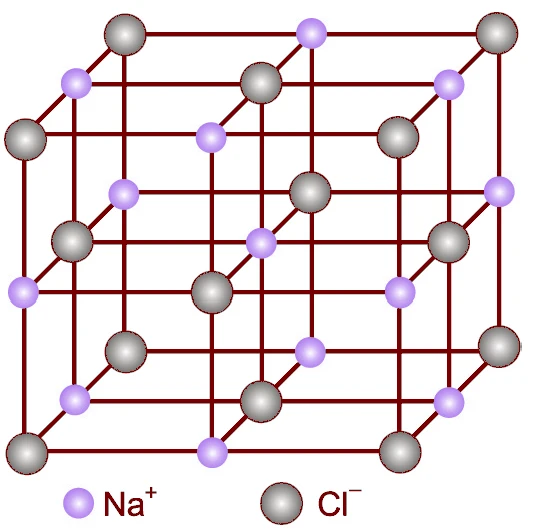
The number of oppositely charged ions present as the nearest neighbours around an ion is called its coordination number. Thus, coordination number of Na+ in NaCl ionic crystal is 6 and similarly, the coordination number of Cl– ion in NaCl crystal is 6. The crystal structure of sodium chloride (called rock salt) is shown. The geometric arrangement of different substances is different. It depends upon the size of the ions and the magnitude of the charges on the ions.
2. Melting and Boiling Points of Ionic Compounds
Ionic compounds have high melting and boiling points. This is because the ions are held together by strong electrostatic forces of attractions and hence large amount of energy is required to break the crystal lattice. The variation in melting point depends upon the charges on the ions and ionic radii. The closer the ions in crystal, the larger will be the electrostatic forces of attraction and consequently, higher will be the melting point.
For example, in case of sodium halides the melting points decrease from NaF to NaI : NaF (1270 K), NaCl (1073 K), NaBr (1023 K) and NaI (924 K).
3. Solubility of Ionic Compounds
Ionic compounds are generally soluble in water and other polar solvents having high dielectric constants. This is due to larger electrostatic interactions between polar solvents and ions. However ionic compounds are insoluble in non-polar solvents.
4. Electrical conductivity of Ionic Compounds
Ionic compounds are good conductors of electricity in the solution or in their molten states. In the solution or in their molten states, the ions become free to move. However, these do not conduct in their solid state because of strong electrostatic forces between the ions.
5. Ionic reactions of Ionic Compounds
The ionic compounds split up into oppositely charged ions when dissolved in water. The chemical reactions of ionic compounds are characteristic of the constituent ions and are known as ionic reactions. Such reactions occur almost instantaneously.
Non-directional character of Ionic Compounds
The ionic bond is non-directional. In ionic-compounds, each ion is surrounded by oppositely charged ions uniformly distributed all around the ion and therefore, electrical field is non-directional. Thus, the ionic bond is non-directional.
Practice more questions from What is the Octet Rule ?
Conceptual Questions and Answers on Lattice Enthalpy of Ionic Crystals and General Properties of Ionic Compounds
What is lattice enthalpy?
Lattice enthalpy is the amount of energy released when one mole of an ionic crystal is formed from its constituent gaseous ions. It is a measure of the strength of attraction between oppositely charged ions in an ionic solid.
Why is lattice enthalpy important?
Lattice enthalpy helps determine the stability, strength, and properties of ionic compounds. A higher lattice enthalpy generally indicates stronger ionic bonding and greater stability of the crystal.
How is lattice enthalpy related to the stability of ionic compounds?
The stability of an ionic compound increases with an increase in lattice enthalpy. Ionic solids with high lattice enthalpy require more energy to separate their ions and are therefore more stable.
What factors affect lattice enthalpy?
Lattice enthalpy mainly depends on the size of the ions and the magnitude of their charges. Smaller ions and ions with higher charges generally produce larger lattice enthalpy values.
How does ionic size influence lattice enthalpy?
Smaller ions can come closer together, resulting in stronger electrostatic attraction between oppositely charged ions. Consequently, lattice enthalpy increases as ionic size decreases.
How does ionic charge affect lattice enthalpy?
As the charge on the ions increases, the electrostatic force of attraction between them becomes stronger, leading to a higher lattice enthalpy.
Why do ionic compounds generally have high melting and boiling points?
Ionic compounds possess strong electrostatic forces of attraction between ions. A large amount of energy is required to overcome these forces, resulting in high melting and boiling points.
Why are ionic compounds usually crystalline solids?
Ions in ionic compounds are arranged in a regular three-dimensional pattern known as a crystal lattice. This orderly arrangement gives ionic compounds their characteristic crystalline nature.
What is meant by the coordination number in an ionic crystal?
The coordination number is the number of oppositely charged ions surrounding a particular ion as its nearest neighbours within the crystal lattice.
Why are ionic compounds generally soluble in water?
Water is a polar solvent and can effectively attract and separate ions present in ionic compounds. Therefore, many ionic compounds dissolve readily in water.
Why are ionic compounds insoluble in most non-polar solvents?
Non-polar solvents cannot provide sufficient attraction to separate the ions present in ionic compounds. As a result, ionic compounds are generally insoluble in such solvents.
Why do ionic compounds conduct electricity in molten and aqueous states?
In molten or dissolved states, ions become free to move and carry electric charge. These mobile ions allow the compound to conduct electricity.
Why do ionic compounds not conduct electricity in the solid state?
In the solid state, ions are fixed at specific positions within the crystal lattice and cannot move freely. Therefore, electrical conduction is not possible.
What are ionic reactions?
Ionic reactions are chemical reactions involving ions present in solution. These reactions generally occur very rapidly because the reacting ions are already separated and mobile.
Why is the ionic bond considered non-directional?
The electrostatic attraction in ionic compounds acts equally in all directions around an ion. Therefore, ionic bonds do not possess a specific directional character.
What is the relationship between lattice enthalpy and interionic forces?
Lattice enthalpy provides an indication of the strength of interionic attractions. Stronger interionic forces correspond to higher lattice enthalpy values.