NCERT Exemplar Solutions for Class 11 Chemistry Chapter 3 Classification of Elements and Periodicity in Properties provide comprehensive answers to important conceptual, objective, and numerical questions based on the modern periodic table and periodic trends. These solutions help students understand the classification of elements, periodicity in atomic and ionic radii, ionization enthalpy, electron affinity, electronegativity, and chemical reactivity. Regular practice of these questions strengthens conceptual understanding and prepares students for CBSE board exams as well as competitive examinations like JEE and NEET.
NCERT Exemplar Solutions of Chapter 3 Classification of Elements and Periodicity in Properties for Class 11 Chemistry
NCERT Exemplar Solutions for Classification of Elements and Periodicity in Properties Class 11 Chemistry are designed to help students master the concepts of the periodic table and the trends observed in the properties of elements. These solutions explain the reasoning behind periodic variations and help students apply theoretical concepts to solve a variety of chemistry problems effectively.
For complete preparation, also study NCERT Solutions: Classification of Elements and Periodicity in Properties Class 11 Chemistry
What topics are covered in Classification of Elements and Periodicity in Properties?
This chapter covers the modern periodic table, periodic classification of elements, atomic size, ionization enthalpy, electron gain enthalpy, electronegativity, and periodic trends in physical and chemical properties.
Practice more questions from NCERT Intext Solutions: Classification of Elements and Periodicity in Properties
How do NCERT Exemplar Solutions help in chemistry preparation?
NCERT Exemplar Solutions provide detailed explanations and additional practice questions that improve conceptual clarity and strengthen problem-solving abilities for exams.
NCERT Exemplar Question 1
Consider the isoelectronic species : Na+, Mg2+, F– and O2-. The correct order of increasing length of their radii is
(a) F– < O2- < Mg2+ < Na+
(b) Mg2+ < Na+ < F– < O2-
(c) O2- < F– < Na+ < Mg2+
(d) O2- < F– < Mg2+ < Na+
Answer : Correct Option (b)
Isoelectronic species are atoms, molecules, or ions that contain the exact same number of electrons. In this specific case, all four given species—the magnesium ion (Mg2+), the sodium ion (Na+), the fluoride ion (F–), and the oxide ion (O2-) are isoelectronic because they each possess exactly 10 electrons, and have stable noble gas electron configuration of neon ($1s^2 2s^2 2p^6$).
Because the total number of electrons and structural arrangement of the surrounding electrons are identical across all four species, the mutual electron-electron repulsion remains effectively constant. Consequently, the primary factor that depends the physical size of each ion is its nuclear charge, which is determined only by the number of protons residing in the nucleus.
The nuclear charge, represented by the atomic number Z, varies significantly among these species. The magnesium ion has 12 protons pulling on its 10 electrons, the sodium ion has 11 protons, the fluoride ion has 9 protons, and the oxide ion has only 8 protons. When an ion has a higher number of protons in its nucleus, it exerts a much stronger electrostatic attraction on the same 10-electron cloud. This stronger inward pull tightly compresses the electron shells closer to the nucleus, which inherently minimizes the overall ionic radius. Conversely, a lower nuclear charge means fewer protons are available to attract the same number of electrons, resulting in a weaker inward pull that allows the electron cloud to expand outward.
Because a higher nuclear charge directly leads to a smaller ionic radius, the sizes of these isoelectronic species will increase as their atomic number decreases.
Magnesium, with the highest nuclear charge of 12, experiences the greatest inward contraction and is therefore the smallest ion. Sodium follows next with 11 protons. The negative ions are significantly larger because their smaller nuclear charges cannot pull the electron cloud in as effectively; fluoride with 9 protons is smaller than oxide, which has the weakest nuclear pull of only 8 protons. Arranging them in the correct order of increasing ionic radii shows the sequence : Mg2+ < Na+ < F– < O2-.
Important exam-related topics include JEE Main Solved Question Papers PYQs Important MCQs Periodic Table and Periodicity
NCERT Exemplar Question 2
Which of the following is not an actinoid?
(a) Curium (Z = 96)
(b) Californium (Z = 98)
(c) Uranium (Z = 92)
(d) Terbium (Z = 65)
Answer: Correct Option (d)
Actinoids = elements with atomic numbers Z = 90 to 103.
Curium (96), Californium (98), Uranium (92) all lie in 90 – 103 and are actinoids whereas Terbium (Z = 65) does NOT; Tb belongs to the lanthanoids (4f series).
Explore more concepts related to What is Chemical Bond ? Why do Atoms Combine ? How do Atoms Combine ?
NCERT Exemplar Question 3
The order of screening effect of electrons of s, p, d and f orbitals of a given shell of an atom on its outer shell electrons is
(a) s > p > d > f
(b) f > d > p > s
(c) p < d < s > f
(d) f > p > s > d
Answer: Correct Option (a)
The screening effect (or shielding effect) describes how inner-shell electrons act as a protective barrier between the positively charged nucleus and the outermost electrons. The inner electrons partially cancel out the attractive pull of the nucleus, causing the outer electrons to experience a reduced net attraction known as the effective nuclear charge (Zeff).
The screening efficiency of an orbital depends heavily on its penetration power, which describes how close an electron in a given subshell can get to the nucleus. Within the same principal energy shell (same value of n), the shape of the orbitals determines this explanation :
s-orbitals : These are completely spherical and symmetrical. They have the highest probability of being found very close to the nucleus. Because they penetrate deepest toward the core, they form the most effective barrier between the nucleus and outer-shell electrons.
p-orbitals : These are dumbbell-shaped and less symmetrical than s-orbitals. They do not penetrate as deeply as s-electrons, meaning their ability to shield outer electrons is slightly weaker.
d and f-orbitals : These orbitals have complex, diffused shapes with more directional nodes. Because their electron density is highly spread out and distant from the core, they possess very poor penetration power. Consequently, they offer a poor screening effect.
Since greater penetration power directly results in a stronger shielding capability, the shielding capacity decreases in the exact order of orbital penetration.
Therefore, the correct order of the screening effect for electrons in a given shell is s > p > d > f
NCERT Exemplar Question 4
The first ionisation enthalpies of Na, Mg, Al and Si are in the order
(a) Na < Mg > Al < Si
(b) Na > Mg > Al > Si
(c) Na < Mg < Al < Si
(d) Na > Mg > Al < Si
Answer: Correct Option (a)
The correct option is (a).
First ionization enthalpy is the energy required to remove the most loosely bound electron from an isolated gaseous atom. As you move from left to right across a period in the periodic table (from Sodium to Silicon), the atomic number increases, which means more protons are added to the nucleus. This increases the effective nuclear charge (Zeff), pulling the valence electrons closer and making them harder to remove.
Based on this general trend alone, you would expect a steady increase : Na < Mg < Al < Si. However, an anomaly occurs between Magnesium (Mg) and Aluminum (Al).
To understand why this anomaly occurs, we look at the valence shell electron configurations of these elements :
Sodium (Na}, Z=11): [Ne] 3s1
Magnesium (Mg, Z = 12) : [Ne] 3s2
Aluminum (Al, Z = 13) : [Ne] 3s2 3p1
Silicon (Si, Z = 14) : [Ne] 3s2 3p2
Even though Aluminum has a higher nuclear charge than Magnesium, its first ionization energy is lower due to two main factors :
Stable Subshell Configuration : Magnesium has a completely filled 3s orbital (3s2). Fully filled subshells possess extra stability due to symmetry, making it more difficult to strip away an electron.
Orbital Energy and Shielding : In Aluminum, the electron to be removed resides in a 3p orbital (3p1). A 3p electron is slightly higher in energy, experiences a lower penetration power toward the nucleus, and is effectively shielded from the nuclear charge by the inner 3s2 electrons. This makes the 3p1 electron easier to remove than a tightly bound 3s electron from Magnesium. Therefore, the ionization enthalpy decreases from Magnesium to Aluminum (Mg > Al).
After Aluminum, the standard trend resumes. Silicon (Si) has a higher nuclear charge (14 protons) compared to Aluminum (13 protons), and both are losing a 3p electron. The increased nuclear pull in Silicon firmly binds its valence electrons, causing its ionization energy to rise sharply above Aluminum.
Combining these steps, the final ordered sequence :
Na < Mg > Al < Si
NCERT Exemplar Question 5
The electronic configuration of gadolinium (atomic number 64) is
(a) $[Xe]\,4f^5\,5d^3\,6s^2$
(b) $[Xe]\,4f^7\,5d^2\,6s^1$
(c) $[Xe]\,4f^7\,5d^1\,6s^2$
(d) $[Xe]\,4f^8\,5d^0\,6s^2$
Answer: Correct Option (c)
After La ($Z=57$, $[Xe]\,5d^1 6s^2$) electrons start to fill the $4f$ orbitals. Half-filled $4f^7$ configuration has extra stability (exchange/stability effects). Eu ($Z=63$) has $4f^7\,6s^2$ (half-filled $4f$). Adding the next electron (to make $Z=64$) is more stable if one electron enters $5d$ rather than pairing in $4f$. So electronic configuration of gadolinium (Gd) is $$[Xe]\,4f^7\,5d^1\,6s^2$$
NCERT Exemplar Question 6
The statement that is not correct for periodic classification of elements is
(a) The properties of elements are periodic function of their atomic numbers
(b) Non-metallic elements are less in number than metallic elements
(c) For transition elements, the 3d-orbitals are filled with electrons after 3p-orbitals and before 4s-orbitals
(d) The first ionisation enthalpies of elements generally increase with increase in atomic number as we go along a period
Answer: Correct Option (c)
Modern Periodic Law states that the physical and chemical properties of elements are periodic functions of their atomic numbers (number of protons), rather than their atomic masses. Statement (a) : Correct
In the periodic table, metals make up more than 78% of all known elements. They occupy the entire left side, center, and bottom (s, d, and f blocks). Non-metals are localized strictly to the upper right corner of the p-block (along with hydrogen), making them much fewer in total number. Statement (b) : Correct
According to the Aufbau principle (and the n+l energy rule), electrons fill atomic subshells in order of increasing energy levels. Let’s look at the energy levels for the subshells in question :
For the 4s orbital : n = 4, and l = 0 ⇒ n + l = 4 + 0 = 4
For the 3d orbital : n = 3, and l = 2 ⇒ n + l = 3 + 2 = 5
Since the 4s orbital has a lower n + l value than the 3d orbital, it is lower in energy. Therefore, the 4s subshell must be filled with electrons before the 3d subshell begins filling. The correct sequence is 3p → 4s → 3d. Because statement (c) claims that 3d orbitals are filled before 4s orbitals, it is false. Statement (c): Incorrect
As you move from left to right along a period, the atomic number increases, adding more protons to the nucleus. This increases the effective nuclear charge (Zeff) and pulls the valence electron cloud closer to the nucleus. Because the outer electrons are bound more tightly, the energy required to remove the first electron (first ionization enthalpy) generally increases across a period. Statement (d): Correct
Statement (c) is the incorrect statement, making it the correct option for this question.
NCERT Exemplar Question 7
Among halogens, the correct order of amount of energy released in electron gain (electron gain enthalpy) is
(a) F > Cl > Br > I
(b) F < Cl < Br < I
(c) F < Cl > Br > I
(d) F < Cl < Br < I
Answer: Correct Option (c)
Electron gain enthalpy (ΔegH) is the energy change that occurs when an electron is added to an isolated gaseous atom. When energy is released during this process, the value is expressed as a negative number. The larger the amount of energy released, the more negative the electron gain enthalpy value is.
Generally, as you move from top to bottom down a group in the periodic table, atomic size increases because new principal electronic shells are added. The incoming electron enters a shell that is further away from the nucleus, experiencing a weaker electrostatic attraction. Therefore, the amount of energy released usually decreases down a group (Cl > Br > I).
Based on the general trend, you would expect Fluorine (F) to release the most energy because it sits at the top of the group and has the smallest atomic radius. However, an anomaly occurs: Chlorine releases more energy than Fluorine (Cl > F).
To understand why, let’s compare their physical structures :
Fluorine (F) : Has an electron configuration of $1s^2 \, 2s^2 \, 2p^5$. Its valence electrons are crowded into a very small, compact 2p subshell.
Chlorine (Cl) : Has an electron configuration of $1s^2 \, 2s^2 \, 2p^6 \, 3s^2 \, 3p^5$. Its valence electrons are spread out over a larger 3p subshell.
When an extra electron is added to a compact Fluorine atom, it experiences significant inter-electronic repulsion from the 7 electrons already present into that small 2p space. This repulsive force opposes the nuclear attraction, reducing the net amount of energy released. In Chlorine, the larger size of the 3p orbital easily accommodates the incoming electron with minimal electron-electron repulsion, allowing the atom to release a greater amount of energy.
After Chlorine, the standard group trend resumes normally. As you move down from Chlorine to Bromine (Br) and then to Iodine (I), the atomic size expands significantly, the nucleus becomes heavily shielded, and the amount of energy released steadily drops.
Hence the exact order of the amount of energy released is :
F < Cl > Br > I
NCERT Exemplar Question 8
The period number in the long form of the periodic table is equal to
(a) magnetic quantum number of any element of the period
(b) atomic number of any element of the period
(c) maximum principal quantum number of any element of the period
(d) maximum azimuthal quantum number of any element of the period
Answer: Correct Option (c)
In the long form of the periodic table, elements are arranged horizontally into rows called periods. Each new period marks the beginning of filling a completely new electron shell.
The principal quantum number, denoted by symbol n, defines the main energy shell or level in which an electron resides. It can take positive integer values like 1, 2, 3, 4, and so on. As you look at the electron configuration of any element within a given row, the outer valence electrons will always occupy a shell corresponding to that row’s number.
According to the Aufbau principle, lower energy subshells fill up before higher energy ones. Because of the way orbital energies shift, inner subshells like 3d or 4f actually fill up after outer shells like 4s or 6s have already started filling.
For example, Iron (Fe), Z = 26), which is located in Period 4. Its electron configuration is $1s^2 \, 2s^2 \, 2p^6 \, 3s^2 \, 3p^6 \, 4s^2 \, 3d^6$. If you look at the principal quantum numbers (n) present in its valence shell, you see both n = 3 (for the 3d electrons) and n = 4 (for the 4s electrons). The maximum principal quantum number out of all these filled subshells is 4. Because the maximum value of n for Iron is 4, it belongs in Period 4.
(a) Magnetic quantum number (ml) : This number specifies the orientation of an orbital in space (e.g., -1, 0, +1). It alternates constantly across elements and has no relation to the row layout.
(b) Atomic number (Z) : This represents the number of protons in an atom. It increases continuously from 1 to 118 across the entire table, rather than remains constant.
(d) Azimuthal quantum number (l) : This defines the shape of the subshell (s = 0, p = 1, d = 2, f = 3). It identifies blocks (s, p, d, f) rather than the specific period row.
Hence the highest main energy shell (n) that contains electrons in an atom’s ground state determines its row. Therefore, the period number is always equal to the maximum principal quantum number (n) of any element in that period. This matches option (c).
NCERT Exemplar Question 9
The elements in which electrons are progressively filled in 4f-orbital are called
(a) actinoids
(b) transition elements
(c) lanthanoids
(d) halogens
Answer: Correct Option (c)
Lanthanoids (lanthanides) are the elements where electrons progressively fill the 4f orbitals – typically Z = 58 (Ce) to 71 (Lu).
Question 10
Which of the following is the correct order of size of the given species
(a) I > I+ > I–
(b) I+ > I > I–
(c) I > I– > I+
(d) I– > I > I+
Answer: Correct Option (d)
The Anion (I–) : When a neutral iodine atom gains an electron to form a iodide ion, the number of electrons increases while the nuclear charge (number of protons) remains the same. These extra electrons cause a significant increase in inter-electronic repulsion within the valence shell, forcing the electron cloud to expand outward. Additionally, the effective nuclear charge per electron decreases, making it harder for the nucleus to hold the cloud tightly. Therefore, the anion is always larger than its parent neutral atom (I– > I).
The Cation (I+) : When a neutral iodine atom loses an electron to form an iodonium ion, the electron count drops. With fewer electrons shielding one another, the remaining electrons experience a much stronger, concentrated inward pull from the unchanged positive nuclear charge. This draws the entire electron cloud closer to the core. Therefore, the cation is always smaller than its parent neutral atom (I > I+).
Hence, the atomic size decreases as electrons are removed and increases as electrons are added. The correct order of decreasing size (or the correct relative sizing comparison) is I– > I > I+.
NCERT Exemplar Question 11
The formation of oxide ion O2- (g) from oxygen atom requires first an exothermic and then an endothermic step as shown below
$$O(g) + e^- \rightarrow O^-(g)\quad \Delta H = -141\ \text{kJ mol}^{-1}$$
$$O^-(g) + e^- \rightarrow O^{2-}(g)\quad \Delta H = +780\ \text{kJ mol}^{-1}$$
Thus, the process of formation of O2- in gas phase is unfavourable even though O2- is isoelectronic with neon. It is due to the fact that
(a) oxygen is more electronegative
(b) addition of electron in oxygen results in larger size of the ion
(c) electron repulsion outweighs the stability gained by achieving noble gas configuration
(d) O– ion has comparatively smaller size than oxygen atom
Answer: Correct Option (c)
The first electron addition (to make O–) is exothermic (ΔH = -141 kJ/mol). The second electron addition (to make O2-) is highly endothermic (+780 kJ/mol) because you must add an electron to an already negatively charged ion and there is strong electrostatic repulsion takes place between O- ions and incoming electron. Hence energy must be supplied to overcome this repulsion. The large positive energy for the second step means the overall gas-phase formation of O2- from O(g) is energetically unfavourable, despite the noble-gas electron count.
NCERT Exemplar Question 12 (Comprehension)
In the modern periodic table, elements are arranged in order of
increasing atomic numbers which is related to the electronic
configuration. Depending upon the type of orbitals receiving the last electron, the elements in the periodic table have been divided into four blocks, viz s, p, d and f.
The modern periodic table consists of 7 periods and 18 groups. Each period begins with the filling of a new energy shell. In accordance with the Aufbau principle, the seven periods (1 to 7) have 2, 8, 8, 18, 18, 32 and 32 elements respectively.
The seventh period is still incomplete. To avoid the periodic table
being too long, the two series of f -block elements, called lanthanoids and actinoids are placed at the bottom of the main body of the periodic table
(i) The element with atomic number 57 belongs to
(a) s-block
(b) p-block
(c) d-block
(d) f-block
Answer: Correct Option (c)
La (Z = 57) is experimentally observed as [Xe]5d1 6s2. The 57th electron goes into 5d rather than 4f. If placing the electron in 5d disturbs the xenon core less than forcing it into an inner 4f orbital; the energy balance favors 5d1 6s2. So La behaves like a d-block element (not f-block) experimentally.
(ii) The last element of the p-block in 6th period is represented by the outermost electronic configuration.
(a) $7s^2 7p^6$
(b) $5d^{10}6s^2 6p^6$
(c) $4f^{14} 5d^{10} 6s^2 6p^6$
(d) $4f^{14} 5d^0 6s^2 6p^6$
Answer: Correct Option (c)
6th period fills 6s, then 4f, then 5d, then 6p. The last p-block element (the end of the 6th period p-block) thus has full 4f (14) and 5d (10) plus 6s2 6p6.
(iii) Which atomic number cannot be accommodated in the present long form?
(a) 107 (b) 118 (c) 126 (d) 102
Answer: Correct Option (c)
The long form currently includes elements with Z=1 to Z=118. Anything beyond 118 (e.g., 126) cannot be placed in the present standard long form.
(iv) The electronic configuration of the element which is just above the element with atomic number 43 in the same group is ………
(a) $1s^2\,2s^2\,2p^6\,3s^2\,3p^6\,4s^2\,3d^{10}\,4p^6\,5s^2$
(b) $1s^2\,2s^2\,2p^6\,3s^2\,3p^6\,4s^2\,3d^{10}\,4p^6\,5s^2\,5p^6$
(c) $1s^2\,2s^2\,2p^6\,3s^2\,3p^6\,4s^2\,3d^{10}\,4p^6\,6s^2$
(d) $1s^2\,2s^2\,2p^6\,3s^2\,3p^6\,4s^2\,3d^{10}\,4p^6\,7s^2$
Answer: Correct Option (a)
Element with Z=43 is in the 5th period. The element just above it in the same group is in the 4th period → its atomic number is 43 – 18 = 25 (Mn).
Electronic Configuration of Mn (Z=25) :
$$\text{Mn: } [Ar]\,4s^2\,3d^5 \quad \text{or} \quad 1s^2\,2s^2\,2p^6\,3s^2\,3p^6\,4s^2\,3d^5$$
(v) The elements with atomic numbers 35, 53 and 85 are all ………
(a) noble gases (b) halogens (c) heavy metals (d) light metals
Answer: Correct Option (b)
Noble gas atomic numbers : $2, 10, 18, 36, 54, 86, …..
The numbers 35 = 36 – 1, 53 = 54 – 1, 85 = 86 – 1 are one less than noble-gas numbers. Therefore they lie in the group just before noble gases i.e. halogens (group 17).
NCERT Exemplar Question 13
Electronic configuration of four elements A, B, C, and D are given below
A. $1s^2\,2s^2\,2p^6$
B. $1s^2\,2s^2\,2p^4$
C. $1s^2\,2s^2\,2p^6\,3s^1$
D. $1s^2\,2s^2\,2p^5$
Which of the following is the correct order of increasing tendency to gain electron?
(a) A < C < B < D
(b) A < B < C < D
(c) D < B < C < A
(d) D < A < B < C
Answer: Correct Option (a)
A : $1s^2,2s^2,2p^6$ → Noble gas (Ne) → virtually zero tendency to gain electrons.
B : $1s^2\,2s^2\,2p^4$ → Oxygen-like (group 16) → wants 2 electrons to reach noble gas.
C : $1s^2\,2s^2\,2p^6\,3s^1$ → Sodium-like (Na, group 1) → tends to lose its single 3s electron rather than gain. So low tendency to gain.
D : $1s^2\,2s^2\,2p^5$ → Fluorine-like (group 17) → one electron short of noble gas → highest tendency to gain.
Order by tendency to gain electron (least → greatest)
- Least : A (noble gas, no tendency)
- Next : C (metal, prefers to lose an electron)
- Then : B (needs 2 e– to reach noble gas, moderate tendency)
- Greatest : D (halogen, strongly wants one electron)
Hence Order is :
A < C < B < D
NCERT Exemplar Question 14
Which of the following elements can show covalency greater than 4?
(a) Be
(b) P
(c) S
(d) B
Answer: Correct Options (b), (c)
Elements Be and B lie in the 2nd period. They can have a maximum of 8 electrons in the valence shell. In other words, they can have a maximum covalency of 8/2 = 4. However, elements P and S have vacant d-orbitals in their respective valence shells and hence can accommodate more than 8 electrons. Thus, P and S can show covalency greater than 4.
NCERT Exemplar Question 15
Those elements impart colour to the flame on heating in it, the atoms of which require low energy for ionisation (i.e., absorb energy in the visible region of spectrum). The elements of which of the following groups will impart colour to the flame?
(a) 2
(b) 13
(c) 1
(d) 17
Answer: Correct Options (a), (c)
The elements of group 1 (alkali metals) and group 2 (alkaline earth metals) have 1 and 2 electrons respectively in their valence shells. Hence, they have low ionisation energies and impart colour to the flame.
NCERT Exemplar Question 16
Which of the following sequences contain atomic numbers of only representative elements?
(a) 3, 33, 53, 87
(b) 2, 10, 22, 36
(c) 7, 17, 25, 37, 48
(d) 9, 35, 51, 88
Answer: Correct Options (a), (d)
Elements of s– and p-block are called representative elements. Elements of d-block are transition elements (Z = 21–30, 39–48, 57, 72–80, 89, 104–112). Elements of f-block are inner transition elements (Z = 58–71, 90–103).
Options (a) and (d) contain only representative elements.
NCERT Exemplar Question 17
Which of the following elements will gain one electron more readily in comparison to other elements of their group?
(a) S(g)
(b) Na(g)
(c) O(g)
(d) Cl(g)
Answer: Correct Options (a), (d)
Chlorine has the highest tendency to gain an electron because it acquires the stable configuration of Argon after gain additional electron.
Between O and S : Oxygen is much smaller, so electron-electron repulsions in its 2p orbital are stronger. Thus, S gains an electron more readily than O.
Sodium prefers to lose its one valence electron instead of gaining.
NCERT Exemplar Question 18
Which of the following statements are correct?
(a) Helium has the highest first ionisation enthalpy in the periodic table
(b) Chlorine has less negative electron gain enthalpy than fluorine
(c) Mercury and bromine are liquids at room temperature
(d) In any period, atomic radius of alkali metal is the highest
Answer: Correct Options (a), (c), (d)
(a) Correct : Helium has the highest first ionisation enthalpy.
(b) Incorrect : Chlorine has more negative electron gain enthalpy than fluorine.
(c) Correct : Hg and Br are liquids at room temperature.
(d) Correct : Alkali metals have the largest atomic radius in their period.
NCERT Exemplar Question 19
Which of the following sets contain only isoelectronic ions?
(a) $Zn^{2+}, \; Ca^{2+}, \; Ga^{3+}, \; Al^{3+}$
(b) $K^+, \; Ca^{2+}, \; Sc^{3+}, \; Cl^-$
(c) $P^{3-}, \; S^{2-}, \; Cl^-, \; K^+$
(d) $Ti^{4+}, \; Ar, \; Cr^{3+}, \; V^{5+}$
Answer: Correct Options (b), (c)
Isoelectronic species having the same number of electrons.
(a) $Zn^{2+}(28), \; Ca^{2+}(18), \; Ga^{3+}(28), \; Al^{3+}(10)$ → Not same.
(b) $K^+(18), \; Ca^{2+}(18), \; Sc^{3+}(18), \; Cl^-(18)$ → All 18 electrons.
(c) $P^{3-}(18), \; S^{2-}(18), \; Cl^-(18), \; K^+(18)$ → All 18 electrons.
(d) $Ti^{4+}(18), \; Ar(18), \; Cr^{3+}(21), \; V^{5+}(18)$ → Not same.
NCERT Exemplar Question 20
In which of the following options order of arrangement does not agree with the variation of property indicated against it?
(a) Al3+ < Mg2+ < Na+ < F– (Increasing ionic size)
(b) B < C < N < O (Increasing first ionisation enthalpy)
(c) I < Br < Cl < F (Increasing electron gain enthalpy)
(d) Li < Na < K < Rb (Increasing metallic radius)
Answer: Correct Options (b), (c)
Ionic size increases as positive charge decreases / negative charge increases : (a) correct.
N has higher ionisation enthalpy than O due to half-filled $2p^3$ stability : (b) incorrect.
Cl has more negative electron gain enthalpy than F : (c) incorrect.
Metallic radius increases down the group : (d) correct.
NCERT Exemplar Question 21
Which of the following have no unit?
(a) Electronegativity
(b) Electron gain enthalpy
(c) Ionisation enthalpy
(d) Metallic character
Answer: Correct Options (a), (d)
Electronegativity and metallic character are relative properties and has No unit.
Electron gain enthalpy and ionisation enthalpy has Units are kJ/mol.
NCERT Exemplar Question 22
Ionic radii vary in
(a) inverse proportion to the effective nuclear charge
(b) inverse proportion to the square of effective nuclear charge
(c) direct proportion to the screening effect
(d) direct proportion to the square of screening effect
Answer: Correct Options (a), (c)
Ionic radius decreases as the effective nuclear charge increases :
$$ r \propto \frac{1}{Z_\text{eff}} $$
Ionic radius increases with the screening effect :
$$ r \propto \text{screening effect} $$
NCERT Exemplar Question 23
An element belongs to the 3rd period and group 13 of the periodic table. Which of the following properties will be shown by the element?
(a) Good conductor of electricity
(b) Liquid, metallic
(c) Solid, metallic
(d) Solid, non-metallic
Answer: Correct Options (a), (c)
Except boron, all elements of group 13 are metallic and solid.
For example, Aluminium is a solid metal and a good conductor of electricity.
NCERT Exemplar Question 24
Explain why the electron gain enthalpy of fluorine is less negative than that of chlorine?
Answer:
The electron gain enthalpy of fluorine is less negative than that of chlorine because in fluorine, the added electron enters the small n = 2 quantum level, where it suffers strong electron-electron repulsions. In chlorine, the added electron enters the larger n = 3 quantum level, where repulsions are much less. Thus, Cl has more negative electron gain enthalpy than F.
NCERT Exemplar Question 25
All transition elements are d-block elements, but all d-block elements are not transition elements. Explain.
Answer:
Elements in which the last electron enters a d-orbital are called d-block elements. Transition elements have the general configuration : $(n-1)d^{1-10} ns^{0-2}$.
Examples : Zn, Cd, Hg have configuration $(n-1)d^{10} ns^2$. Their d-orbitals are completely filled in both ground state and common oxidation states.
Therefore, Zn, Cd, Hg do not show typical transition properties.
Hence All transition elements are d-block elements, But not all d-block elements are transition elements.
NCERT Exemplar Question 26
Identify the group and valency of the element having atomic number 119. Also predict the outermost electronic configuration and write the general formula of its oxide.
Answer:
Current periodic table accommodates up to 118 elements. The next element (Z = 119) will have its last electron in the 8s orbital and configuration: [Og] 8s1. Since it has one valence electron, valency = 1. It will belong to Group 1 (alkali metals). Its general oxide formula is M2O.
NCERT Exemplar Question 27
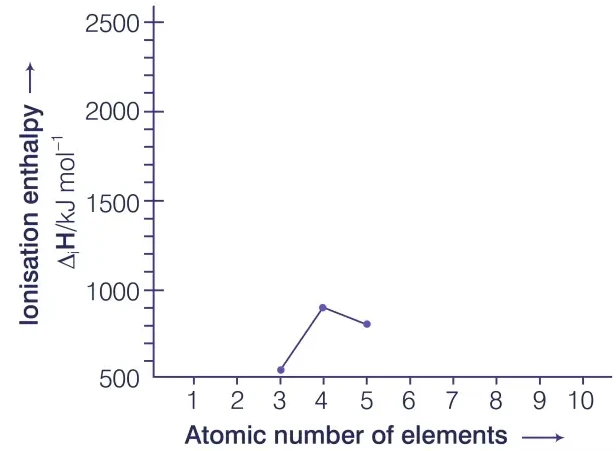
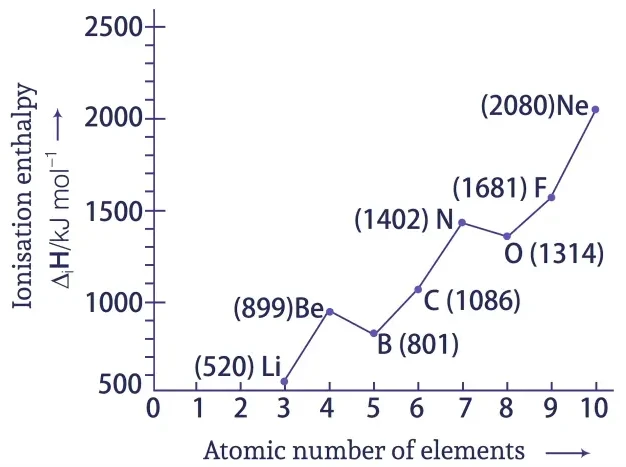
Ionisation enthalpies of elements of the second period are given:
520, 899, 801, 1086, 1402, 1314, 1681, 2080 (kcal/mol). Match with correct elements and complete the graph.
Answer:
As we move left to right in a period, ionisation enthalpy generally increases due to increasing nuclear charge and decreasing size.
Exceptions :
Be > B: Be has a stable fully-filled 2s orbital, so removing an electron requires more energy. B loses from 2p, easier.
N > O : N has a stable half-filled 2p^3 configuration. O has paired electrons in one 2p orbital, so repulsion lowers ionisation enthalpy.
Thus the sequence is as follows :
Li (520), Be (899), B (801), C (1086), N (1402), O (1314), F (1681), Ne (2080).
NCERT Exemplar Question 28
Among the elements B, Al, C, and Si :
(a) Which element has the highest first ionisation enthalpy?
(b) Which element has the most metallic character?
Answer:
(a) Ionisation enthalpy increases left to right across a period and decreases down a group. Carbon has the highest ionisation enthalpy.
(b) Metallic character decreases across a period but increases down the group.
Aluminium has the most metallic character.
Question 29
Write four characteristic properties of p-block elements.
Answer :
(a) Both metals and non-metals present, but non-metals are more numerous.
- Metallic character increases down a group.
- Non-metallic character increases left to right in a period.
(b) Ionisation enthalpies are relatively high compared to s-block.
(c) They mostly form covalent compounds.
(d) Many show variable oxidation states.
- Oxidising character increases left to right.
- Reducing character increases top to bottom.
NCERT Exemplar Question 30
Choose the correct order of atomic radii of fluorine and neon (in pm):
(a) 72, 160
(b) 160, 160
(c) 72, 72
(d) 160, 72
Answer: Correct Option (a)
Atomic radius of fluorine is expressed as covalent radius.
Atomic radius of neon is usually expressed as van der Waals radius, which is always larger than covalent radius. Therefore, r(F) < r(Ne). Their numerical values are F = 72 pm, Ne = 160 pm.
NCERT Exemplar Question 31
Illustrate by taking examples of transition elements and non-transition elements that oxidation states of elements are largely based on electronic configuration.
Ans.
The oxidation state of an element depends mainly on the number of valence electrons (outermost shell electrons). It can also be predicted as (8 − number of valence electrons) for p-block elements. Let us see through examples :
(A) Non-transition elements (s- and p-block):
- Alkali metals (Group 1):
- General valence shell configuration : ns1
- They can lose 1 electron i.e. its Oxidation state = +1
- Example : Na ($1s^22s^22p^63s^1$) and exists as Na+
- Alkaline earth metals (Group 2) :
- General valence shell configuration : ns2
- They can lose 2 electrons i.e. its Oxidation state = +2
- Example : Mg ([Ne]3s2) and exists as Mg2+
- Group 13 elements :
- General configuration: $ns^2 np^1$
- Oxidation states: +3 (common), sometimes +1 (in heavier elements due to inert pair effect).
- Example: Al → +3; Tl → +1 and +3
- Group 14 elements:
- General configuration: $ns^2 np^2$
- Oxidation states: +4 (common), sometimes +2 (in heavier elements).
- Example: C → +4 (CO$_2$), Sn → +2, +4
- Group 15 elements:
- General configuration: $ns^2 np^3$
- Oxidation states: –3, +3, +5
- Example: N shows +1, +2, +4, +5 (like in N$_2$O, NO, NO$_2$, HNO$_3$).
- Group 16 elements:
- General configuration: $ns^2 np^4$
- Oxidation states: –2, +2, +4, +6
- Example: O → –2, S → +2, +4, +6
- Group 17 (halogens):
- General configuration: $ns^2 np^5$
- Common oxidation state = –1
- Heavier halogens (Cl, Br, I) also show +1, +3, +5, +7.
- Group 18 (noble gases):
- General configuration: $ns^2 np^6$
- Oxidation state = 0 (inert), but heavier ones (Xe) can show +2, +4, +6, +8.
(B) Transition elements (d-block):
- General configuration: $(n-1)d^{1-10} ns^{0-2}$
- They exhibit variable oxidation states because both (n-1)d and ns electrons can participate in bonding.
- Example:
- Fe → +2 (loss of 2 electrons from 4s), +3 (loss of 2 from 4s + 1 from 3d).
- Mn → +2, +3, +4, +6, +7.
Thus, non-transition elements usually show fixed oxidation states based on their group number, while transition elements show variable oxidation states due to the availability of both d- and s-electrons.
Q. 32 Nitrogen has positive electron gain enthalpy whereas oxygen has negative. However, oxygen has lower ionisation enthalpy than nitrogen. Explain.
Answer:
Electron gain enthalpy (ΔegH) :
- Nitrogen (Z = 7) : Electronic configuration = $1s^2 2s^2 2p^3$. The 2p orbital is exactly half-filled, which is very stable. Adding an electron would disturb this stability, so energy must be supplied and has positive electron gain enthalpy.
- Oxygen (Z = 8) : Electronic configuration = $1s^2 2s^2 2p^4$. The p-orbitals are not half-filled. Addition of an electron completes pairing in one orbital and releases energy and has negative electron gain enthalpy.
Ionisation enthalpy (IE) :
- Nitrogen : Removing an electron from half-filled 2p orbitals is difficult due to stability and has higher IE.
- Oxygen : Removing one electron from 2p4 gives oxygen a stable 2p3 (half-filled) configuration and has lower IE.
Q. 33 First member of each group of representative elements (s- and p-block) shows anomalous behaviour. Illustrate with two examples.
Ans.
The first member of each group shows anomalous behaviour due to :
- Small size
- High ionisation enthalpy
- High electronegativity
- Absence of d-orbitals
Examples:
(A) s-block (alkali metals) :
- Lithium differs from other alkali metals.
- Li compounds have more covalent character (due to small size & high polarising power).
- Li forms Li3N (lithium nitride) while other alkali metals do not form stable nitrides.
(B) p-block :
- Carbon (first member of Group 14) shows anomaly.
- C forms strong covalent bonds due to small size and ability to form pπ−pπ multiple bonds.
- Si, Ge, Sn, Pb cannot form strong $pπ−pπ$ bonds due to larger size.
- Boron (first member of Group 13) also shows different chemistry than Al, Ga, In.
Q. 34 p-block elements form acidic, basic and amphoteric oxides. Explain with examples and reactions with water.
Ans.
(A) General trend across a period:
- From left to right → oxides become more acidic.
- Example :
- 2nd period: B$_2$O$_3$ < CO$_2$ < N$_2$O$_3$ (acidic strength increases)
- 3rd period: Al$_2$O$_3$ < SiO$_2$ < P$_2$O$_5$ < SO$_3$ < Cl$_2$O$_7$
(B) Down a group:
- Acidic character decreases, basic character increases.
Examples of oxides:
- Acidic oxides:
- Non-metal oxides like CO$_2$, SO$_2$, P$_2$O$_5$, Cl$_2$O$_7$.
- Reactions:
$$SO_3 + H_2O → H_2SO_4$$
$$P_2O_5 + 6H_2O → 4H_3PO_4$$
- Basic oxides:
- Metallic oxides like Na$_2$O, CaO, Tl$_2$O.
- Reactions:
$$Na_2O + H_2O → 2NaOH$$
$$CaO + H_2O → Ca(OH)_2$$
- Amphoteric oxides:
- Example: Al$_2$O$_3$, ZnO.
- Reacts with acids:
$$Al_2O_3 + 6HCl → 2AlCl_3 + 3H_2O$$ - Reacts with bases:
$$Al_2O_3 + 2NaOH → 2NaAlO_2 + H_2O$$
Key point : Higher oxidation state → more acidic oxide.
E.g., SO$_3$ (S in +6) is more acidic than SO$_2$ (S in +4).
Q. 35 Why is the first ionisation enthalpy of Na lower than Mg, but the second ionisation enthalpy of Na higher than Mg?
Ans.
Step 1: First ionisation enthalpy (IE1) :
- Na (Z = 11): $1s^22s^22p^63s^1$
- Outer electron in 3s, low nuclear charge → easy to remove.
- Mg (Z = 12): $1s^22s^22p^63s^2$
- Has 2 outer electrons, stronger nuclear charge → harder to remove.
Thus, IE$_1$(Na) < IE$_1$(Mg).
Step 2: Second ionisation enthalpy (IE$_2$):
- Na$^+$ = [Ne] → stable noble gas configuration. Removing another electron breaks stability → very high IE$_2$.
- Mg$^+$ = [Ne]3s$^1$ → still has 1 valence electron in 3s. Removing it is easier than removing from noble gas core.
Thus, IE$_2$(Na) > IE$_2$(Mg).
Q. 36 Define exothermic and endothermic reactions with examples.
Ans.
Exothermic reaction : Reaction accompanied by evolution of heat.
- Heat released = negative ΔH.
Examples:
- $$C(s) + O_2(g) → CO_2(g) + 393.5\ \text{kJ}$$
- $$H_2(g) + \tfrac{1}{2}O_2(g) → H_2O(l); \ ΔH = -285.8\ \text{kJ mol}^{-1}$$
Endothermic reaction: Reaction accompanied by absorption of heat.
- Heat absorbed = positive ΔH.
Examples:
- $$C(s) + H_2O(g) → CO(g) + H_2(g); \ ΔH = +131.4\ \text{kJ}$$
- $$N_2(g) + 3H_2(g) → 2NH_3(g); \ ΔH = +92.4\ \text{kJ mol}^{-1}$$
Q. 37 Arrange N, P, O and S in the order of :
(i) increasing first ionisation enthalpy.
(ii) increasing non-metallic character.
Ans.
Elements:
- 2nd period: N (Group 15), O (Group 16)
- 3rd period: P (Group 15), S (Group 16)
(i) Ionisation enthalpy order:
- Down a group → decreases (N > P, O > S).
- Across a period → increases (P < S, N < O).
- But N has higher IE than O due to half-filled p-orbitals.
Final order : S < P < O < N
(ii) Non-metallic character:
- Across a period → increases (P < S, N < O).
- Down a group → decreases (N > P, O > S).
Final order : P < S < N < O
Q. 38 Explain the deviation in ionisation enthalpy of some elements from the general trend by using given figure.
Ans.
- General trend : IE increases across a period.
- Deviations:
- Boron < Beryllium:
- Be has stable filled 2s2, requires more energy.
- B has 2p1, easier to remove.
- Nitrogen > Oxygen:
- N has half-filled stable p3, so IE is higher.
- O has p4, electron pairing causes repulsion, easier to remove.
Q. 39 (a) Electronegativity increases left to right. Why?
Ans:
Across the period, the nuclear charge increases and the atomic radius decreases. As a result, the tendency of the atom of an element to attract the shared pair of electrons towards itself increases and hence the electronegativity of the element increases.
Example : In 2nd period → Li (1.0), Be (1.5), B (2.0), C (2.5), N (3.0), O (3.5), F (4.0).
(b) Ionisation enthalpy decreases top to bottom. Why?
Ans:
The ionisation enthalpy decreases regularly as we move from top to bottom, as explained below
(i) On moving down a group from top to bottom, the atomic size increases gradually due to the addition of a new principal energy shell at each succeding element. As a result, the distance between the nucleus and the valence shell increases.
In other words, the force of attraction of the nucleus for the valence electrons
decreases and hence the ionisation enthalpy should decrease.
(ii) With the addition of new shells, the number of inner shell which shield the valence electrons from the nucleus increases. In other words, the shielding effect or the screening effect increases.
As a result, the force of attraction of the nucleus for the valence electrons further decreases and hence the ionisation enthalpy should decrease.
(iii) Further, in a group from top to bottom nuclear charge increases with increase in atomic number. As a result, the force of attraction of the nucleus for the valence electrons increases and hence the ionisation enthalpy should increase.
The combined effect of the increase in atomic size and screening effect more than compensate the effect of the increased nuclear charge. Consequently, the valence electrons become less and less firmly held by the nucleus and hence the ionisation enthalpy gradually decreases as we move down the group.
Q. 40 How does metallic and non-metallic character vary across a period?
Ans.
As we move from left to right in a period, the number of valence electrons increases by one at each succeeding element but the number of shells remains same. Due to this effective nuclear charge increases. More is the effective nuclear charge, more is the attraction between nuclei and electron.
Hence, the tendency of the element to lose electrons decreases, this results in decrease in metallic character. Furthermore, the tendency of an element to gain electrons increases with increase in effective nuclear charge, so non-metallic character increases on moving from left to right in a period
Example (Period 2) : Li (metallic) to Be to B to C to N to O to F (non-metallic).
Q. 41 The radius of Na⁺ cation is less than that of Na atom. Give reason.
Answer:
When an atom loses an electron to form a cation, its radius always decreases. In Na atom : 11 protons attract 11 electrons and in Na⁺ ion : 11 protons attract only 10 electrons. This means the effective nuclear charge per electron increases in Na⁺.
As a result, electrons are pulled closer to the nucleus and the ionic size decreases.
Q. 42 Among alkali metals which element do you expect to be least electronegative and why?
Answer:
Electronegativity decreases down the group because atomic size increases and the attraction between nucleus and valence electrons becomes weaker. Francium (Fr) lies at the bottom of Group 1 and has the largest atomic size. Thus, its nucleus has the weakest pull on bonding electrons.
Q. 43 Match the correct atomic radius with the element.
| Element | Atomic Radius (pm) |
|---|---|
| O | 66 |
| N | 74 |
| C | 77 |
| B | 88 |
| Be | 111 |
Answer :
All elements belong to the 2nd period. Across a period, atomic radius decreases due to increasing effective nuclear charge.
Order : O < N < C < B < Be
Q. 44 Match the correct ionisation enthalpies and electron gain enthalpies of the following elements.
| Element Type | ΔiH₁ (kJ/mol) | ΔiH₂ (kJ/mol) | ΔegH (kJ/mol) |
|---|---|---|---|
| (i) Most reactive non-metal | 1681 | 3374 | –328 |
| (ii) Most reactive metal | 419 | 3051 | –48 |
| (iii) Least reactive element | 2372 | 5251 | +48 |
| (iv) Metal forming halide | 738 | 1451 | –40 |
Answer :
Explanation:
- Most reactive non-metals (halogens) have high ionisation enthalpy and very negative electron gain enthalpy (e.g., Fluorine).
- Most reactive metals (alkali metals) have low first ionisation enthalpy but very high second ionisation enthalpy (because the second electron must be removed from noble gas configuration).
- Noble gases (least reactive elements) have very high ionisation enthalpies and positive electron gain enthalpy (because adding electrons is highly unfavorable).
- Binary halide forming metals (alkaline earth metals) have intermediate values.
Q. 45 Electronic configuration of some elements is given in Column I and their electron gain enthalpies are given in Column II. Match the electronic configuration with electron gain enthalpy
| Configuration (Column I) | Electron Gain Enthalpy (Column II) |
|---|---|
| A. $1s^2 2s^2 2p^6$ | +48 kJ/mol |
| B. $1s^2 2s^2 2p^6 3s^1$ | –53 kJ/mol |
| C. $1s^2 2s^2 2p^5$ | –328 kJ/mol |
| D. $1s^2 2s^2 2p^4$ | –141 kJ/mol |
Answer :
A. This electronic configuration corresponds to the noble gas i.e., neon. Since, noble gases have positive $Δ_{eg}H$ values, therefore, electronic configuration (A) corresponds to the $Δ_{eg}H$ = +48 kJ/mol.
B. This electronic configuration corresponds to the alkali metal i.e., potassium. Alkali metals have small negative $Δ_{eg}H$ values, hence, electronic configuration (B) corresponds to $Δ_{eg}H$ = –53 kJ/mol.
C. This electronic configuration corresponds to the halogen i.e., fluorine. Since, halogens have high negative $Δ_{eg}H$ values, therefore, electronic configuration (C) corresponds to $Δ_{eg}H$ = 328 kJ/mol.
D. This electronic configuration corresponds to the chalcogen i.e., oxygen. Since, chalcogens have $Δ_{eg}H$ values less negative than those of halogens, therefore, electronic configuration (D) corresponds to $Δ_{eg}H$ = – 141kJ/mol.
Q. 46 Assertion and Reason:
Assertion (A): Generally, ionisation enthalpy increases from left to right in a period.
Reason (R): When successive electrons are added in the same principal quantum level, shielding effect does not increase much compared to the increase in nuclear attraction of the electron to the nucleus.
Answer:
Both assertion and reason are true, and the reason correctly explains the assertion. lonisation enthalpy increases along a period because effective nuclear charge increases and atomic size decreases
Q. 47 Assertion and Reason:
Assertion (A): Boron has a smaller first ionisation enthalpy than beryllium.
Reason (R): The 2s electron penetrates closer to the nucleus than the 2p electron, hence 2p electron is more shielded by the inner core of electrons than the 2s electrons.
Answer:
Both statements are true, and the reason correctly explains the assertion.
Boron has a smaller first ionisation enthalpy than beryllium because the penetration of a 2s electron to the nucleus is more than the 2p electron. Hence, 2p electron is more shielded by the inner core of electron than the 2s electron.
Q. 48 Assertion and Reason:
Assertion (A): Electron gain enthalpy becomes less negative as we go down a group.
Reason (R): Atomic size increases, so the added electron is farther from the nucleus.
Answer:
Both assertion and reason are true, and the reason correctly explains the assertion.
Electron gain enthalpy becomes less negative as the size of an atom increases down the group. This is because within a group screening effect increases on going downward and the added electron would be farther away from the nucleus.
Q. 49 Discuss the factors affecting electron gain enthalpy and the trend in its variation in the periodic table.
Ans.
Electron gain enthalpy (ΔegH) of an element is the energy released when an electron is added to the valence shell of an isolated gaseous atom.
$$ A(g) + e^- \;\;\longrightarrow\;\; A^-(g) \quad \Delta_{eg}H < 0 $$
Factors affecting electron gain enthalpy are as follows :
Effective nuclear charge (Zeff) : As effective nuclear charge increases, the attraction of the nucleus towards the incoming electron increases. Hence, electron gain enthalpy becomes more negative.
Size of the atom : Larger the atomic size, weaker the attraction of the nucleus towards the added electron. Hence, electron gain enthalpy becomes less negative with increase in size.
Type of subshell (orbital) : Closer the subshell is to the nucleus, easier it is to add an electron. General order (for same n value) is s > p > d > f
Nature of electronic configuration : Atoms with half-filled or fully-filled orbitals are particularly stable. Addition of an electron to such configurations is not energetically favorable, so ΔegH becomes less negative (or may even be positive).
Variation in the periodic table (Across a period (left to right)) :
- Effective nuclear charge increases and atomic size decreases.
- Hence, electron gain enthalpy becomes more negative across a period.
- Example:
$$ \Delta_{eg}H(\text{Cl}) < \Delta_{eg}H(\text{S}) < \Delta_{eg}H(\text{P}) < \Delta_{eg}H(\text{Na}) $$
Variation in the periodic table (Down a group (top to bottom))
- Atomic size increases, shielding effect increases.
- The added electron feels less attraction from the nucleus.
- Hence, electron gain enthalpy becomes less negative down the group.
- Exception : ΔegH of O and F is less negative than those of S and Cl respectively. In O and F, the incoming electron enters the smaller n = 2 shell where electron-electron repulsions are stronger.
- In S and Cl, the added electron enters the larger n = 3 shell where repulsions are less.
Q. 50 Define ionisation enthalpy. Discuss the factors affecting ionisation enthalpy of the elements and its trends in the periodic table.
Ans.
Ionisation enthalpy is defined as the minimum amount of energy required to remove the most loosely bound electron from an isolated gaseous atom to convert it into a gaseous cation. It is represented by ΔiH.
Factors affecting ionisation enthalpy of the elements
(i) Nuclear charge
Ionisation enthalpy increases with increase in nuclear charge. This is because a higher nuclear charge attracts the outer electrons more strongly, making it harder to remove them.
For example, in the 2nd period :
| Element (Period 2) | Li | Be | B | C | N | O | F | Ne |
|---|---|---|---|---|---|---|---|---|
| Nuclear charge | +3 | +4 | +5 | +6 | +7 | +8 | +9 | +10 |
| First ionisation enthalpy (kJ/mol) | 520 | 899 | 801 | 1086 | 1402 | 1314 | 1681 | 2080 |
Thus, ionisation enthalpy generally increases across a period due to increasing nuclear charge.
(ii) Atomic size (radius)
Ionisation enthalpy decreases with increase in atomic size. As the distance of the valence electron from the nucleus increases, the nucleus attracts it less strongly.
Hence, less energy is required to remove it.
For alkali metals :
| Alkali metals (Group 1) | Li | Na | K | Rb | Cs |
|---|---|---|---|---|---|
| First ionisation enthalpy (kJ mol$^{-1}$) | 520 | 496 | 419 | 403 | 374 |
So, ionisation enthalpy decreases down the group.
(iii) Penetration effect of electrons
Electrons in orbitals with higher penetration are held more strongly by the nucleus, so ionisation enthalpy increases with penetration.
Penetration order : s > p > d > f
For example :
Mg (1s$^2$ 2s$^2$ 2p$^6$ 3s$^2$) → removal of an s electron
Al (1s$^2$ 2s$^2$ 2p$^6$ 3s$^2$ 3p$^1$) → removal of a p electron
Since s electrons penetrate more than p, Al has lower ionisation enthalpy than Mg.
(iv) Shielding or screening effect
The greater the shielding effect of inner electrons, the weaker the attraction between the nucleus and valence electrons. Hence, ionisation enthalpy decreases with increasing shielding.
(v) Electron configuration (stability)
Atoms with half-filled or completely filled orbitals are more stable, so removal of an electron requires more energy.
Examples :
Be (1s$^2$ 2s$^2$) has higher ionisation enthalpy than B (1s$^2$ 2s$^2$ 2p$^1$).
N (1s$^2$ 2s$^2$ 2p$^3$) has higher ionisation enthalpy than O (1s$^2$ 2s$^2$ 2p$^4$).
Trends in the periodic table
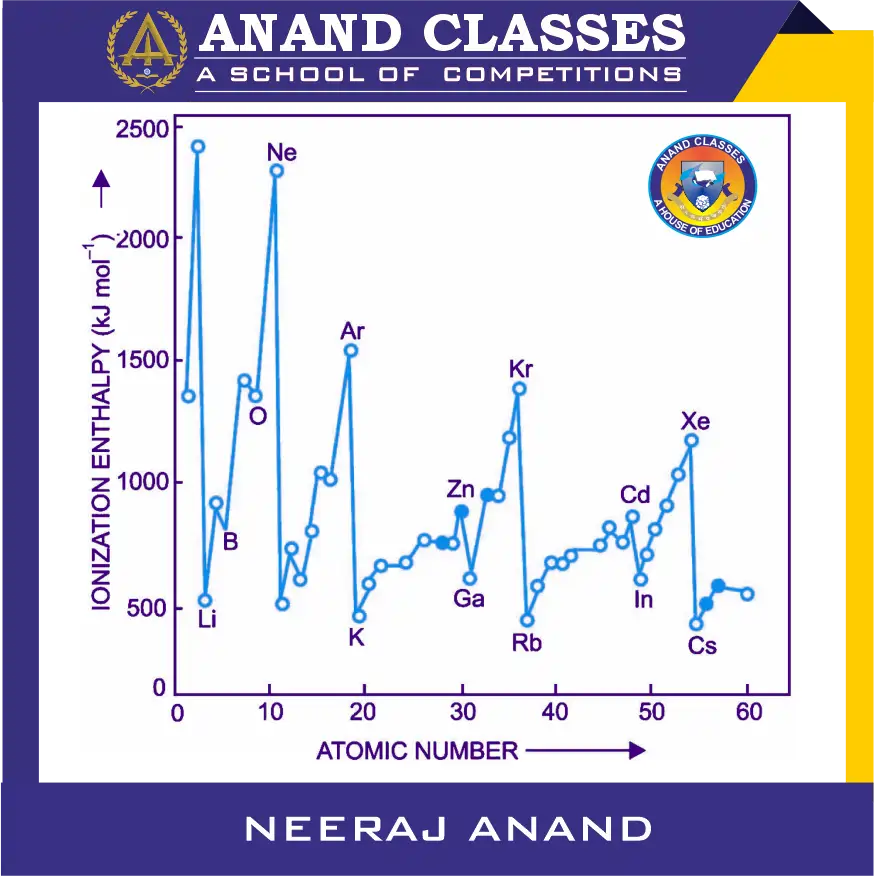
- Across a period: Ionisation enthalpy increases due to increasing nuclear charge and decreasing atomic size.
- Down a group: Ionisation enthalpy decreases due to increasing atomic size and shielding effect, which outweigh the increase in nuclear charge.
Q. 51 Justify the given statement with suitable examples – “the properties of the elements are a periodic function of their atomic numbers”.
Ans. The periodic law states that the physical and chemical properties of elements are a periodic function of their atomic numbers. This means that when the elements are arranged in order of increasing atomic number, their properties repeat at regular intervals.
The cause of periodicity is the repetition of similar outer electronic configurations after regular intervals of atomic numbers.
Example 1: Group 1 elements (Alkali metals)
All the alkali metals have similar outer electronic configuration ns1.
- Lithium (Z = 3): $1s^2 2s^1$
- Sodium (Z = 11): $1s^2 2s^2 2p^6 3s^1$
- Potassium (Z = 19): $[Ar] 4s^1$
- Rubidium (Z = 37): $[Kr] 5s^1$
- Cesium (Z = 55): $[Xe] 6s^1$
- Francium (Z = 87): $[Rn] 7s^1$
Since they all have one electron in the outermost s-orbital, they exhibit similar properties:
- They are soft, highly reactive metals.
- They form basic oxides (M2O), whose basic strength increases down the group.
- They form unipositive ions (M+) by losing one electron.
Example 2: Group 17 elements (Halogens)
All halogens have similar outer electronic configuration ns2 np5.
- Fluorine (Z = 9): $1s^2 2s^2 2p^5$
- Chlorine (Z = 17): $[Ne] 3s^2 3p^5$
- Bromine (Z = 35): $[Ar] 3d^{10} 4s^2 4p^5$
- Iodine (Z = 53): $[Kr] 4d^{10} 5s^2 5p^5$
- Astatine (Z = 85): $[Xe] 4f^{14} 5d^{10} 6s^2 6p^5$
Since they all have seven valence electrons, their properties are similar:
- They are non-metals.
- They exist as diatomic molecules (X2).
- They form uninegative ions (X–).
- They all form volatile covalent halides with metals.
Because of the periodic repetition of outer electronic configuration, elements in the same group (like alkali metals or halogens) exhibit similar physical and chemical properties. Hence, the properties of elements are truly a periodic function of their atomic numbers.
Q. 52 Write down the outermost electronic configurations of alkali metals. How will you justify their placement in group 1 of the periodic table?
Ans. All the elements of group IA (or group 1), i.e., alkali metals, have the similar outermost electronic configuration ns1, where n refers to the number of principal shell. This means they all have one electron in the outermost s-orbital.
Their outer electronic configurations are :
| Symbol | Atomic number | Electronic configuration |
|---|---|---|
| Li | 3 | $1s^2 , 2s^1$ or [He]$,2s^1$ |
| Na | 11 | $1s^2 , 2s^2 , 2p^6 , 3s^1$ or [Ne]$,3s^1$ |
| K | 19 | $[Ar],4s^1$ |
| Rb | 37 | $[Kr],5s^1$ |
| Cs | 55 | $[Xe],6s^1$ |
| Fr | 87 | $[Rn],7s^1$ |
Justification of placement in Group 1 :
- Since all alkali metals have one electron in the outermost shell (ns1), they exhibit similar chemical properties.
- They readily lose this single valence electron to form unipositive ions (M+).
- They all form strongly basic oxides and hydroxides.
- Their metallic and chemical reactivity increases down the group as the atomic size increases and ionisation enthalpy decreases.
Hence, due to the similarity in their outer electronic configuration (ns1), all these elements are placed together in Group 1 of the periodic table.
Q. 53 Write the drawbacks in Mendeleef’s periodic table that led to its modification.
Ans. The main drawbacks of Mendeleef’s periodic table are:
(i) Anomalous grouping of elements
Some elements having similar properties were placed in different groups, whereas some elements having dissimilar properties were placed in the same group.
- Example: Alkali metals (Li, Na, K, etc., Group IA) were grouped together with coinage metals (Cu, Ag, Au, Group IB) even though their properties are quite different.
- Similarly, chemically similar elements such as Cu (IB group) and Hg (IIB group) were placed in different groups.
(ii) Anomalous order of atomic weights
Some elements with higher atomic weights were placed before elements with lower atomic weights in order to maintain similarity in chemical properties.
- Example : Argon ($^{18}$Ar, 39.9) was placed before Potassium ($^{19}$K, 39.1).
- Similarly, Cobalt ($^{27}$Co, 58.9) was placed before Nickel ($^{28}$Ni, 58.7).
(iii) No place for isotopes
Mendeleef’s table did not accommodate isotopes. According to his classification, isotopes (which differ in atomic mass) should be placed separately, but this would break the periodic arrangement.
(iv) Uncertain position of hydrogen
The position of hydrogen was controversial since it resembled alkali metals (Group IA) as well as halogens (Group VIIA). Its proper placement was not justified.
(v) Position of Group VIII elements unclear
The elements of Group VIII were arranged in three triads without proper justification, which did not fit the periodic pattern.
(vi) Failure to explain long periods
The table could not explain the even and odd series in the long periods (IV, V, and VI).
(vii) No proper place for lanthanides and actinides
Lanthanides and actinides (discovered later) were not given positions in the main body of the table, making the arrangement incomplete.
Note: Most of these defects were later removed by the Modern Periodic Law (based on atomic number instead of atomic mass), which led to the modern periodic table.
Here’s a comparison table of Mendeleef’s periodic law vs. Modern periodic law :
| Basis | Mendeleef’s Periodic Law | Modern Periodic Law |
|---|---|---|
| Definition | Properties of elements are a periodic function of their atomic masses. | Properties of elements are a periodic function of their atomic numbers. |
| Arrangement | Elements arranged in increasing order of atomic mass. | Elements arranged in increasing order of atomic number. |
| Position of Isotopes | Isotopes could not be placed properly (since they have different masses). | Isotopes placed at the same position (same atomic number). |
| Anomalies | Some elements with higher atomic mass placed before lower mass ones (e.g., Ar–K, Co–Ni). | No such anomalies; order is strictly based on atomic number. |
| Hydrogen Position | Position was uncertain (resembled both alkali metals and halogens). | Still debatable, but more justifiable by electronic configuration. |
| Noble Gases | Noble gases were not discovered, so no place was given. | Noble gases placed in Group 18, completing the table. |
| Lanthanides & Actinides | No proper place given in the table. | Placed separately below the main body of the periodic table. |
| Justification | Explained periodicity only partly; many inconsistencies remained. | Better justified by electronic configuration and periodic trends. |
Q. 54 In what manner is the long form of periodic table better than Mendeleef’s periodic table? Explain with examples.
Ans. The long form of the periodic table is better than Mendeleef’s periodic table because it classifies the elements on the basis of the electronic configurations of their atoms, which explains their periodicity more logically and accurately.
Characteristics of the Long Form Periodic Table
(i) The table consists of 18 vertical columns (groups) and 7 horizontal rows (periods), unlike Mendeleef’s which had only 8 groups.
(ii) Groups are numbered from 1 to 18. This systematic numbering removes the confusion of subgroups (A and B) in Mendeleef’s table.
(iii) Elements are classified into well-defined families :
- Group 1 (IA) → Alkali metals (Li, Na, K, Rb, Cs, Fr)
- Group 2 (IIA) → Alkaline earth metals (Be, Mg, Ca, Sr, Ba, Ra)
- Group 17 (VIIA) → Halogens (F, Cl, Br, I, At)
- Group 18 (0) → Noble gases (He, Ne, Ar, Kr, Xe, Rn)
(iv) Transition elements are placed separately in the middle (Groups 3–12). Elements like Fe, Co, Ni or Ru, Rh, Pd form well-defined series instead of “triads” as in Mendeleef’s table.
(v) The Lanthanides (6th period) and Actinides (7th period) are placed separately at the bottom of the table, without disturbing the main framework.
(vi) Based on their electronic configuration, elements are grouped into s-, p-, d-, and f-blocks, which makes prediction of their properties systematic.
(vii) The table clearly shows a gradual change in properties (such as atomic size, ionisation enthalpy, electronegativity, metallic character) across a period and down a group.
Example:
- Alkali metals (Group 1) all have outer electronic configuration $ns^1$ and show similar properties such as forming unipositive ions ($M^+$), reacting with water to form hydroxides, etc.
- Halogens (Group 17) all have outer electronic configuration $ns^2np^5$, and hence they show similar properties such as forming diatomic molecules ($F_2, Cl_2$) and forming negative ions ($X^-$).
Thus, the long form periodic table explains periodic trends on the basis of atomic number and electronic configuration, removing the defects of Mendeleef’s atomic mass-based arrangement.
Here’s a comparison table of Mendeleef’s Periodic Table vs. Long Form (Modern) Periodic Table :
| Feature | Mendeleef’s Periodic Table | Long Form (Modern) Periodic Table |
|---|---|---|
| Basis of classification | Atomic mass | Atomic number & electronic configuration |
| Numbering of groups | 8 groups (I–VIII), each with subgroups A & B | 18 groups, no subgroups (clearer arrangement) |
| Periods | 7 periods (not clearly differentiated in length) | 7 well-defined periods with increasing elements (short, long, very long) |
| Position of isotopes | Could not be explained (different masses → should be placed separately) | All isotopes placed together (same atomic number) |
| Anomalies (e.g., Ar–K, Co–Ni) | Present (heavier elements sometimes placed before lighter ones) | Removed (strictly increasing atomic number order) |
| Noble gases | Not discovered when table was proposed → no place | Placed in Group 18, completing the table |
| Transition elements | Group VIII arranged in “triads” (Fe, Co, Ni etc.), confusing | Clearly placed in d-block (Groups 3–12) |
| Lanthanides & Actinides | No separate place | Placed separately below the main table as f-block |
| Property explanation | Could not explain periodicity in terms of structure | Explained trends (atomic size, ionisation enthalpy, electronegativity) using electronic configuration |
| Hydrogen | Position uncertain (resembled both Group 1 & Group 17) | Placed in Group 1 (but still considered special) |
| Predictive power | Could predict existence of undiscovered elements (e.g., Eka-Silicon → Germanium) | More systematic and accurate, still used as the standard today |
Q. 55 Discuss and compare the trend in ionisation enthalpy of the elements of group 1 with those of group 17 elements.
Ans. Ionisation enthalpy is the amount of energy required to remove the most loosely bound electron from an isolated gaseous atom. The values of the first ionisation enthalpies of group 1 and group 17 elements are as follows:
| Group 1 (Alkali Metals) | Ionisation Enthalpy (kJ mol⁻¹) | Group 17 (Halogens) | Ionisation Enthalpy (kJ mol⁻¹) |
|---|---|---|---|
| H | 1312 | F | 1681 |
| Li | 520 | Cl | 1255 |
| Na | 496 | Br | 1142 |
| K | 419 | I | 1009 |
| Rb | 403 | At | 917 |
| Cs | 374 | — | — |
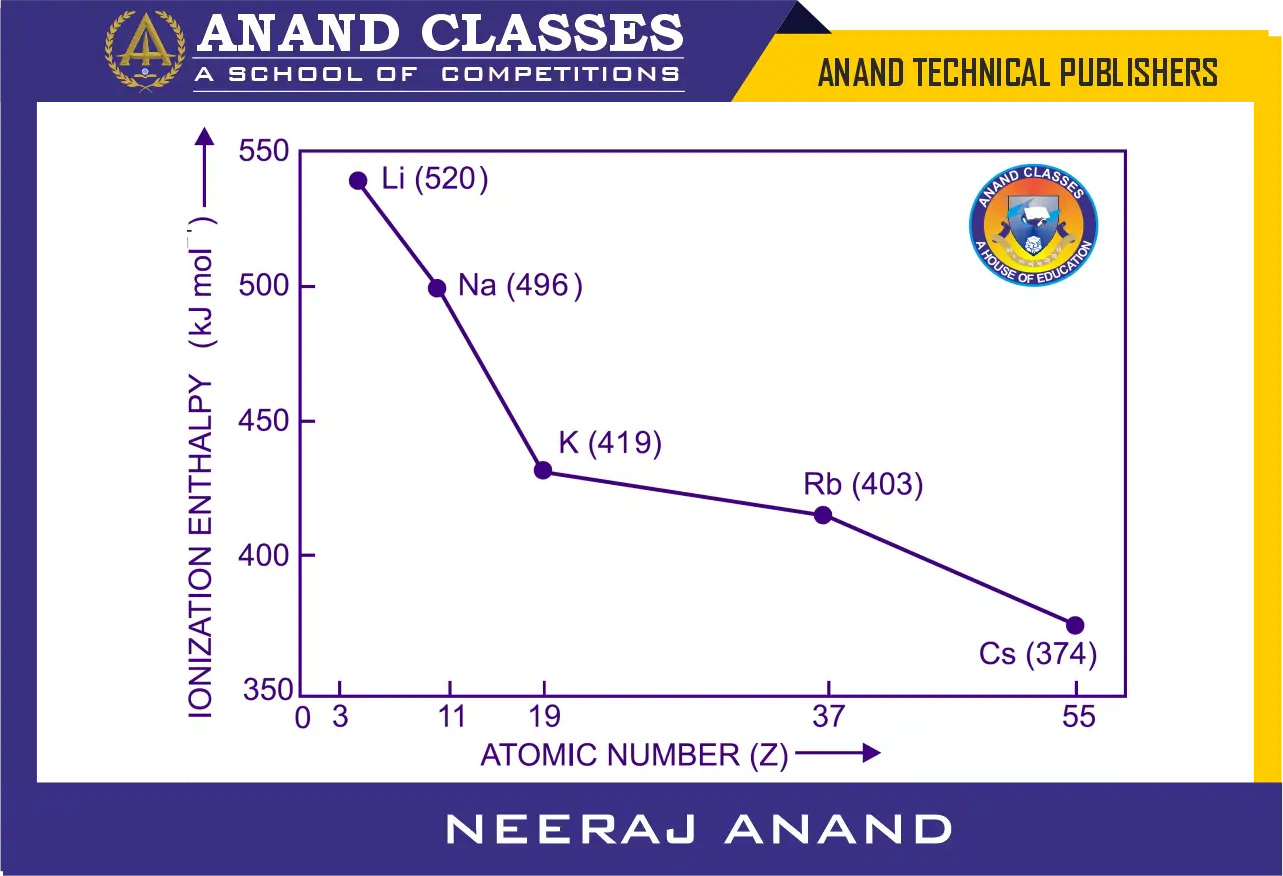
Trend in Group 1 (Alkali Metals):
- Ionisation enthalpy decreases regularly down the group.
- This is due to increase in atomic size (addition of new principal energy shell) and increase in screening effect.
- Both these factors reduce the effective nuclear attraction for valence electrons.
- Hence, the outermost electron is more easily removed in heavier alkali metals.
- Example: Li (520) → Cs (374).
Trend in Group 17 (Halogens):
- Ionisation enthalpy also decreases down the group, but the values are much higher compared to group 1 elements.
- Halogens have small atomic size and high effective nuclear charge, so they hold their valence electrons very tightly.
- Example: F (1681) → At (917).
Comparison of Group 1 vs Group 17:
- Group 1 elements have very low ionisation enthalpies, because they need to lose one electron to attain stable noble gas configuration.
- Group 17 elements have very high ionisation enthalpies, because they are just one electron short of completing their octet, so they do not easily lose electrons.
- In both groups, the values decrease down the group due to increase in atomic radius and screening effect.
- However, the absolute values are always much higher for group 17 than for group 1.