NCERT Intext Solutions: Classification of Elements and Periodicity in Properties

NCERT Intext Solutions: Classification of Elements and Periodicity in Properties

NCERT Intext Solutions for Classification of Elements and Periodicity in Properties provide clear and detailed explanations of important chemistry concepts related to the modern periodic table and periodic trends. These solutions help students understand topics such as atomic radius, ionization enthalpy, electron gain enthalpy, electronegativity, valence electrons, metallic and non-metallic character, and periodic classification of elements. The chapter explains how the properties of elements change systematically across periods and down groups due to electronic configuration. These NCERT intext solutions are useful for CBSE board exams, competitive exams, and concept building in chemistry.

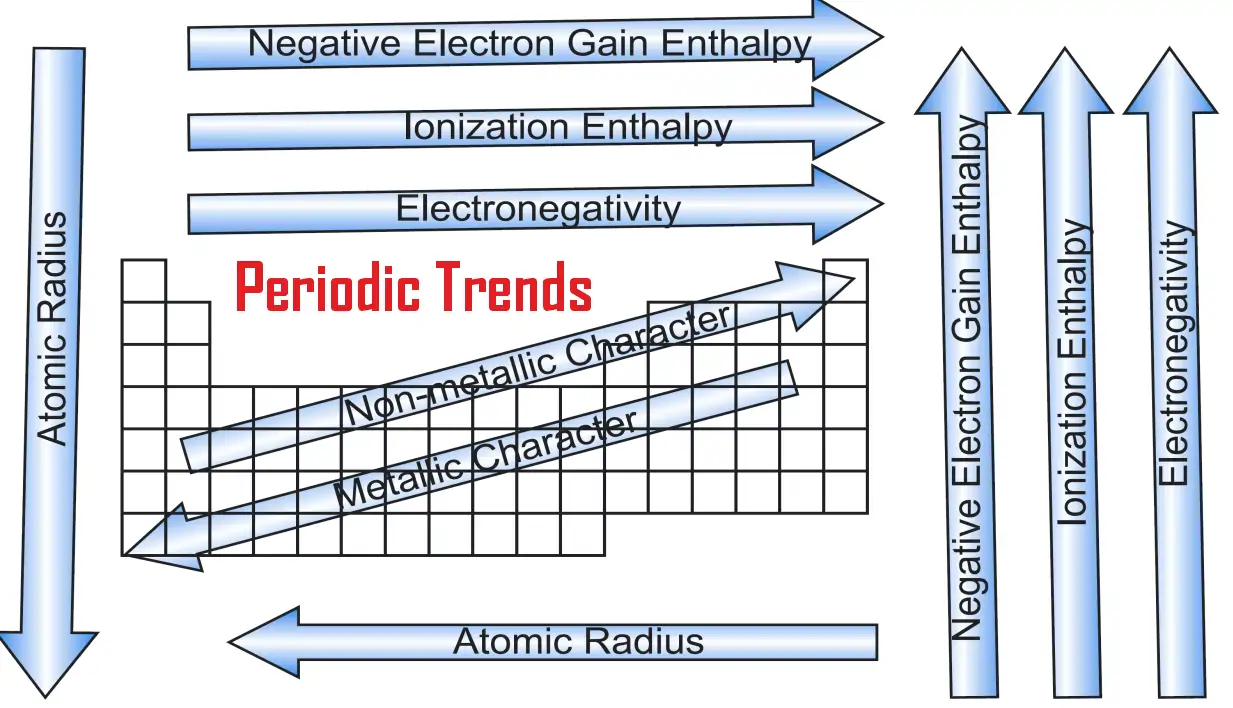
Periodic Trends and Chemical Reactivity: Metallic and Non-Metallic, Basic, Acidic Character Across a Period and Down a Group

Periodic Trends and Chemical Reactivity: Metallic and Non-Metallic, Basic, Acidic Character Across a Period and Down a Group

Periodic trends and chemical reactivity are important concepts in chemistry that explain how the physical and chemical properties of elements change across periods and down groups in the periodic table. These trends are mainly based on variations in atomic size, ionization enthalpy, electron gain enthalpy, electronegativity, metallic character, and non-metallic character. Understanding these periodic properties helps in predicting the behavior, reactivity, oxidising nature, reducing nature, and compound formation of different elements. The study of periodic trends also explains why metals and non-metals show different chemical properties and how the nature of oxides and hydroxides changes across the periodic table.

Diagonal Relationship: Anomalous Properties of Second Period Elements

Diagonal Relationship in Periodic Table: Anomalous Properties of Second Period Elements

Diagonal Relationship and Anomalous Properties of Second Period Elements are important concepts in the classification of elements and periodicity in properties. Although elements in the same group generally show similar chemical properties, the first element of each group often differs significantly from the remaining members. This unusual behaviour is called anomalous behaviour and is mainly due to small atomic size, high ionization enthalpy, high electronegativity, and absence of vacant d-orbitals. Certain second period elements also show similarities with diagonally placed third period elements, known as diagonal relationship. Understanding these concepts helps explain periodic trends, chemical bonding, and the unique behaviour of elements in the periodic table.

Valence or Oxidation States, Variation of Valency Along a Period and Down the Group

Valency or Oxidation States, Variation of Valency Along a Period and Down the Group

Valency and Oxidation States are important concepts in chemistry that describe the combining capacity of elements and the charge carried by atoms in compounds. Valency represents the number of electrons an atom loses, gains, or shares during chemical bonding, while oxidation state indicates the apparent charge of an atom in a molecule or ion. In the periodic table, valency varies regularly across a period and down a group due to changes in electronic configuration. Understanding the variation of valency and oxidation states helps students explain chemical reactions, bonding, and periodic trends effectively. These concepts are essential for CBSE exams, NEET, JEE, and other competitive examinations.

Electronegativity : Pauling and Mulliken Scale, Periodic Trends, Factors Affecting Electronegativity

Electronegativity : Pauling and Mulliken Scale, Periodic Trends, Factors Affecting Electronegativity

Electronegativity is one of the most important periodic properties in chemistry that explains the tendency of an atom to attract the shared pair of electrons towards itself in a chemical bond. The concept of electronegativity was introduced to understand the unequal sharing of electrons in covalent compounds and the nature of chemical bonding. It helps … Read more