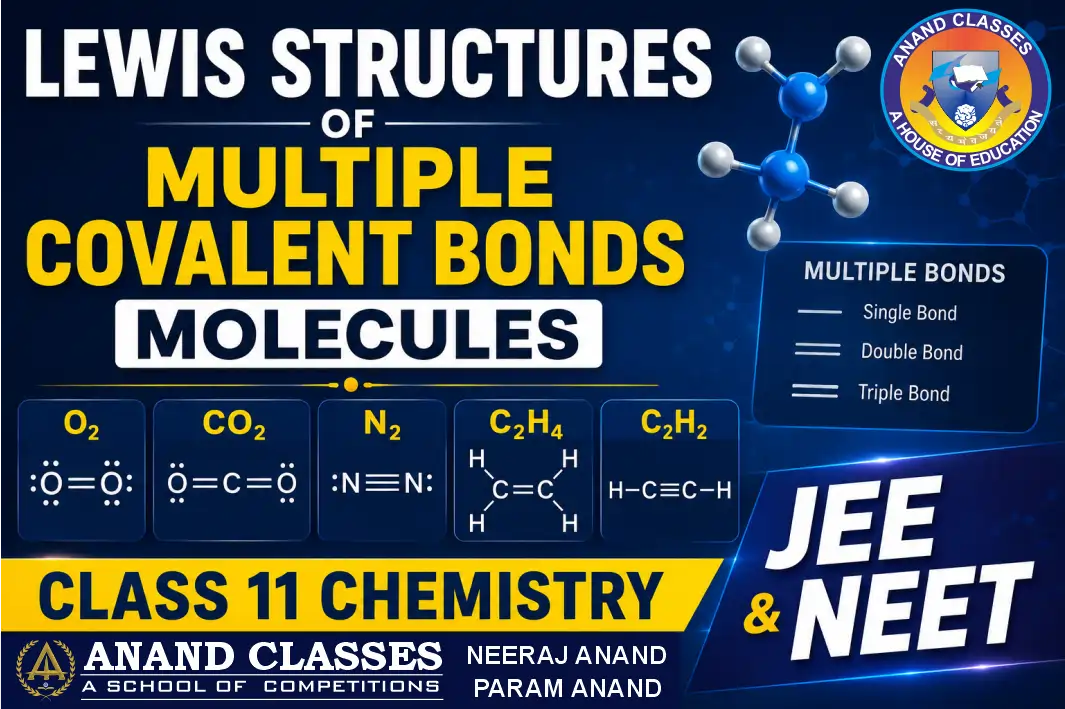
Lewis Structures of multiple covalent bonds molecules (O₂, CO₂, N₂, C₂H₄, C₂H₂)

Lewis Structures of multiple covalent bonds molecules (O₂, CO₂, N₂, C₂H₄, C₂H₂)

Lewis structures for molecules having multiple covalent bonds are an essential part of Class 11 Chemistry, helping students understand how atoms share more than one pair of electrons to form double and triple bonds. These exam-oriented notes by chief author Neeraj Anand of Anand Classes explain the Lewis structures of molecules with multiple covalent bonds through simple illustrations, step-by-step methods, and clear concepts. Specially prepared for CBSE, JEE Main, JEE Advanced, and NEET aspirants, these study materials strengthen conceptual understanding and improve problem-solving skills for board and competitive examinations.
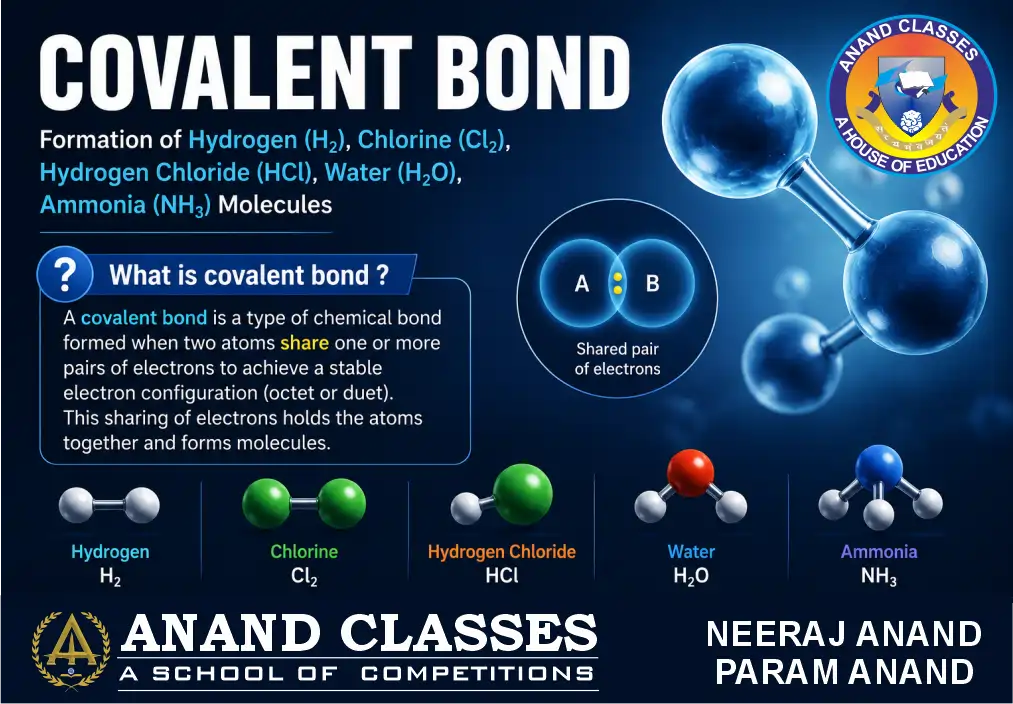
Covalent Bond, Formation of Hydrogen (H₂), Chlorine (Cl₂), Hydrogen Chloride (HCl), Water (H₂O), Ammonia (NH₃) Molecules

Covalent Bond is one of the most important concepts in Class 11 Chemistry and forms the foundation for understanding molecular structures and chemical bonding. These comprehensive, student-friendly notes by Neeraj Anand for Anand Classes explain the formation of Hydrogen (H₂), Chlorine (Cl₂), Hydrogen Chloride (HCl), Water (H₂O), and Ammonia (NH₃) molecules with clear diagrams, simple explanations, and exam-oriented concepts. Specially designed for CBSE, JEE Main, JEE Advanced, and NEET preparation, these notes help students build strong fundamentals and achieve excellent results in both board and competitive examinations.
Covalent Bond is one of the most important concepts in Class 11 Chemistry and forms the foundation for understanding molecular structures and chemical bonding. These comprehensive, student-friendly notes by Neeraj Anand for Anand Classes explain the formation of Hydrogen (H₂), Chlorine (Cl₂), Hydrogen Chloride (HCl), Water (H₂O), and Ammonia (NH₃) molecules with clear diagrams, simple explanations, and exam-oriented concepts. Specially designed for CBSE, JEE Main, JEE Advanced, and NEET preparation, these notes help students build strong fundamentals and achieve excellent results in both board and competitive examinations.

Lattice Enthalpy of Ionic Crystals, Properties of Ionic Compounds

Lattice Enthalpy of Ionic Crystals, Properties of Ionic Compounds

Lattice Enthalpy of Ionic Crystals is an important concept in Chemical Bonding that measures the strength of attraction between oppositely charged ions in an ionic solid. Lattice enthalpy plays a crucial role in determining the stability, melting point, boiling point, solubility, and other properties of ionic compounds. This topic is an essential part of Class 11 Chemistry and is frequently asked in CBSE, JEE Main, JEE Advanced, NEET, and other competitive examinations.

Ionic or Electrovalent Bond Explanation, Examples, Factors Affecting Formation of Ionic Bonds

Ionic or Electrovalent Bond Explanation, Examples, Factors Affecting Formation of Ionic Bonds

An Ionic or Electrovalent Bond is a type of chemical bond formed by the complete transfer of one or more electrons from one atom to another, resulting in the formation of positively charged cations and negatively charged anions. The electrostatic force of attraction between these oppositely charged ions holds them together to form ionic compounds. Understanding the formation of ionic bonds, their characteristics, examples, and the factors affecting their formation is essential for explaining the properties of many chemical substances. This topic is an important part of Class 11 Chemistry and is frequently asked in CBSE, JEE Main, JEE Advanced, NEET, IMUCET, and other competitive examinations.

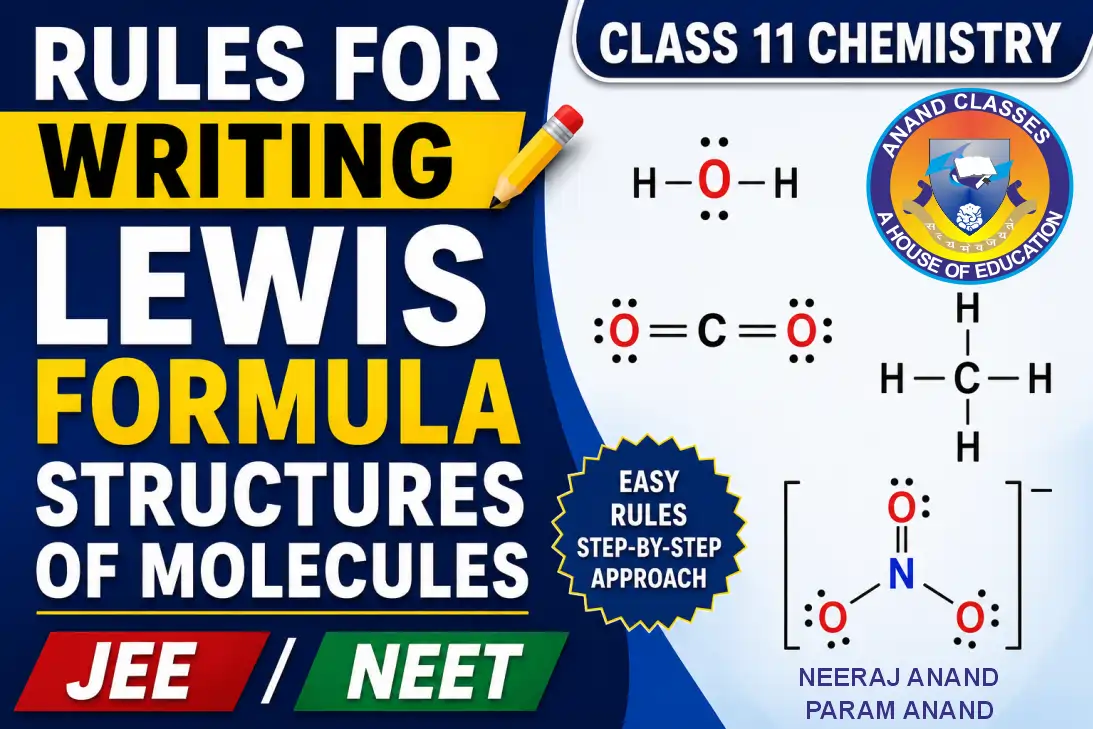
Lewis Electron Dot (Symbols) Structure Theory and its Significance

Lewis Electron Dot (Symbols) Structure Theory and its Significance

Lewis Electron Dot Structure Theory is a simple and effective method used to represent the valence electrons of atoms and molecules. Introduced by Gilbert N. Lewis, this theory helps explain how atoms combine to form chemical bonds by gaining, losing, or sharing electrons. Lewis symbols and electron dot structures provide a visual representation of valence electrons, making it easier to understand bond formation, molecular structure, and chemical stability. This concept is an important part of Class 11 Chemistry and serves as a foundation for studying chemical bonding in JEE Main, JEE Advanced, NEET, and other competitive examinations.